

10 Best English pronunciation apps in 2026 (AI tested)
elsaspeakadmin
October 9, 2026
English pronunciation
Nowadays, having an English pronunciation app can help learners to improve their speaking skills, especially when they’re having a job interview, workplace presentations, or everyday conversations in international settings. In this guide, we compare 10 English pronunciation apps in 2026 to help you find the right tool for your learning goals.
What makes an effective English pronunciation app?
An effective AI pronunciation app should do more than recognize the words you say. It should help you understand how you produce individual sounds, identify patterns that affect intelligibility, and practice applying what you learn in real conversations.
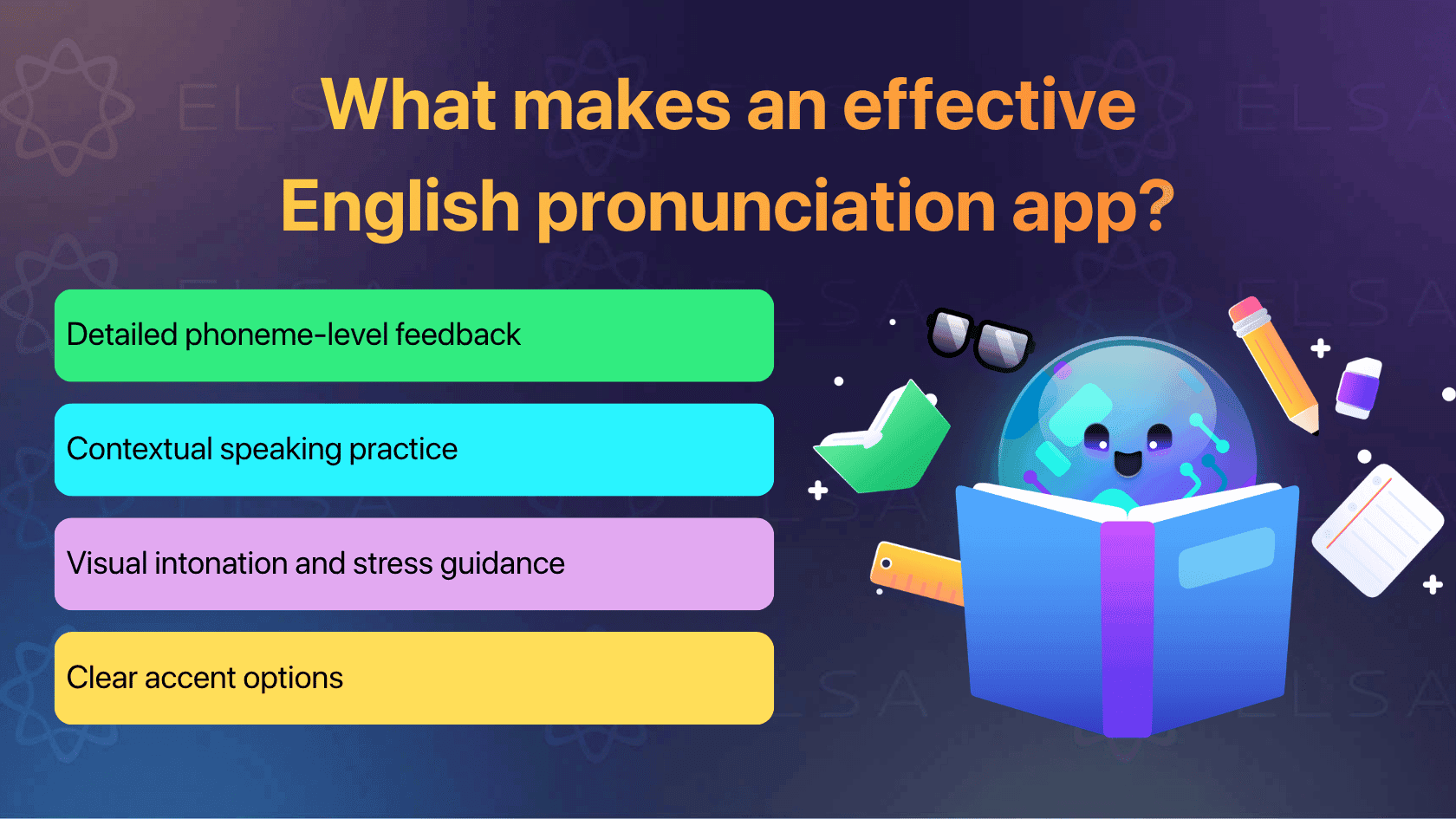
- Detailed phoneme-level feedback: Try to look for an app that can identify specific pronunciation problems rather than simply assigning a general score. Useful feedback may highlight vowel and consonant errors, dropped ending sounds, or incorrect word stress. Visual mouth-position guidance can also help you understand how to produce a sound.
- Contextual speaking practice: Pronouncing individual words correctly is just a part of speaking clearly. Good English pronunciation apps should support learners with full sentences, connected speech, and interactive conversation to help learners apply the pronunciation skill when speaking at a natural pace.
- Visual intonation and stress guidance: Word stress, sentence stress, rhythm, and intonation all influence how natural and understandable speech sounds. Some apps use pitch displays, waveforms, or visual indicators to help learners compare their speech with a reference.
- Clear accent options: Check whether an app supports the accent you want to practice. General American English and British English, including Received Pronunciation (RP), have different pronunciation patterns. Your choice should reflect your learning goals, preferred model, and communication environment rather than an assumption that one accent is inherently better.
Top 10 best English pronunciation apps
The right app to improve English pronunciation depends on whether you want to correct individual sounds, practice a specific accent, or become more comfortable speaking in real-life situations. The comparison below covers each app's main strength, feedback method, accent support, platform, and indicative pricing.
| App | Best for | Technology | Indicative pricing |
| ELSA Speak | Comprehensive AI pronunciation and speaking practice | AI speech analysis and targeted pronunciation feedback | Free plan available, with ELSA Pro plan starts from $7.99/month |
| BoldVoice | Structured American accent training | AI feedback and expert-led video lessons | Free trial available From $15.00/month when billed annually |
| Speakometer | British and American pronunciation practice | AI feedback, IPA guidance, and sound comparison | Free plan available with Pro plan starting with $4.99/month |
| Speechling | Human pronunciation coaching | Multiple pronunciation models, depending on course | Free; Unlimited from $19.99/month |
| Praktika | AI-avatar conversation practice | Interactive speaking and AI feedback | Free access; paid plans vary |
| Hello Nabu | Context-based dialogue and story practice | AI pronunciation feedback in interactive role-plays | Free download; in-app options vary |
| EnglishCentral | Video-based pronunciation practice | IntelliSpeech speech scoring | Free access; paid plans vary |
| Say It | Visual sound and pronunciation practice | Sound and phonetic comparison | Check current app-store listing |
| Rosetta Stone | Immersive language learning | TruAccent speech recognition | Subscription from $11.99/month |
| Pronunroid | IPA phonetic chart drills | Phonetic quizzes and reference tools | Free with ads |
ELSA Speak: Best for Comprehensive AI Speech Curriculum
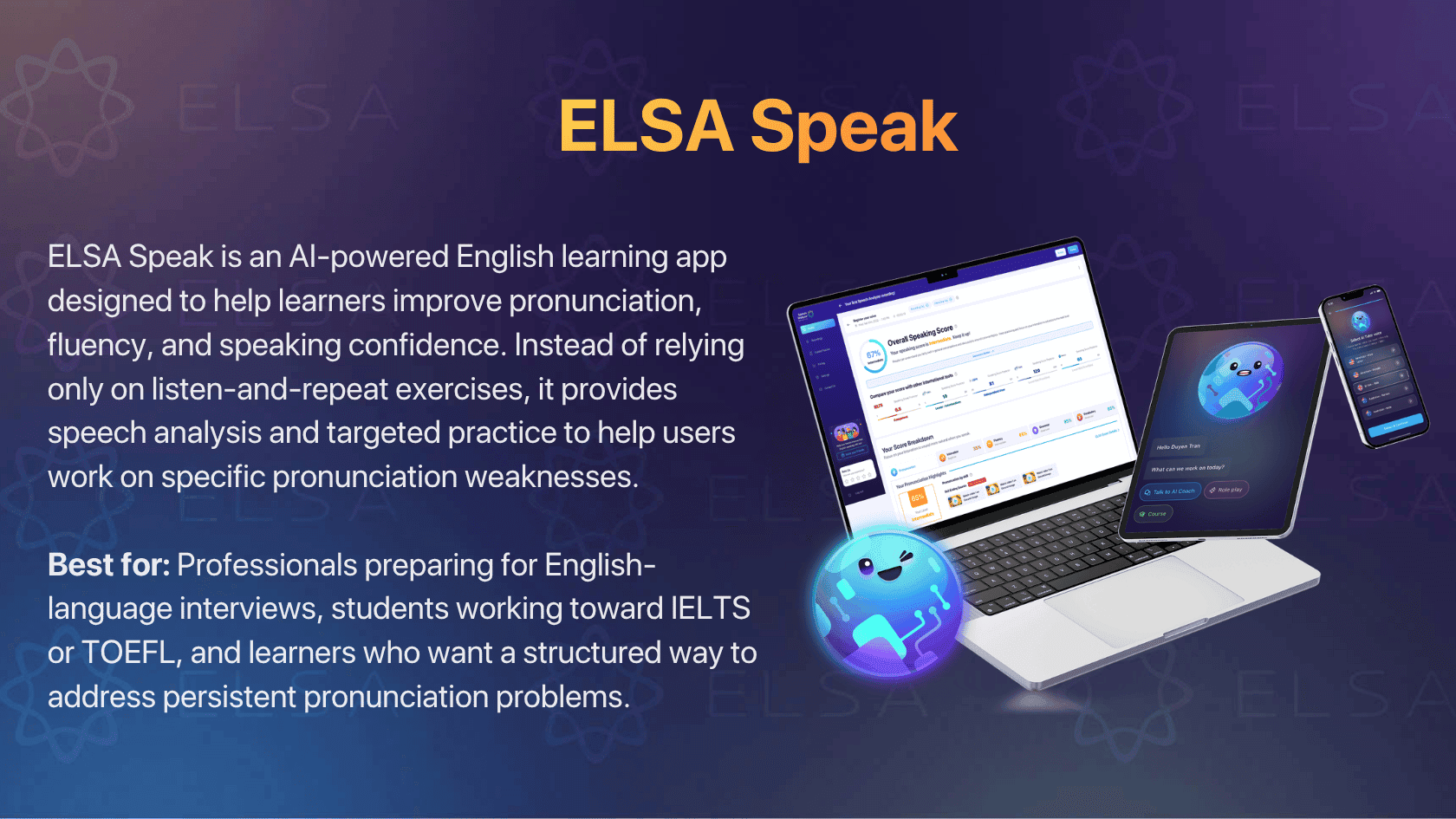
ELSA Speak is an AI-powered English learning app designed to help learners improve pronunciation, fluency, and speaking confidence. Instead of relying only on listen-and-repeat exercises, it provides speech analysis and targeted practice to help users work on specific pronunciation weaknesses.
Key features:
- Phoneme-level pronunciation feedback: Visual indicators help learners identify sounds that need more practice. Depending on the exercise, feedback can highlight pronunciation differences and direct attention to specific sounds.
- Five speaking dimensions: Practice focuses on pronunciation, word stress, intonation, fluency, and listening-related skills.
- AI Role-play: Interactive scenarios let learners practice conversations such as job interviews, workplace meetings, and everyday exchanges.
- Personalized learning: Practice recommendations help users focus on recurring errors rather than repeating the same exercises indefinitely.
Best for: Professionals preparing for English-language interviews, students working toward IELTS or TOEFL, and learners who want a structured way to address persistent pronunciation problems.
BoldVoice: Best for Structured American Accent Training
BoldVoice combines video lessons from professional accent coaches with AI-powered speech feedback. Its curriculum is designed to help non-native speakers understand the physical movements and pronunciation patterns that affect the clarity of their English.
Key features:
- Expert-led video lessons: Learn pronunciation techniques from coaches who demonstrate mouth positioning and sound production.
- AI pronunciation feedback: Receive feedback on spoken sounds, words, and sentences.
Personalized training: Follow a learning plan tailored to your pronunciation needs. - Structured practice: Work through short lessons and exercises instead of choosing drills entirely on your own.
Best for: Professionals who frequently present, negotiate, or collaborate in English-speaking workplaces and want a guided American accent curriculum.
Speakometer: Best for British & American IPA Practice
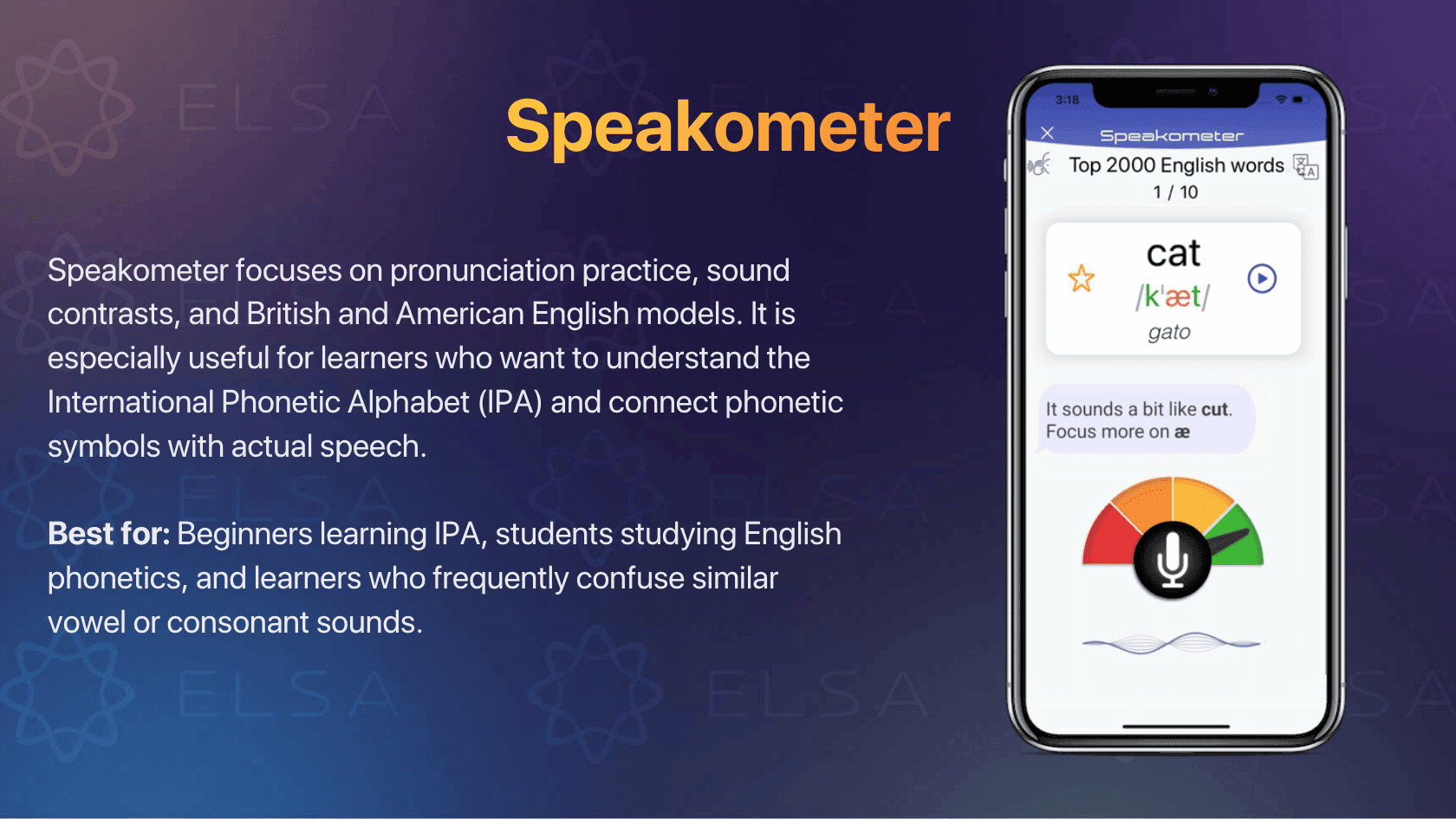
Speakometer focuses on pronunciation practice, sound contrasts, and British and American English models. It is especially useful for learners who want to understand the International Phonetic Alphabet (IPA) and connect phonetic symbols with actual speech.
Key features:
- IPA-based practice: Explore phonetic symbols and learn how they correspond to English sounds.
- Minimal pairs: Practice distinguishing words such as ship and sheep.
- Accent comparison: Work with British and American pronunciation models.
- Speech comparison: Use available recording and feedback tools to identify differences between your pronunciation and reference audio.
Best for: Beginners learning IPA, students studying English phonetics, and learners who frequently confuse similar vowel or consonant sounds.
Speechling: Best for Combining AI Tools with Real Human Coaching
Speechling combines structured listening and speaking exercises with human coaching. Learners can listen to reference recordings, record their own speech, and submit recordings for personalized feedback.
Key features:
- Human coach feedback: Receive comments on submitted recordings to help identify pronunciation issues.
- Reference audio: Compare your recording with professional voice recordings.
- Sentence-based practice: Learn pronunciation through complete sentences rather than isolated sounds alone.
- Progress tracking: Review past recordings and feedback to monitor your practice.
Best for: Independent learners who want expert guidance but do not need to schedule regular live tutoring sessions.
Praktika: Best for Realistic AI Avatar Conversations
Praktika uses AI tutors to simulate conversations in a low-pressure learning environment. Rather than focusing exclusively on isolated sounds, it helps learners practice speaking in context and build confidence responding to questions.
Key features:
- AI avatar conversations: Practice a range of everyday and professional scenarios with virtual tutors.
- Speaking feedback: Receive automated guidance during or after speaking exercises, depending on the activity.
- Flexible practice: Study at your own pace without scheduling a session with a human tutor.
- Personalized learning: Work through activities based on your goals and learning progress.
Best for: Learners who already have some pronunciation foundations and want to develop conversational confidence and speaking fluency.
Hello Nabu: Best for Natural, Context-Based Micro-Dialogues
Hello Nabu takes a story-driven approach to language learning. Learners move through personalized scenarios and use spoken role-play to practice responding in context. This approach encourages learners to use language meaningfully rather than memorize isolated words and phrases.
Key features:
- Story-based learning: Practice language through scenarios that unfold as you progress.
- AI role-play: Respond to conversational prompts rather than simply repeating scripted sentences.
- Contextual pronunciation practice: Use available speaking activities to develop clearer speech in meaningful situations.
- Short practice sessions: Complete bite-sized activities that fit into a daily routine.
Best for: Learners who want to build speaking habits through short stories, role-play, and everyday interactions.
EnglishCentral: Best for Video-Based Pronunciation Practice
EnglishCentral integrates video-based learning with speaking exercises. Learners can watch English content, study useful vocabulary, and practice speaking by recording lines from videos. This format helps connect pronunciation practice with listening comprehension and language used in context.
Key features:
- Video-based learning: Explore English content across a range of subjects.
- Watch, Learn, Speak workflow: Watch a video, review vocabulary, and record spoken lines.
- IntelliSpeech technology: The platform uses speech assessment to evaluate recorded speaking exercises.
- Contextual vocabulary: Learn how words and expressions are used in complete sentences.
Best for: Learners who enjoy videos and want to improve pronunciation alongside listening comprehension and vocabulary.
Say It: Best for Visual Soundwave Comparison
Say It is associated with phonetic learning and visual pronunciation practice. It has been used to help learners explore speech sounds and compare their pronunciation with reference models. Because app availability and features can change, verify its current status before choosing it as your primary pronunciation tool.
Key features:
- Phonetic references: Connect words with pronunciation models.
- Visual comparison: Where supported, compare recordings or sound representations to notice differences.
- Sound awareness: Practice recognizing vowel and consonant distinctions.
- Independent study: Use reference audio to repeat and review challenging words.
Best for: Learners who prefer visual aids and want to compare pronunciation with reference audio.
Rosetta Stone: Best for TruAccent Speech Engine & Immersion
Rosetta Stone combines language instruction with speech recognition through its TruAccent technology. Its immersive learning method uses images, audio, and contextual exercises to help learners connect spoken language with meaning.
Key features:
- TruAccent speech recognition: Provides pronunciation feedback during supported speaking exercises.
- Immersive lessons: Learn vocabulary and language patterns through images and audio.
- Structured progression: Build foundational skills through guided lessons.
- Accent options: English courses include American and British English learning materials.
Best for: Beginners who want to learn pronunciation, vocabulary, and basic English together.
Pronunroid: Best for Interactive IPA Phonetic Chart Drills
Pronunroid focuses on learning phonetic symbols and understanding the relationship between English spelling and pronunciation. It is a more specialized study tool than an AI conversation coach.
Key features:
- IPA practice: Learn to recognize symbols used in phonetic transcriptions.
- Sound quizzes: Test your understanding of phonetic categories and sound patterns.
- Pronunciation reference: Review how individual symbols relate to English sounds.
- Compact study sessions: Practice phonetics without committing to a full language course.
Best for: English majors, language students, and independent learners who want to become more comfortable reading phonetic transcriptions.
How to choose the right pronunciation app for your goals
The best English pronunciation app depends on your current speaking level, the skills you want to improve, and the type of feedback that helps you learn. Use these recommendations to narrow down your options.
- If you want to correct individual sounds and improve overall speaking: ELSA Speak is a strong option because it combines AI-powered pronunciation feedback with structured lessons and AI Role-play.
- If you want to improve your American accent through video lessons: BoldVoice offers a guided curriculum with demonstrations from professional accent coaches and AI feedback.
- If you want to learn IPA and compare British and American pronunciation: Speakometer is worth considering for its focus on phonetic symbols and sound contrasts. Pronunroid can supplement your study of IPA.
- If you want a real person to review your recordings: Speechling combines independent practice with feedback from human coaches.
- If you want to build conversational confidence with virtual tutors: Praktika provides interactive dialogue practice with AI avatars.
- If you prefer learning through stories and short dialogues: Hello Nabu offers a context-based approach to language practice.
- If you want to practice pronunciation through authentic videos: EnglishCentral combines video lessons, vocabulary, and speaking exercises.
- If you prefer immersive language lessons: Rosetta Stone integrates pronunciation practice into a broader learning curriculum.
Before subscribing, try the free features or trial options available to you. Practice the same challenging words and a short paragraph with each app, then compare the feedback, ease of use, and relevance to your goals.
FAQ about English Pronunciation Apps
What is the best English pronunciation app overall?
ELSA Speak is a strong overall choice for learners who want AI-powered pronunciation feedback alongside structured speaking practice. Its speech analysis helps users identify pronunciation weaknesses, practice challenging sounds, and apply their skills in interactive conversations through AI Role-play.
BoldVoice may be a better fit for learners whose primary goal is structured American accent training, while Speechling suits those who prefer personalized feedback from human coaches.
Can an AI pronunciation app completely replace a human accent coach?
No. AI pronunciation apps can support independent practice by providing repeatable exercises, automated feedback, and flexible learning schedules. However, their accuracy and the level of detail they provide vary by tool and exercise.
How long does it take to see noticeable pronunciation improvement using an app?
Some learners may notice changes within a few weeks, but the timeline depends on their starting level, the sounds they need to improve, and how consistently they practice. A practical starting routine is 10–15 minutes a day for four to eight weeks.
Which is better for pronunciation practice: British English or American English apps?
Neither accent is inherently better. The right choice depends on your learning goals, preferred pronunciation model, and communication environment. Whichever accent you choose, focus on consistent pronunciation, word stress, and intelligibility rather than trying to eliminate every trace of your native accent.
Ready to improve your English pronunciation? Explore ELSA Speak for AI-powered speaking practice, and visit the English Communication Tips category on the ELSA Speak blog to discover expert tips and practical strategies for improving your English skills.