

100+ funny idioms with meanings and examples for everyday English
elsaspeakadmin
August 7, 2026
Idioms
Want to make your English more natural and fun? Learning funny idioms is a great way to add personality to your everyday conversations. From “when pigs fly” to “kill two birds with one stone,” discover the meanings and simple examples of funny idioms you can easily use in real-life situations.
| Key Takeaways |
Funny idioms often use wild mental pictures to make everyday ideas easier to understand and remember. Funny English idioms about animals:
Funny idioms in English about food and body parts:
|
100+ funny English idioms, organized by theme
From playful animal comparisons to silly everyday situations, funny idioms often use wild mental pictures to make everyday ideas easier to understand and remember.
Funny idioms about animals
Animals appear in many funny idioms in English, often creating hilarious ways to describe everyday situations. Here are some popular animal idioms and their meanings to add a little fun to your English.
| Idiom | Meaning | Example |
| When pigs fly | Something that will never happen | When pigs fly, he’ll clean his room. |
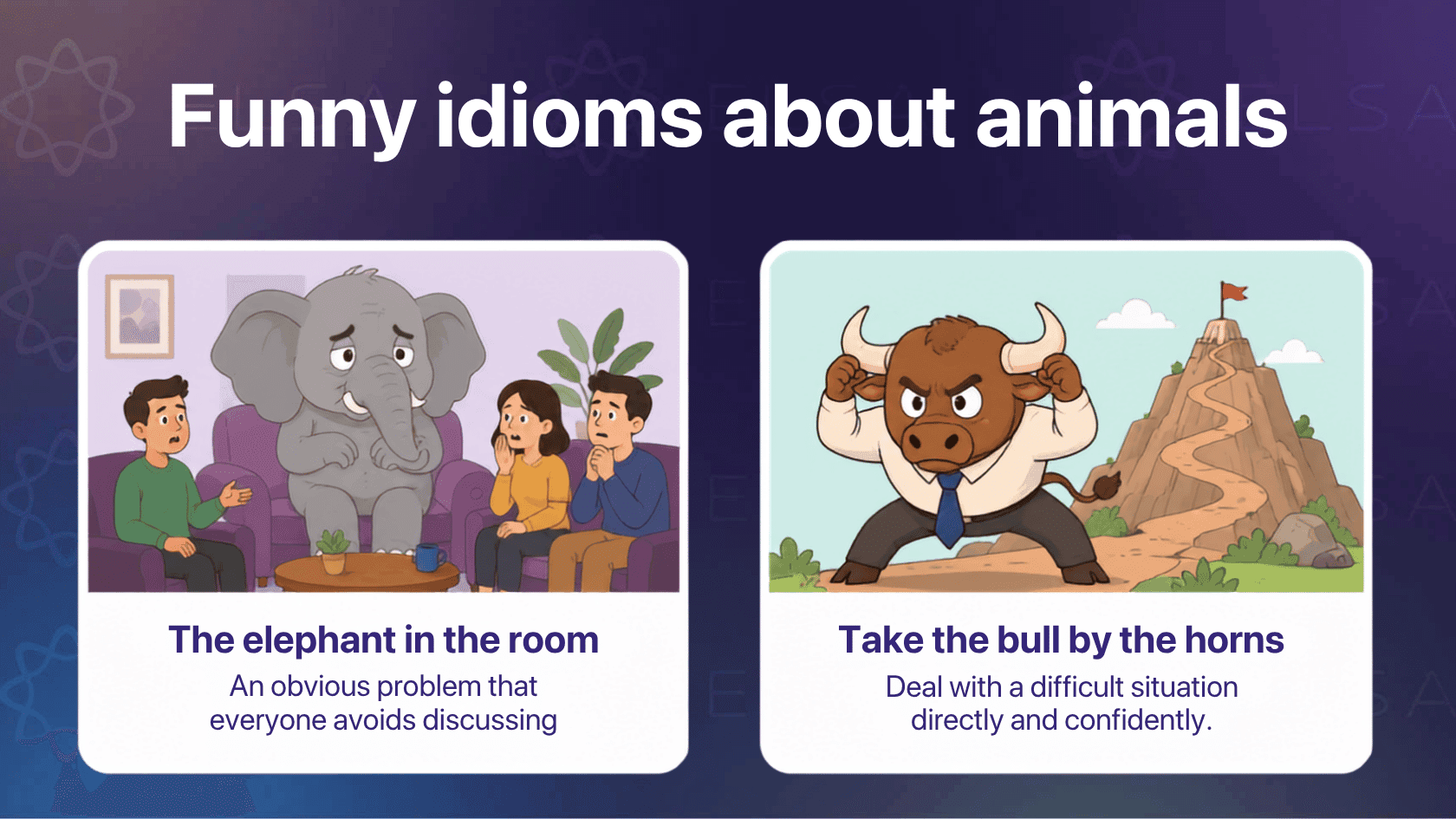
| The elephant in the room | An obvious problem that everyone avoids discussing | We need to talk about the elephant in the room. |
| Let the cat out of the bag | To reveal a secret accidentally | Jane let the cat out of the bag about the party. |
| Hold your horses | Wait and be patient | Hold your horses! I’m almost ready. |
| Busy as a bee | Very busy and hardworking | She’s been busy as a bee all week. |
| A fish out of water | Someone who feels uncomfortable in a new situation | Jack feels like a fish out of water at his new job. |
| Monkey see, monkey do | People copy what others do without thinking | Kids often copy their parents. Monkey see, monkey do. |
| The early bird catches the worm | Those who act early often succeed | He got the last ticket! The early bird catches the worm, I guess. |
| Like a bull in a china shop | Very clumsy and likely to break things | John’s like a bull in a china shop when he’s in a hurry. |
| Have butterflies in your stomach | To feel nervous or anxious | Before the interview, I had butterflies in my stomach. |
| Kill two birds with one stone | Achieve two goals with a single action | I’m meeting Sarah for lunch, so we can talk business too. Kills two birds with one stone. |
| Straight from the horse's mouth | Information from the original or most reliable source | I heard it straight from the horse’s mouth. |
| Take the bull by the horns | Deal with a difficult situation directly and confidently | I finally took the bull by the horns and asked for a raise. |
| Barking up the wrong tree | Directing your anger, accusations, or efforts in the wrong place | If you think I broke the vase, you’re barking up the wrong tree. |
Funny idioms about body parts
Body parts also feature in many funny idioms with meaning that may be very different from the literal words. Let’s explore some common expressions and see how they are used in everyday English.
| Idiom | Meaning | Example |
| Cost an arm and a leg | To be extremely expensive | That bike costs an arm and a leg. |
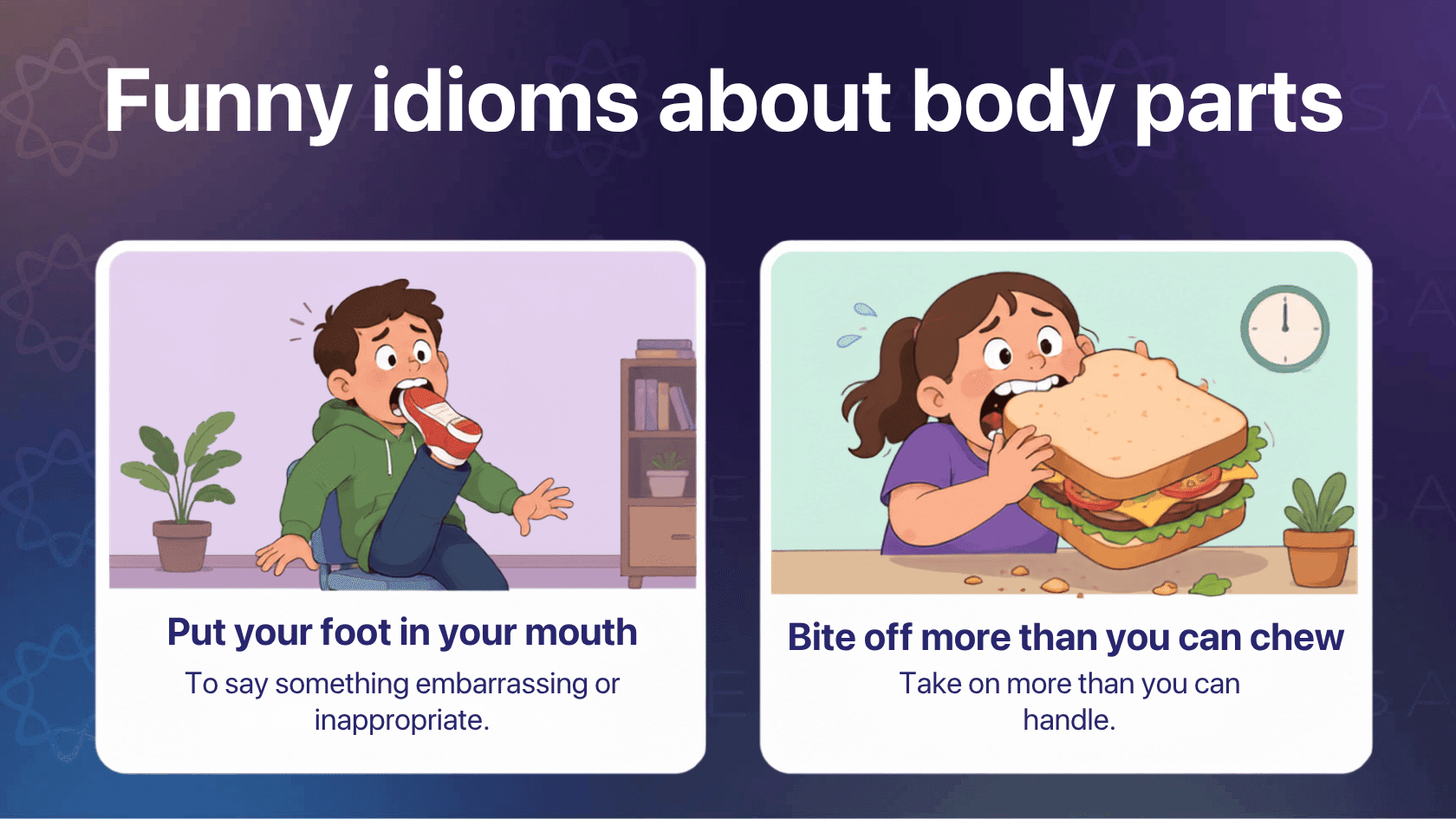
| Put your foot in your mouth | To say something embarrassing or inappropriate | He really put his foot in his mouth. |
| Break a leg | Good luck | Break a leg at your audition! |
| Stick your nose into something | To interfere in someone else's business | Don’t stick your nose into our business. |
| Have eyes bigger than your stomach | To take more food than you can eat | She had eyes bigger than her stomach. |
| Blue in the face | Exhausted from trying without success | I could explain it until I’m blue in the face. |
| Have a thick skin | Not easily offended by criticism | You need a thick skin in this job. |
| Tongue in cheek | Said humorously, not meant seriously | He made the comment tongue in cheek. |
| Bite off more than you can chew | Take on more than you can handle | I think Jane bit off more than she can chew. |
| Pull someone's leg | To joke or tease someone | Are you pulling my leg? |
| Neck and neck | To be even or tied in a competition or comparison | The two teams are neck and neck. |
| Neck of the woods | A certain area, neighborhood, or locality | What brings you to this neck of the woods? |
| Go belly up | To fail, to go bankrupt | The business went belly up. |
| Armed to the teeth | Heavily armed or well-equipped, could be with literal weapons or figuratively well-prepared | We arrived armed to the teeth with equipment. |
| Wet behind the ears | Used to describe someone inexperienced or immature | She’s still wet behind the ears. |
Funny idioms about food
Food is a common theme in jokes funny idioms, with many playful expressions inspired by everyday meals and ingredients. Here are a list of idioms that can make your English more colorful and memorable.
| Idiom | Meaning | Example |
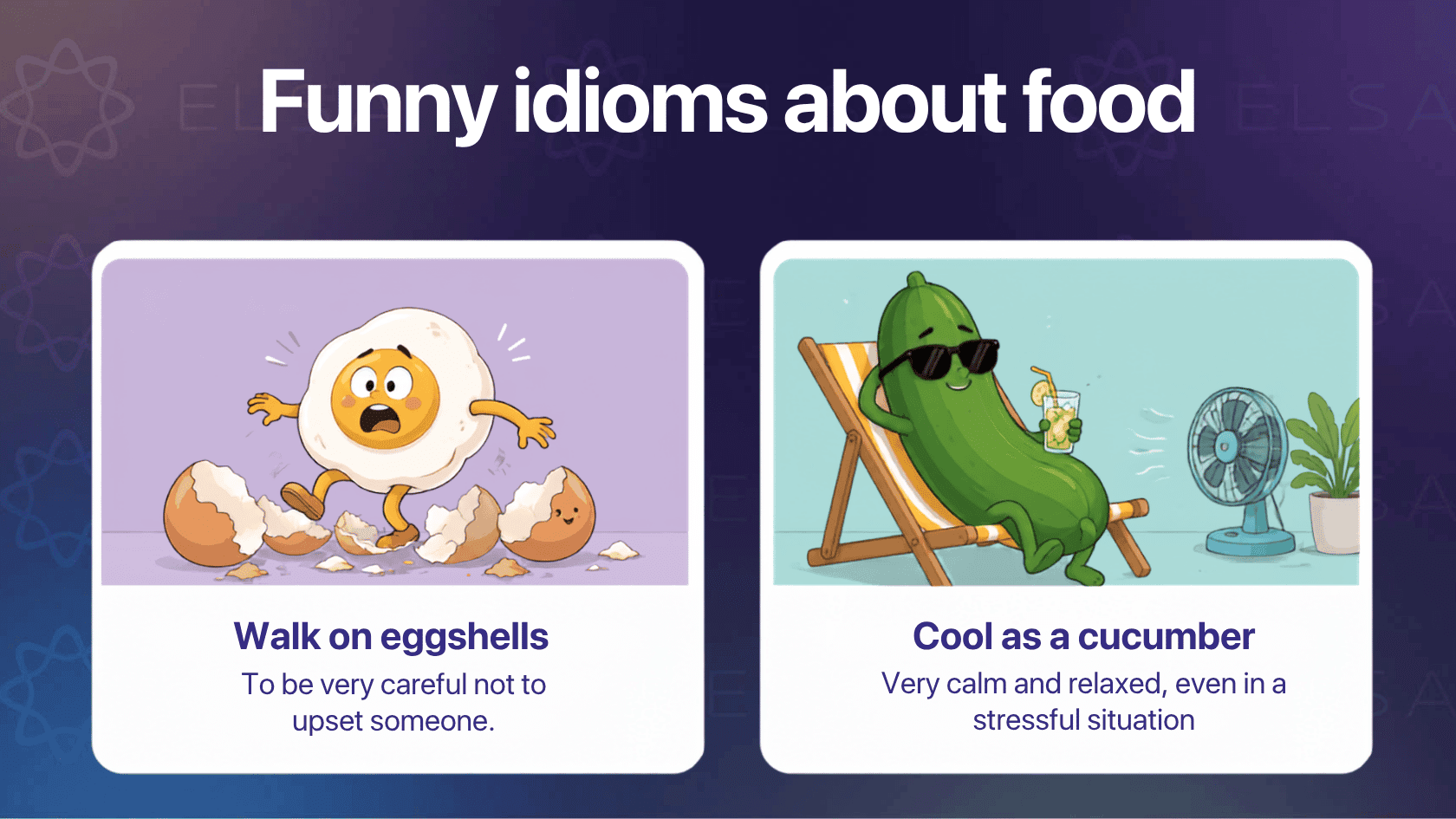
| Cool as a cucumber | Very calm and relaxed, even in a stressful situation | Mary stayed cool as a cucumber during the interview. |
| Take something with a grain of salt | To not completely believe something | Take what they say with a grain of salt. |
| Butter someone up | To flatter someone to gain a favor | He’s just buttering the boss up. |
| More holes than a Swiss cheese | Something that has a lot of faults and problems | Her story has more holes than Swiss cheese. |
| Cheesed off | Feeling annoyed or irritated | I think he’s pretty cheesed off about it. |
| A hot potato | A controversial issue that nobody wants to discuss because it is uncomfortable to talk about it | Everyone’s avoiding the issue like it’s a hot potato. |
| Big cheese | An important or influential person | She’s the big cheese around here. |
| In a pickle | In a difficult or awkward situation | I’m in a bit of a pickle. |
| Sell like hot cakes | To sell very quickly | These lemonades are selling like hot cakes. |
| Walk on eggshells | To be very careful not to upset someone | I feel like I’m walking on eggshells around Tom. |
| Couch potato | Someone who spends a lot of time sitting and watching TV | Stop being a couch potato and get up. |
| Go bananas | To go wild, to go crazy with excitement or other extreme emotions | The whole crowd went bananas when Taylor Swift came on stage. |
| Bring home the bacon | To earn money to support a family | She works hard to bring home the bacon. |
| Pie in the sky | Something nice but unlikely to happen. An empty wish | That sounds like a pie-in-the-sky idea. |
| Piece of cake | Something that is very easy to do | Everyone can do that. It’s a piece of cake. |
Funny idioms with meaning about quirky situations
Some everyday situations can be described in surprisingly funny ways. These idioms funny expressions add humor and personality to casual English conversations.
| Idiom | Meaning | Example |
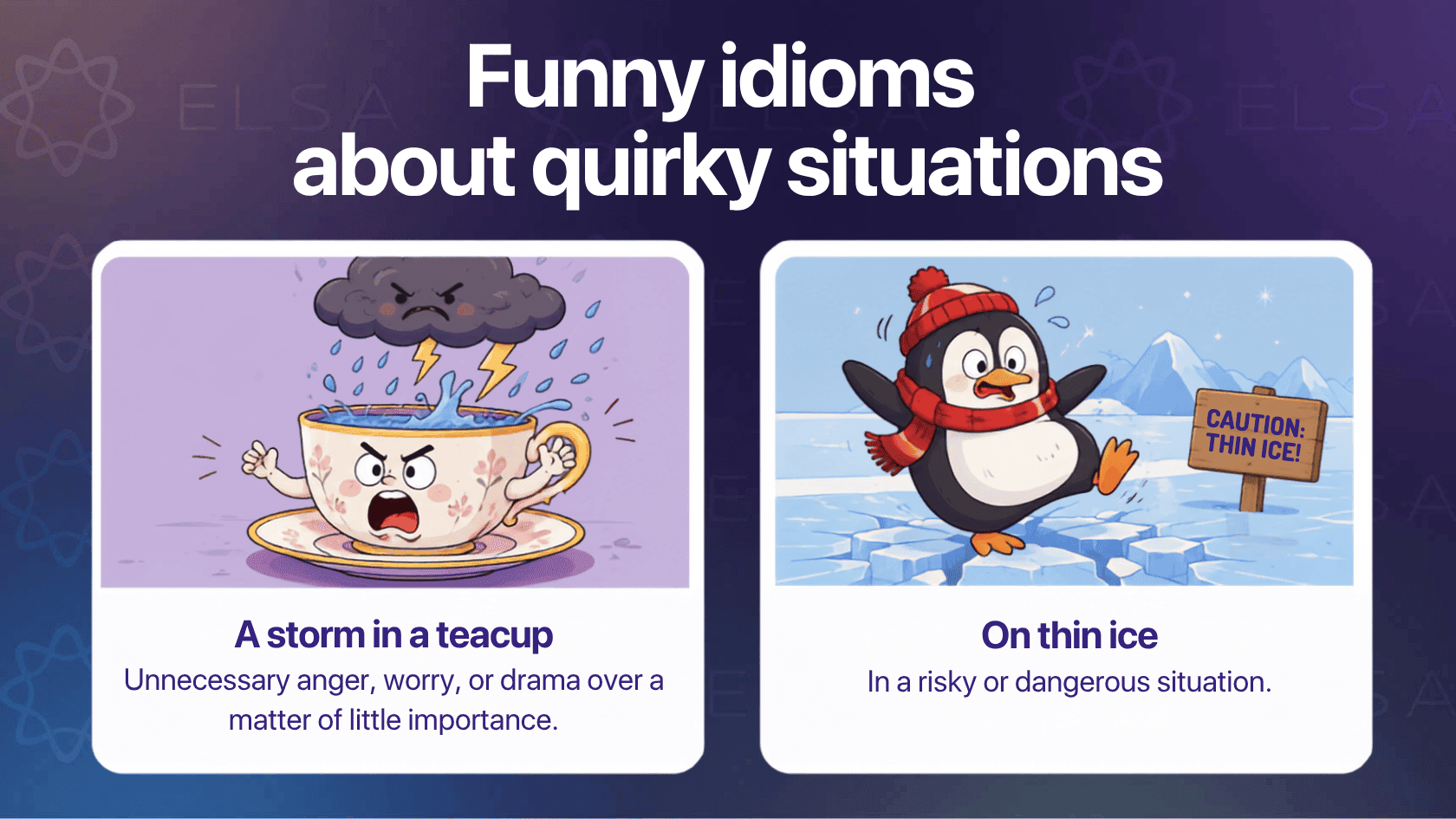
| A storm in a teacup | Unnecessary anger, worry, or drama over a matter of little importance. | It’s just a storm in a teacup. |
| To kick the bucket | To pass away or die | Tom joked that he’d kick the bucket someday. |
| Out of the frying pan and into the fire | To go from one bad situation to an even worse one | I quit my job and ended up in a worse one. Out of the frying pan and into the fire. |
| Hit the sack | To go to bed | I’m tired. I’m hitting the sack. |
| Throw in the towel | To admit defeat or give up | I’m ready to throw in the towel. |
| On thin ice | In a risky or dangerous situation | You’re on thin ice, young man. |
| Jump on the bandwagon | To join something because it is popular | Everyone’s using it, so they jumped on the bandwagon. |
| Run around like a headless chicken | To act in a panicked, disorganized way | He was running around like a headless chicken this morning. |
| Throw a wrench in the works | To cause an unexpected problem or delay | The rain threw a wrench in the works. |
| When it rains, it pours | Problems often happen all at once | First my car broke down, then I lost my phone. When it rains, it pours. |
| Hit the nail on the head | To describe or identify something exactly right | You just hit the nail on the head. |
| Murphy's Law | The idea that if something can go wrong, it probably will | Of course it started raining. Murphy’s Law. |
| Back to square one | To start over after a failed attempt | The plan didn’t work, so they’re back to square one. |
| Make a mountain out of a molehill | To exaggerate a small problem | You’re making a mountain out of a molehill. |
| Go cold turkey | Suddenly stop doing something | Jack quits coffee cold turkey. |
Funny idioms about items around the house
Everyday household items also inspire plenty of funny idioms examples in English. From kitchen tools to things around the house, these expressions often have meanings that are very different from their literal words.
| Idiom | Meaning | Example |
| Sweep something under the rug | To hide or ignore a problem instead of dealing with it | You can’t keep sweeping this problem under the rug. |
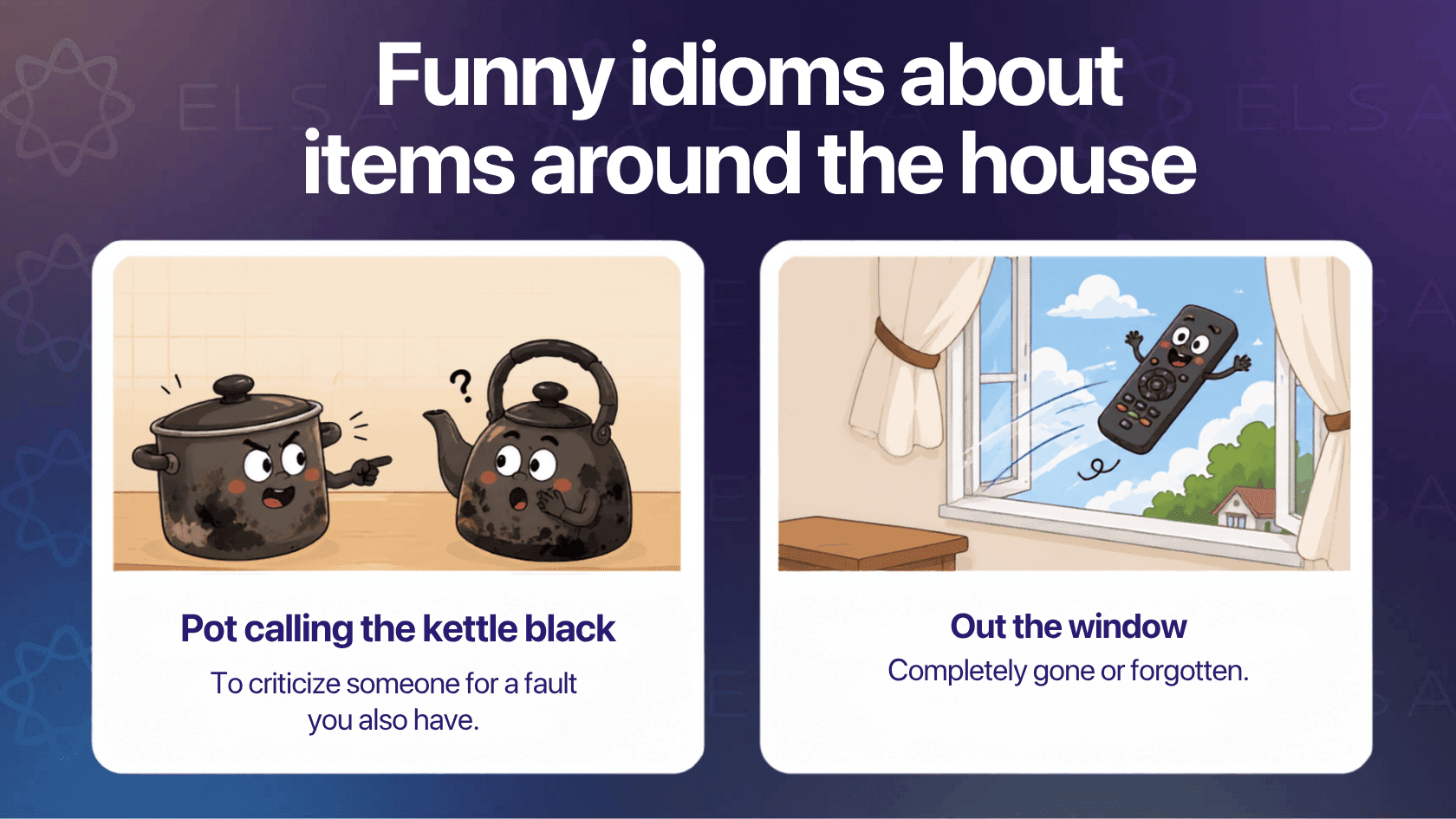
| Pot calling the kettle black | To criticize someone for a fault you also have | You’re calling me lazy? That’s the pot calling the kettle black. |
| Drop the ball | To make a mistake by failing to do something important | He really dropped the ball on this one. |
| Get the ball rolling | To start an activity or process | Let’s get the ball rolling! |
| A wet blanket | A person who spoils all the fun by disapproving of the activities. | Don’t be such a wet blanket. |
| Lock, stock, and barrel | Completely, including everything | She moved out, lock, stock, and barrel. |
| Out the window | Completely gone or forgotten | All their plans went out the window. |
| Skeleton in the closet | A hidden secret that could cause embarrassment | Everyone has a skeleton in the closet. |
| Keep something on the back burner | To delay dealing with something until later | Let’s keep that idea on the back burner for now. |
| Everything but the kitchen sink | Almost everything imaginable, even the unnecessary ones | He packed everything but the kitchen sink. |
| Smoke and mirrors | Tricks or deception used to hide the truth | The whole thing is just smoke and mirrors. |
| Get up on the wrong side of the bed | To begin the day with a bad mood | Mary got up on the wrong side of the bed today. |
| Not the sharpest tool in the shed | Not very intelligent | He’s not the sharpest tool in the shed, is he? |
| The lights are on, but nobody's home | Someone appears present but isn't thinking clearly | I asked her three times, but the lights are on and nobody’s home |
| A different kettle of fish | A completely different matter or situation | Working from home is one thing. Managing a team is a different kettle of fish. |
| Dead as a doornail | To be completely devoid of life | That old phone is dead as a doornail. |
Funny idioms with odd descriptions
| Idiom | Meaning | Example |
| Put a sock in it | A rather rude, but funny way to tell someone to be quiet or stop talking | Oh, put a sock in it! |
| The whole nine yards | Everything possible, the complete amount of something | They went the whole nine yards for the party |
| A penny for your thoughts | Asking someone what they are thinking | You look quiet. A penny for your thoughts? |
| Bob's your uncle | A funny way to say “there you go” or “it’s done.” | Just sign here, and Bob’s your uncle! |
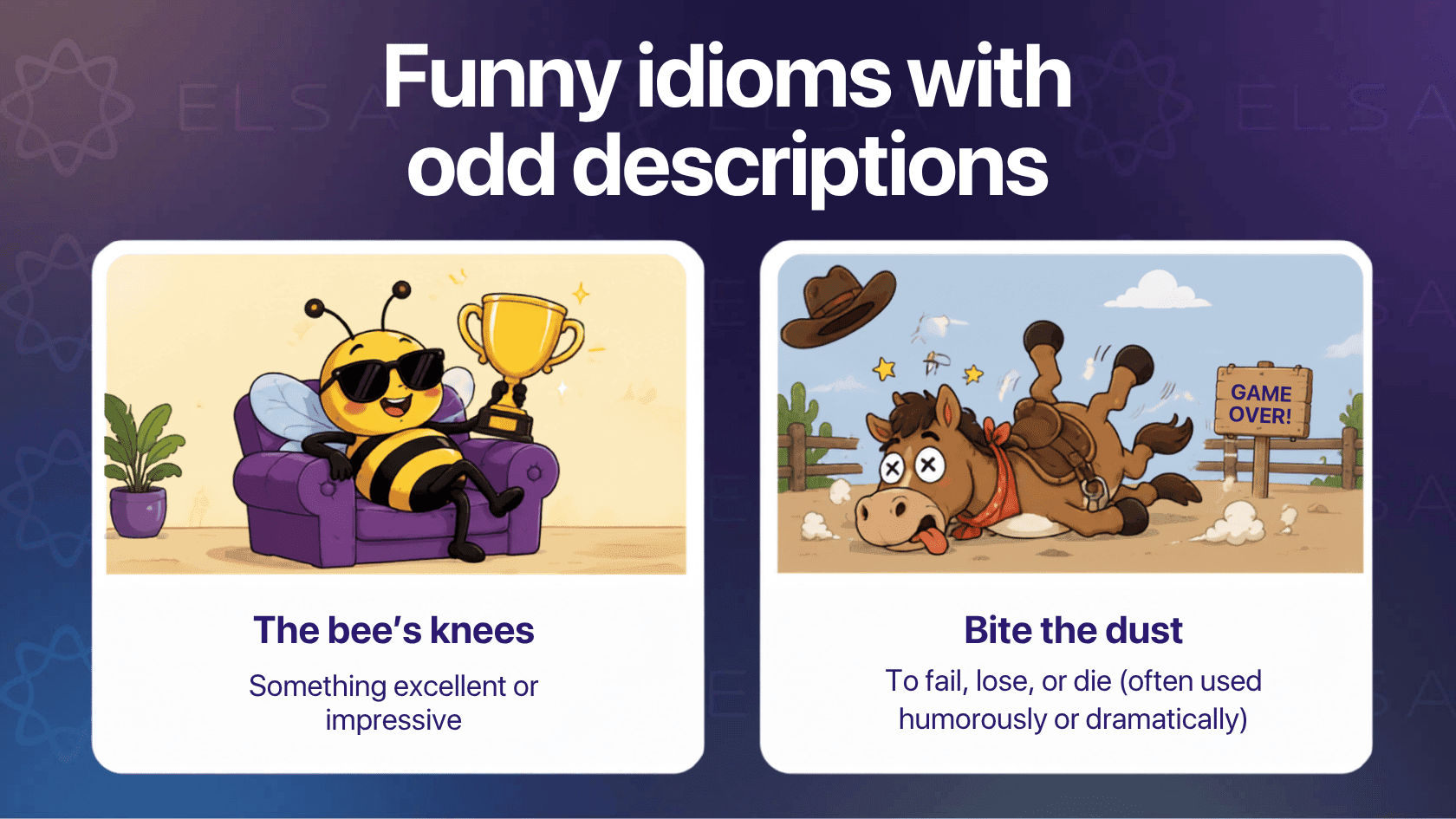
| The bee's knees | Something excellent or impressive | This new café is the bee’s knees. |
| A wild goose chase | A pointless search or impossible task | The police were on a wild goose chase for a non-existent thief |
| Throw a spanner in the works | To cause problems or disrupt a plan | His sudden arrival threw a spanner in the works. |
| Get your knickers in a twist | To become unnecessarily upset or worried | Don’t get your knickers in a twist. |
| Not my circus, not my monkeys | Not my problem or responsibility | It’s their problem. Not my circus, not my monkeys. |
| Take the biscuit | To be the most surprising, annoying, or ridiculous example | That really takes the biscuit! |
| The cat’s pajamas | Someone or something considered amazing or stylish | This bike is the cat’s pajamas. |
| As useful as a chocolate teapot | Completely useless | This broken calculator is as useful as a chocolate teapot. |
| Have a bee in your bonnet | To have an unusual idea or obsession | He’s got a bee in his bonnet about saving money. |
| Bite the dust | To fail, lose, or die (often used humorously or dramatically) | Another one bites the dust. |
Funny American idioms
| Idiom | Meaning | Example |
| That’s the way the cookie crumbles | That’s just how things happen, even if they are disappointing. | That’s the way the cookie crumbles, I guess. |
| Easy peasy lemon squeezy | Something extremely easy to do | I can do that. Easy peasy lemon squeezy. |
| Holy cow! | An expression of surprise or amazement | Holy cow! That’s so expensive! |
| Talk a blue streak | To talk very quickly and continuously | She can talk a blue streak. |
| Off your rocker | Acting crazy or unreasonable | You must be off your rocker. |
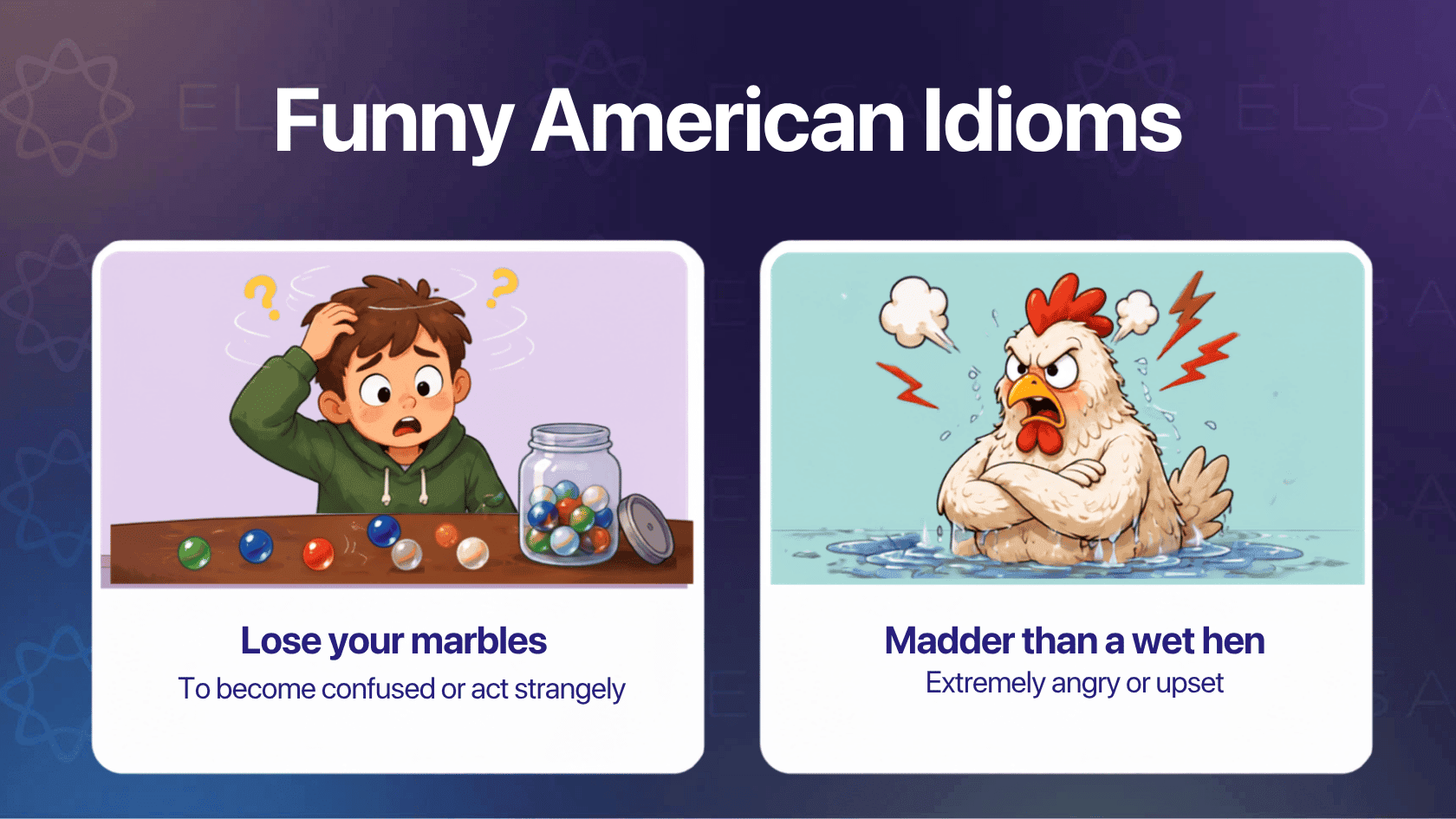
| Lose your marbles | To become confused or act strangely | Don’t lose your marbles on this one. |
| All hat, no cattle | Someone who talks big or looks impressive but has no real ability or substance | Don’t trust him. He’s all hat, no cattle. |
| Doesn’t have a pot to piss in | Someone who is extremely poor or has no money | Tom doesn’t have a pot to piss in, so the landlord kicked him out. |
| A few bricks short of a load | Someone who is not very intelligent or capable | He’s just a few bricks short of a load. |
| One sandwich short of a picnic | Someone is slightly crazy or not very intelligent | She’s one sandwich short of a picnic. |
| Madder than a wet hen | Extremely angry or upset | Someone made him madder than a wet hen. |
| Nuttier than a fruitcake | Very strange or crazy | That lad is nuttier than a fruitcake. |
| Tougher than a two-dollar steak | Extremely tough or resilient | That pot is tougher than a two-dollar steak. |
| Slicker than a greased pig | Very clever, hard to catch, or difficult to deal with | That thief is slicker than a greased pig. |
| Sweating like a sinner in church | Sweating heavily because of heat, stress, or fear | Stop sweating like a sinner in church! It’s not that difficult! |
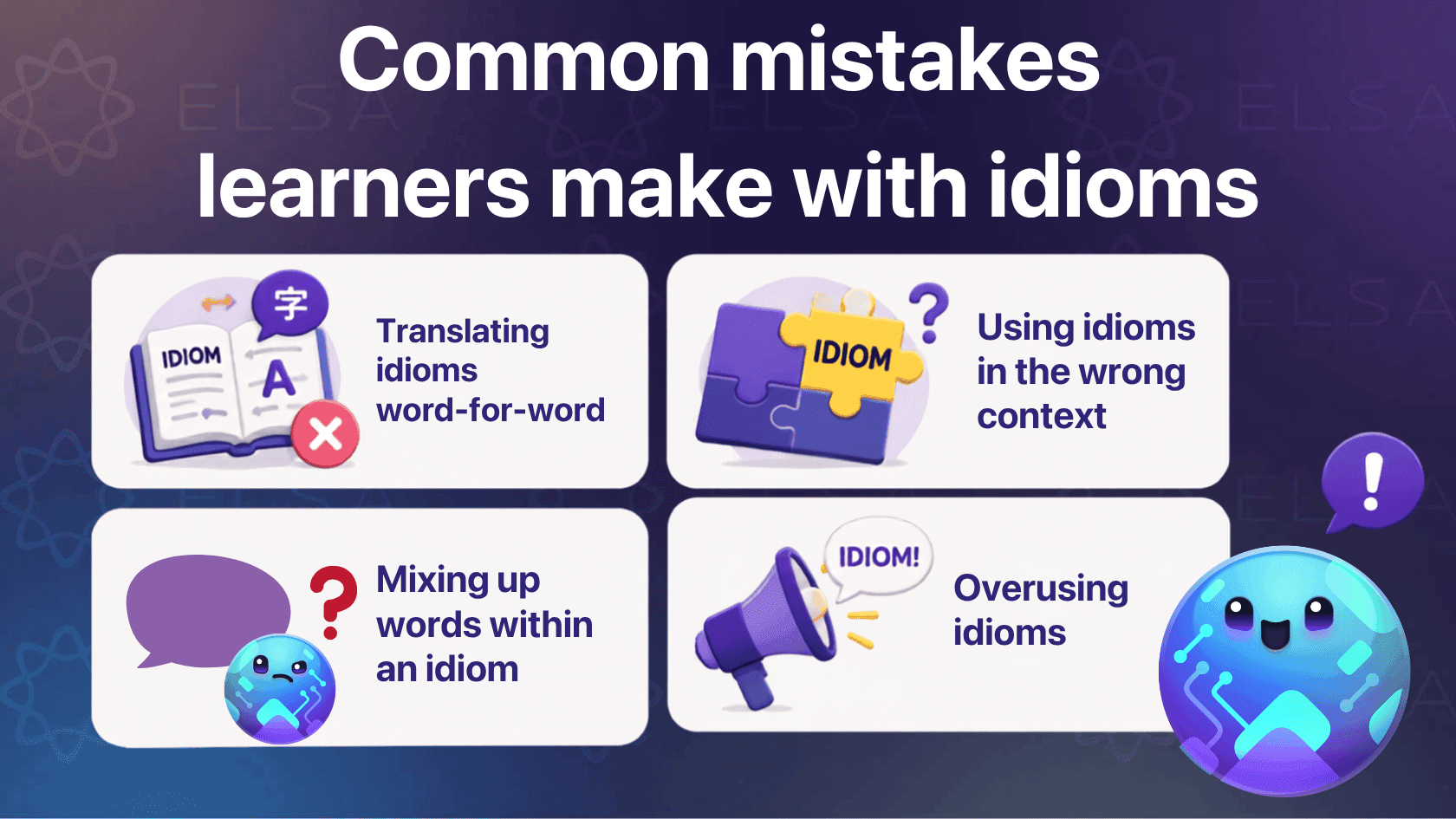
Common mistakes learners make with idioms
Idioms can make your English sound more natural, but using them incorrectly can make your meaning confusing. Here are some common mistakes to avoid:
- Translating idioms word-for-word: English idioms often have figurative meanings that cannot be understood by translating each word.
- Using idioms in the wrong context: Choose an idiom that matches the situation, meaning, and t one of your conversation.
| Mistake | Correct |
| I said “break a leg” to my friend who was sick. | I said “break a leg” before her performance. |
- Mixing up words within an idiom: Most idioms have a fixed form, so changing the words can make the expression incorrect.
| Mistake | Correct |
| Kill two ducks with one stone. | Kill two birds with one stone. |
- Overusing idioms: Using too many idioms in one conversation can make your English sound forced.
| Mistake | Correct |
| I hit the sack, woke up, and was busy as a bee, so I had butterflies in my stomach. | I hit the sack, woke up early and had a busy day. |
- Learning idioms without examples: Knowing an idiom’s meaning is not enough. Learn it in context to understand when and how to use it naturally.
>> Want to use English idioms more naturally? Practice idioms in context with ELSA Speak and build your confidence through interactive English lessons and speaking practice. Try ELSA today!
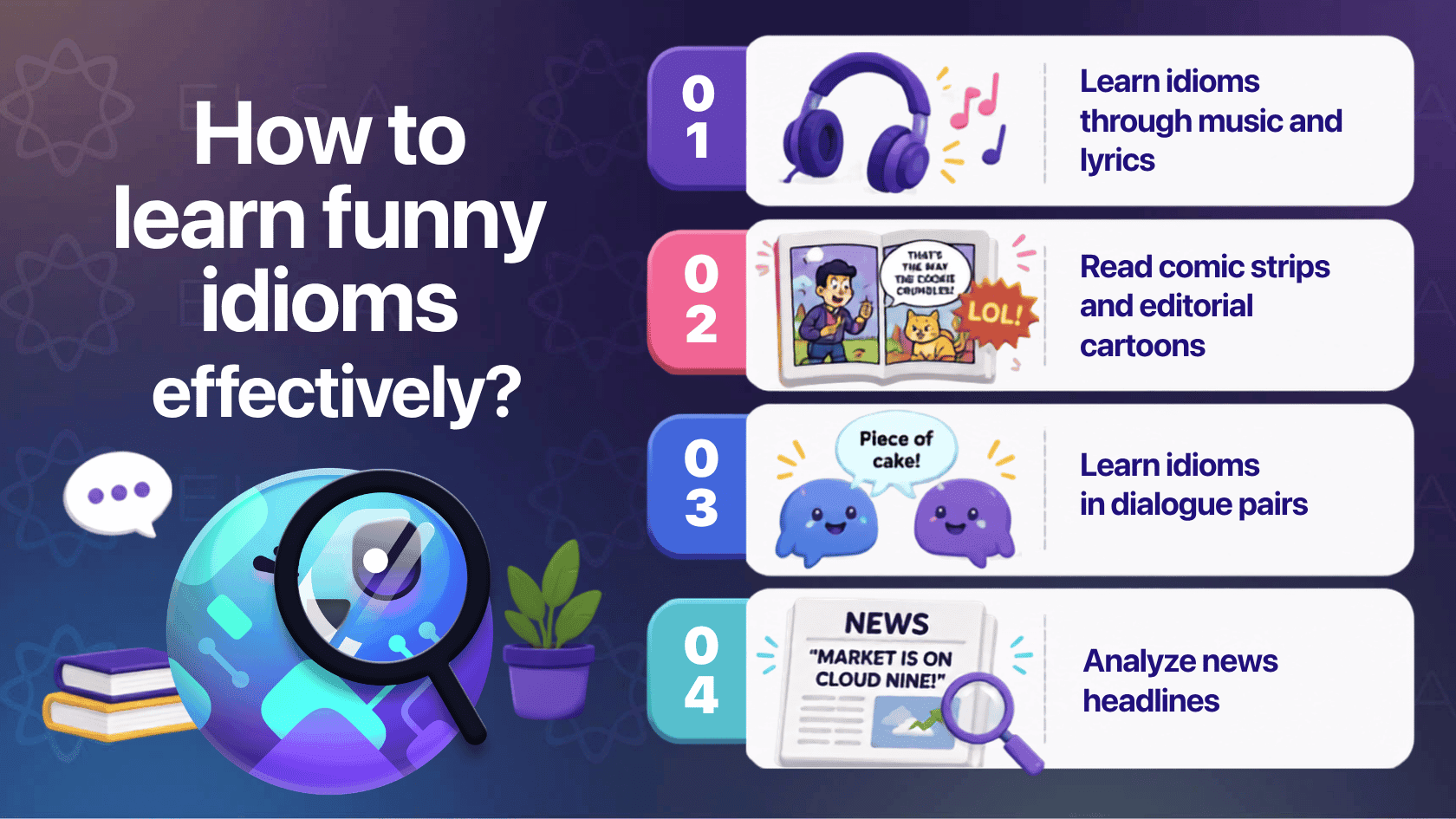
How to learn funny idioms effectively?
Learning funny idioms in English is easier when you see and hear them in real-life contexts. Try these simple strategies to remember idioms and use them more naturally:
- Learn idioms through music and lyrics: Songs often use idiomatic expressions in memorable contexts. Look up the meaning and note how the idiom is used in the lyrics.
- Read comic strips and editorial cartoons: Comics combine idioms with visual situations, making their figurative meanings easier to understand and remember.
- Study regional variations: Some idioms are more common in American, British, or Australian English. Learning these differences helps you choose expressions that sound natural to your audience.
- Learn idioms in dialogue pairs: Practice idioms through short conversations instead of memorizing them alone. This helps you understand how they naturally fit into everyday speech.
- Analyze news headlines: News headlines often use creative idioms and wordplay to grab attention. Look for familiar expressions and learn how their meanings change with context.
Learning funny idioms is a great way to make your English more natural, expressive, and engaging. For more interesting English lessons and vocabulary tips, visit the Vocabulary category on ELSA Speak and keep improving your English every day!