

Future perfect continuous tense: Formula, uses & examples
elsaspeakadmin
October 15, 2026
English tenses
The future perfect continuous tense is particularly useful for discussing work progress, long-term plans, and ongoing activities with future deadlines. In this guide, you’ll learn its formula, uses with future perfect continuous formula, along with exercises to help you use this tense correctly.
What is the future perfect continuous tense?
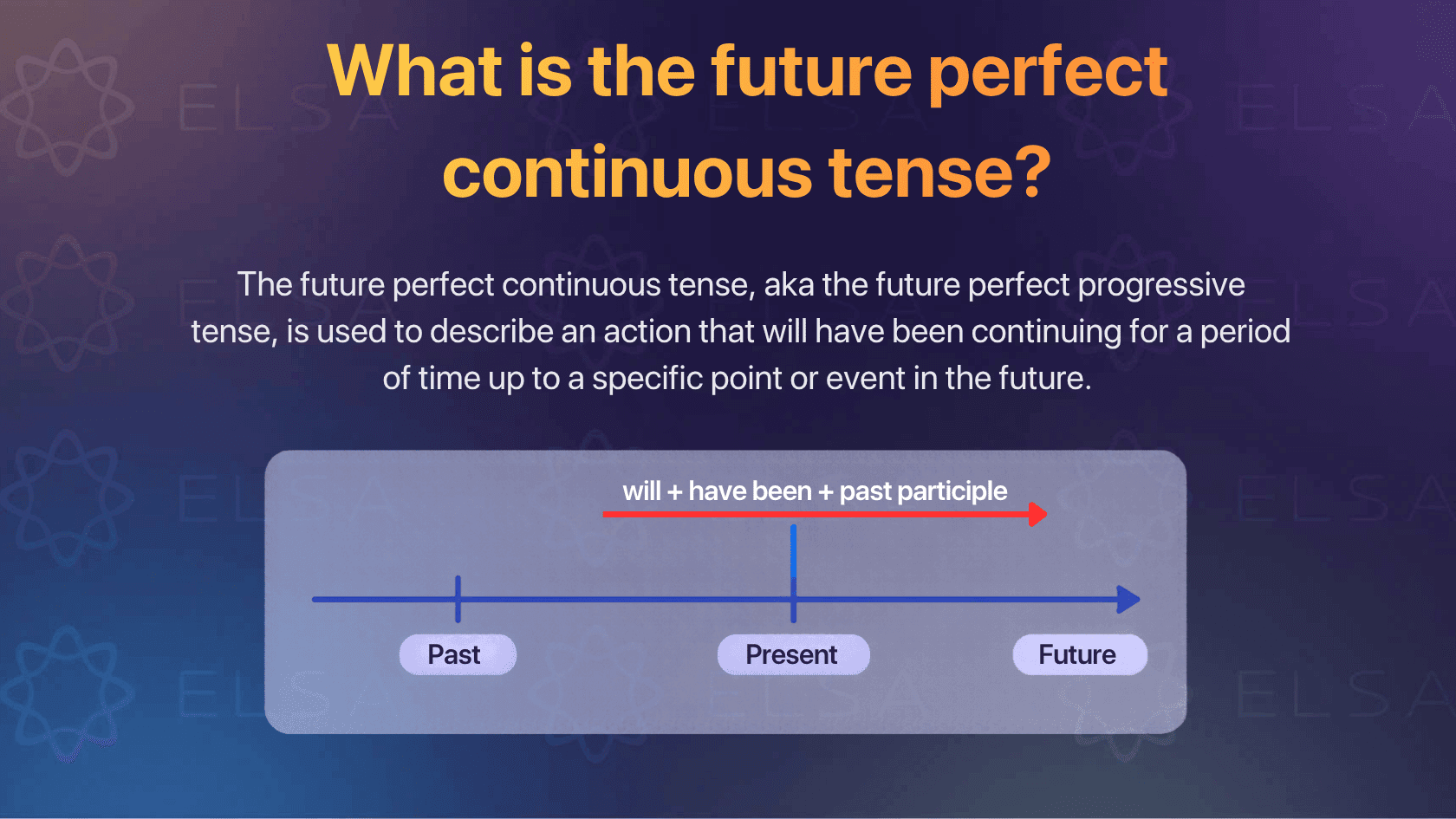
The future perfect continuous tense, aka the future perfect progressive tense, is used to describe an action that will have been continuing for a period of time up to a specific point or event in the future. The action or event in the sentence may have started in the past or present, and continued into the future. It can also begin at a future time and continue until a later point.
Let’s take a look at this example:
By next June, I will have been working at this company for five years.
→ In this sentence, the speaker mentions looking up ahead to next June and measures the duration of their activity, “working at the company” up to that future point.
The tense combines three grammatical elements:
- Future: "will" places the statement in the future.
- Perfect: "have been" connects the ongoing action to a future reference point.
- Continuous: The "-ing" form of the main verb emphasizes the action's duration.
For easier understanding, imagine a timeline: you start from the present, look toward a point in the future, and then look back at the duration that an activity will have continued by that point.
For instance, if you started learning English in January 2025, you could say:
→ By January 2028, I will have been learning English for three years.
Instead of simply focusing on the future activity, the sentence will focus on how long the activity will have continued by January 2028.
Future perfect continuous formula and sentence structures
The future perfect progressive tense has 3 main structures: affirmative, negative, and interrogative. In standard American English, contractions such as “I’ll” and “won’t” are common in everyday conversation, while the full forms (such as I will, or will not) are often preferred in formal writings.
Affirmative form
We use the affirmative form to describe an activity that will have continued for a particular duration by a future point.
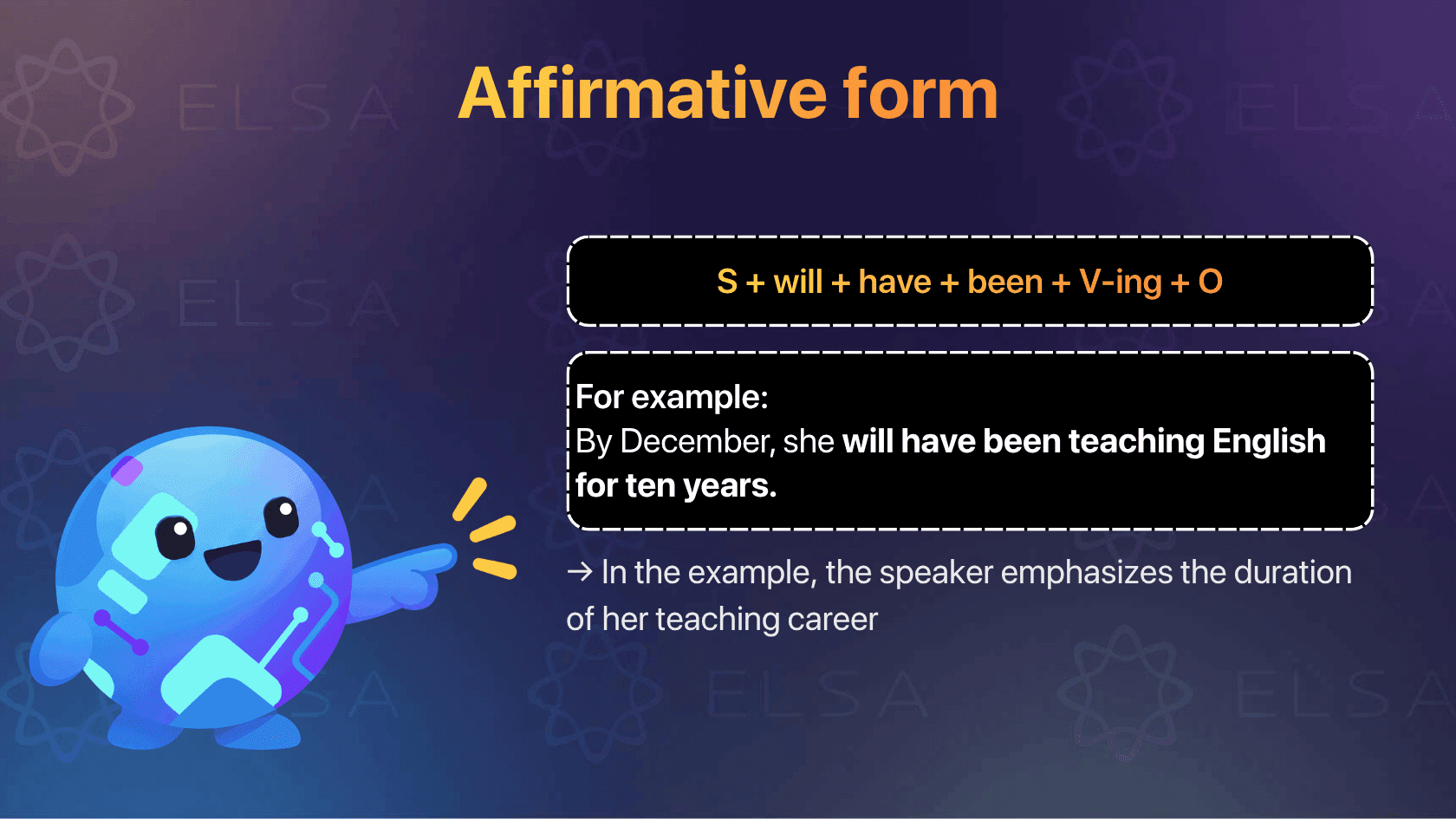
Formula:
| S + will + have + been + V-ing + O |
The short form will be:
| S + 'll have been + V-ing |
This structure is applied to all subjects, including I, you, he, she, it, we, and they. Unlike the simple present tense, this future tense does not change have to has after will.
For example:
- By December, she will have been teaching English for ten years.
- By the time the project ends, we will have been working together for six months.
→ In the first example, the speaker emphasizes the duration of her teaching career. In the second, the sentence highlights how long the team will have worked together by the project's end.
Negative form
We use the negative form to emphasize that an activity will not have continued for a particular duration by a future point.
Formula:
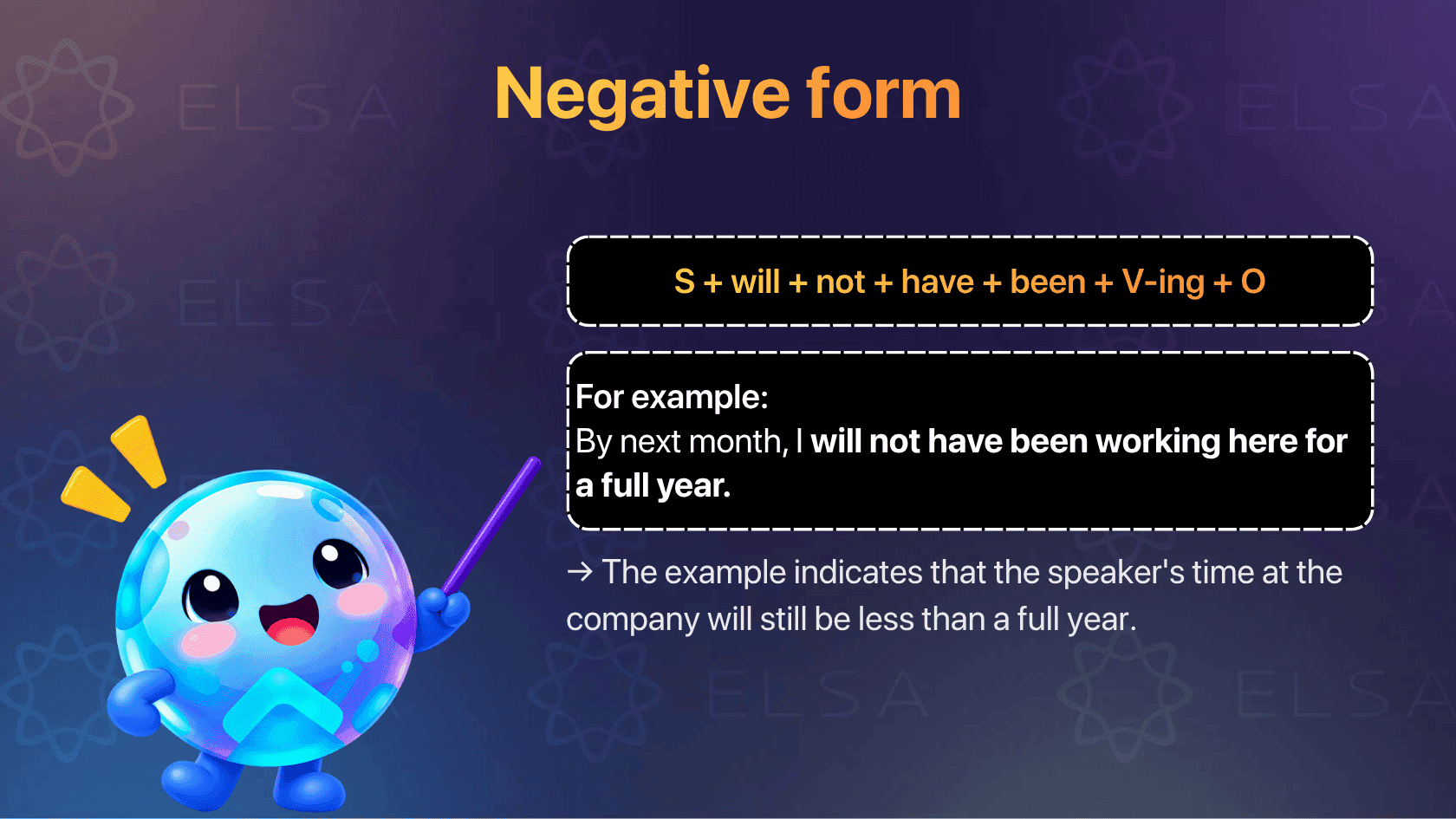
| S + will + not + have + been + V-ing + O |
The short form is:
| S + won't + have + been + V-ing |
For example:
- By next month, I will not have been working here for a full year.
- By 6 p.m., they won't have been waiting for more than thirty minutes.
→ The first example indicates that the speaker's time at the company will still be less than a full year. The second emphasizes the expected duration of the wait.
Interrogative Form
We use the interrogative form to ask how long an activity will have continued by a future point, or whether it will have continued for a particular period. There are 2 common types of this form:
Yes/no question:
Formula:
| Will + S + have + been + V-ing + O? |
Short answers:
- Yes, S + will.
- No, S + won't.
For example: Will you have been studying English for three years by next September?
- Yes, I will.
- No, I won't.
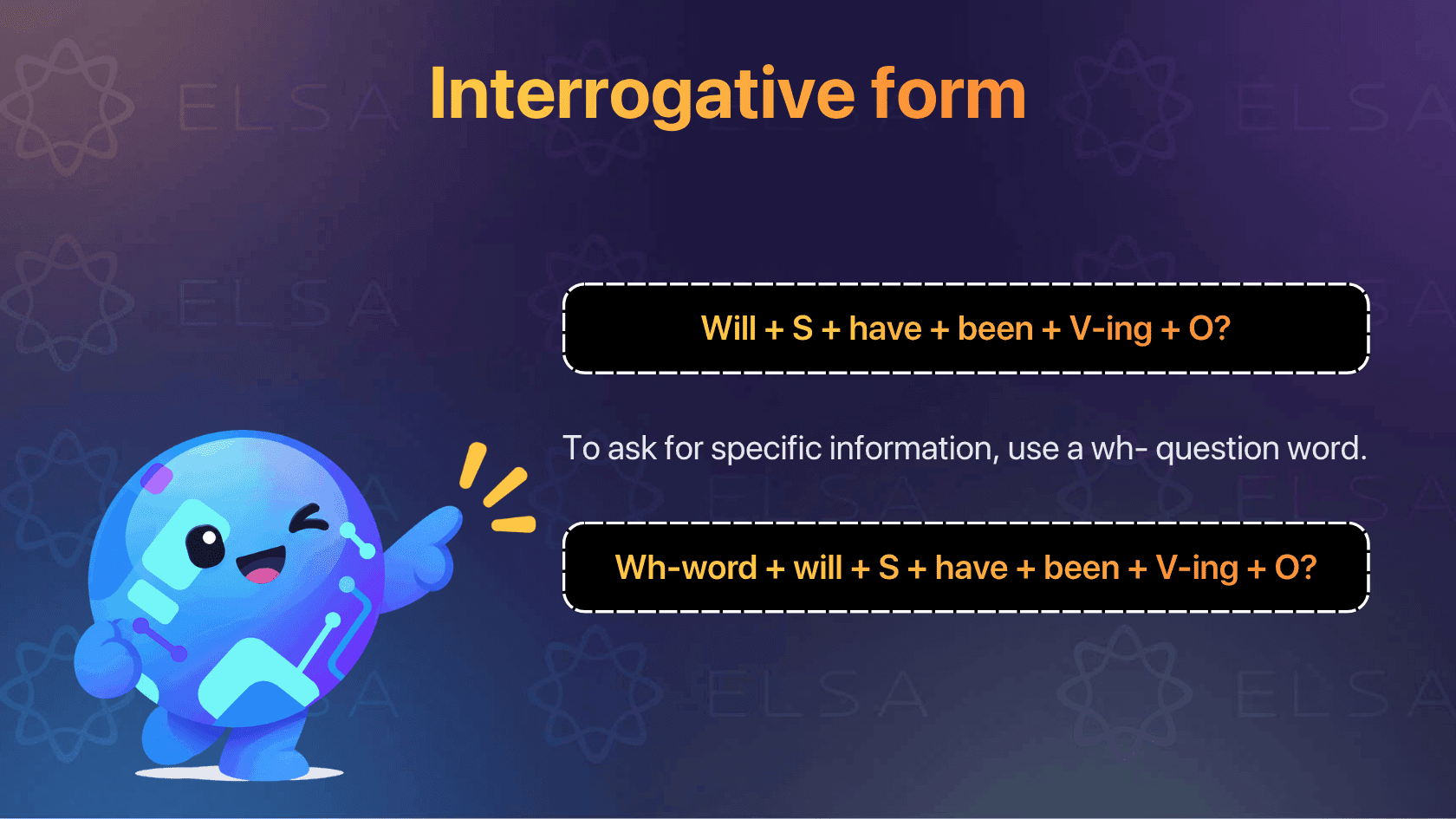
To ask for specific information, use a wh- question word.
WH- question
Formula:
| Wh-word + will + S + have + been + V-ing + O? |
For example: How long will she have been working at the company by the end of this year?
Answer: She will have been working there for eight years by the end of this year.
→ The question word “how long” asks about the duration of the activity, while the rest of the sentence identifies the future reference point.
When to use the future perfect continuous tense
The future perfect continuous tense has two main uses:
Emphasizing the duration of an action before a future point
Use the future perfect continuous when you want to highlight how long an activity will have continued before a specific future time or event.
The structure often combines a duration with a future deadline:
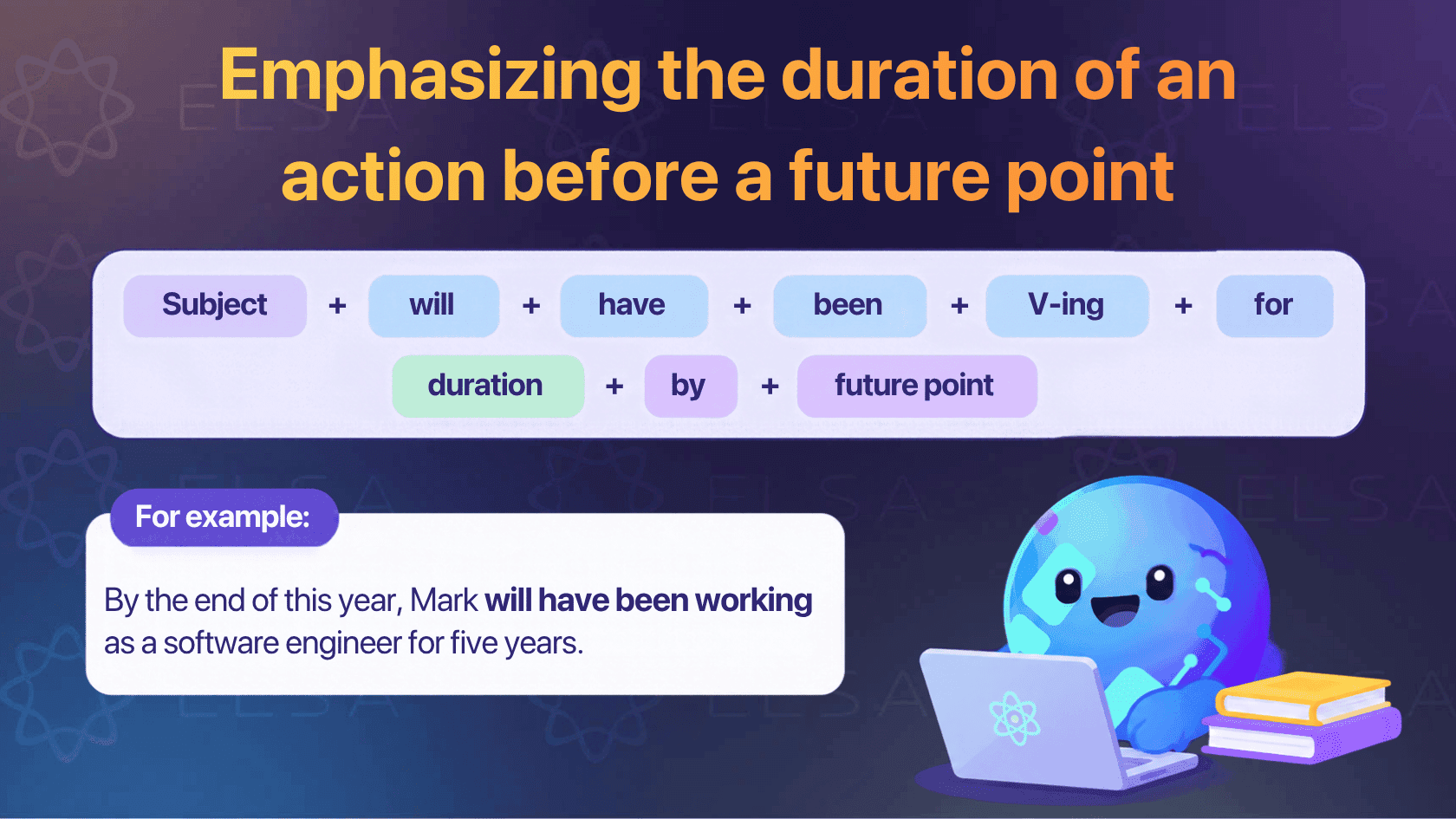
| Subject + will + have + been + V-ing + for + duration + by + future point |
For example:
- Affirmative: By the end of this year, Mark will have been working as a software engineer for five years.
- Negative: By July, she won't have been studying at this university for a full year.
- Interrogative: Will they have been traveling for twelve hours by the time they reach London?
→ These sentences emphasize the length of time an activity will have continued by the stated future point.
Explaining the cause of a future result
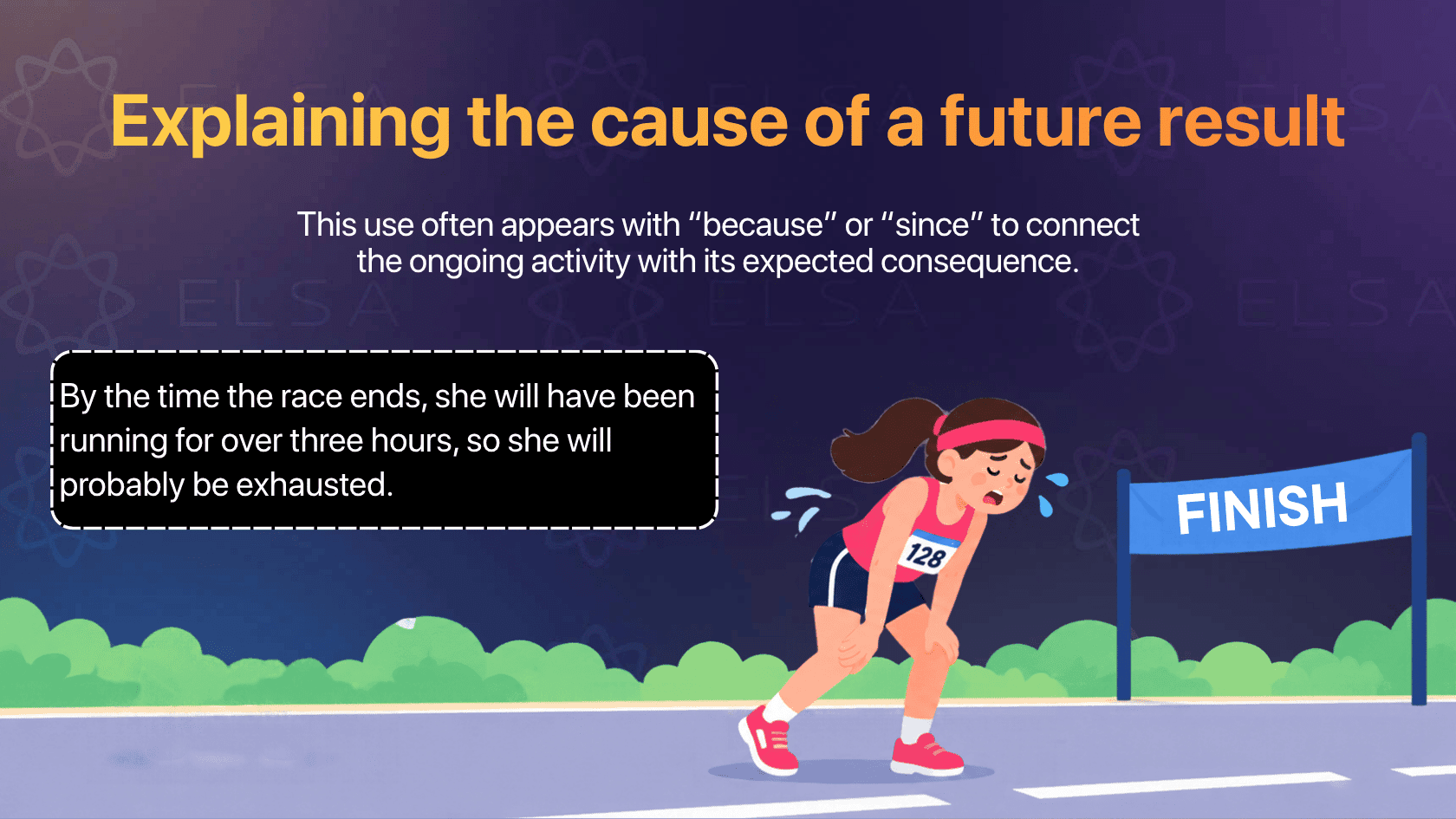
The future perfect continuous can explain a future condition or result by emphasizing the activity that will have continued before that point. This use often appears with “because” or “since” to connect the ongoing activity with its expected consequence.
Examples:
- Affirmative: By the time the race ends, she will have been running for over three hours, so she will probably be exhausted.
- Negative: He won't have been sleeping well for several nights by Monday, so he may find it difficult to concentrate.
- Interrogative: Will you have been working long hours for several weeks by the time the project deadline arrives?
→ In the first example, the long period of running helps explain why the runner is expected to feel exhausted. In the second, a lack of sleep provides a possible explanation for future difficulty concentrating. The third asks whether a prolonged period of work will have occurred by a particular deadline.
You can also use because or since to make the causal relationship explicit:
For example: By Friday, she will have been practicing every day for a month because she wants to prepare for the competition.
→ The future perfect continuous emphasizes the duration of the practice, while the because clause explains the reason for it.
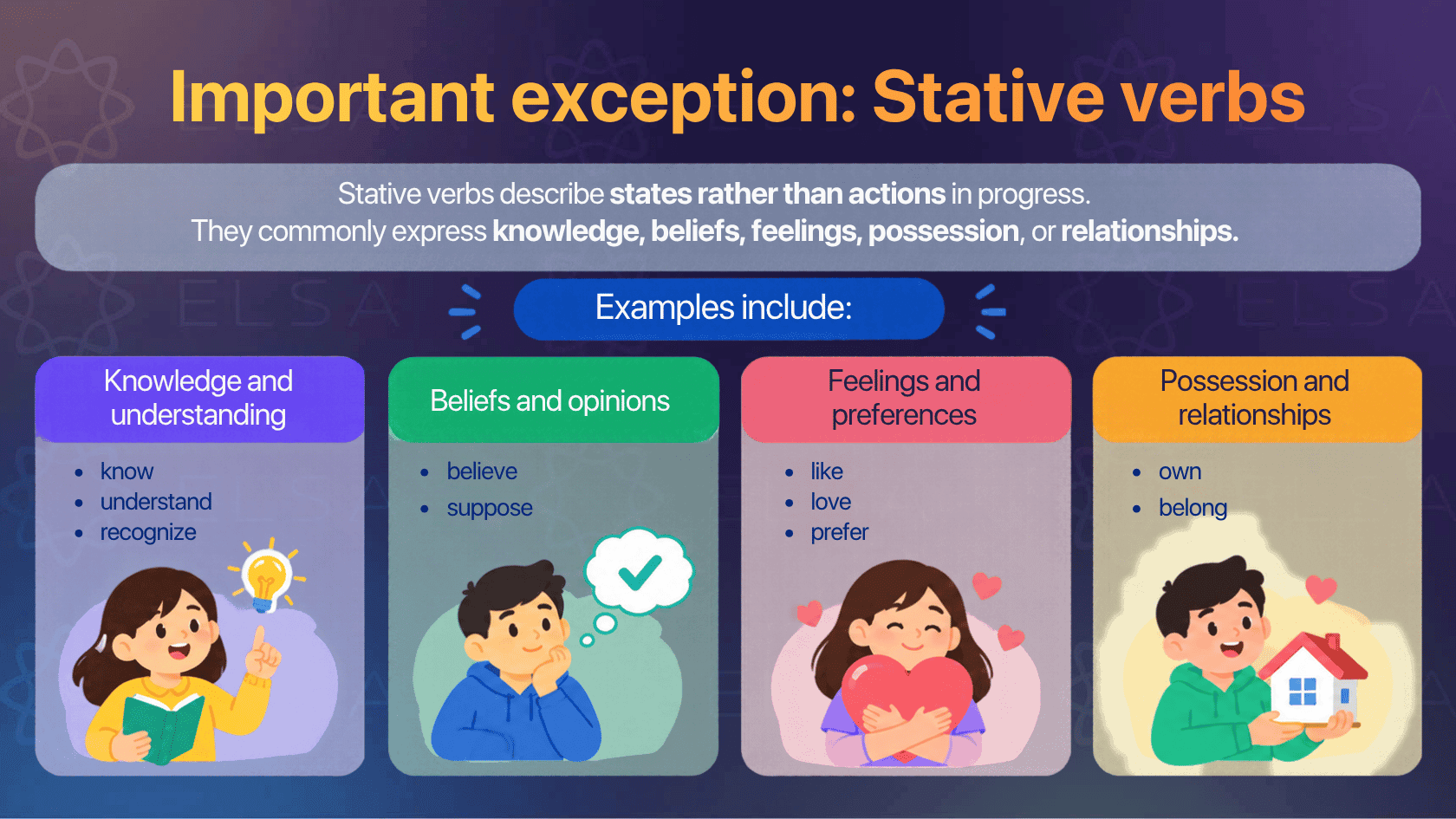
Important exception: Stative verbs
Stative verbs describe states rather than actions in progress. They commonly express knowledge, beliefs, feelings, possession, or relationships.
Examples include:
- Knowledge and understanding: know, understand, recognize
- Beliefs and opinions: believe, suppose
- Feelings and preferences: like, love, prefer
- Possession and relationships: own, belong
These verbs generally do not take continuous forms when they express their usual stative meanings. To describe how long a state will have lasted by a future point, use the future perfect tense instead.
- Incorrect: By next month, I will have been knowing Alex for ten years.
- Correct: By next month, I will have known Alex for ten years.
The correct sentence uses will + have + past participle (V3) because “know” describes a state rather than an ongoing physical activity.
Some verbs can be used in continuous forms when their meanings change. For example, “think” can describe an ongoing mental activity in “I will have been thinking about your proposal for a week.” The appropriate form depends on the verb's meaning in context.
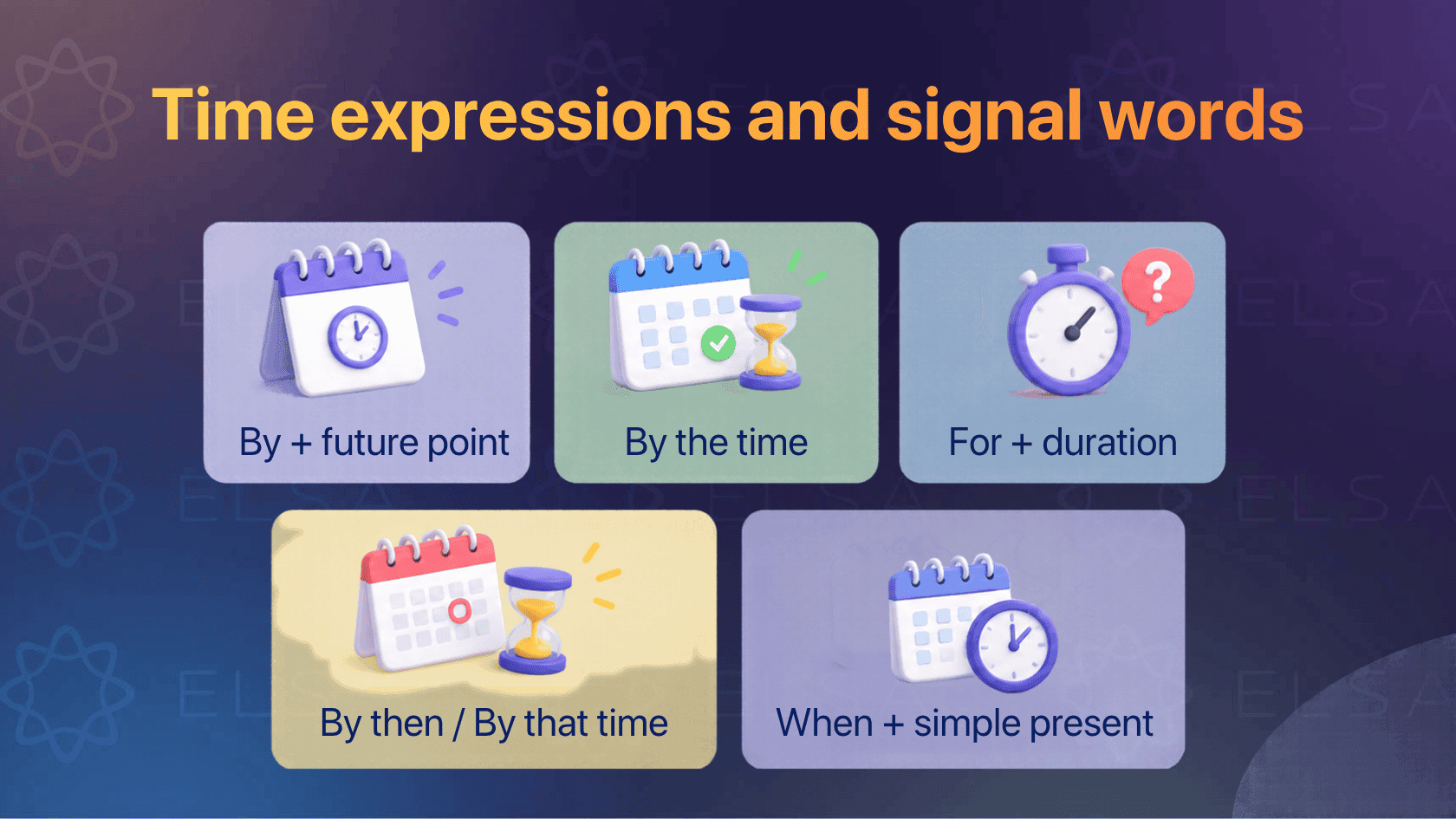
Time expressions and signal words
Time expressions help identify the duration of an activity and the future point used to measure it. The future perfect continuous commonly combines for with a duration and by with a future deadline. Here are the list of words along with future perfect continuous examples:
| Signal word or expression | Structure | Example |
| By + future point | By + time/date/year + subject + will have been + V-ing + for + duration | By June, I will have been learning English for two years. |
| By the time | By the time + subject + simple present, subject + will have been + V-ing | By the time she arrives, we will have been waiting for an hour. |
| For + duration | For + hours/days/months/years | By December, he will have been living here for six months |
| By then / By that time | By then/by that time + subject + will have been + V-ing | By then, they will have been developing the product for a year. |
| When + simple present | When + subject + simple present, subject + will have been + V-ing | When the course ends, I will have been studying English for six months. |
Remember the difference between by and for:
- By identifies the future reference point
- For measures the duration.
A sentence may use both to show how long an activity will have continued by a deadline.
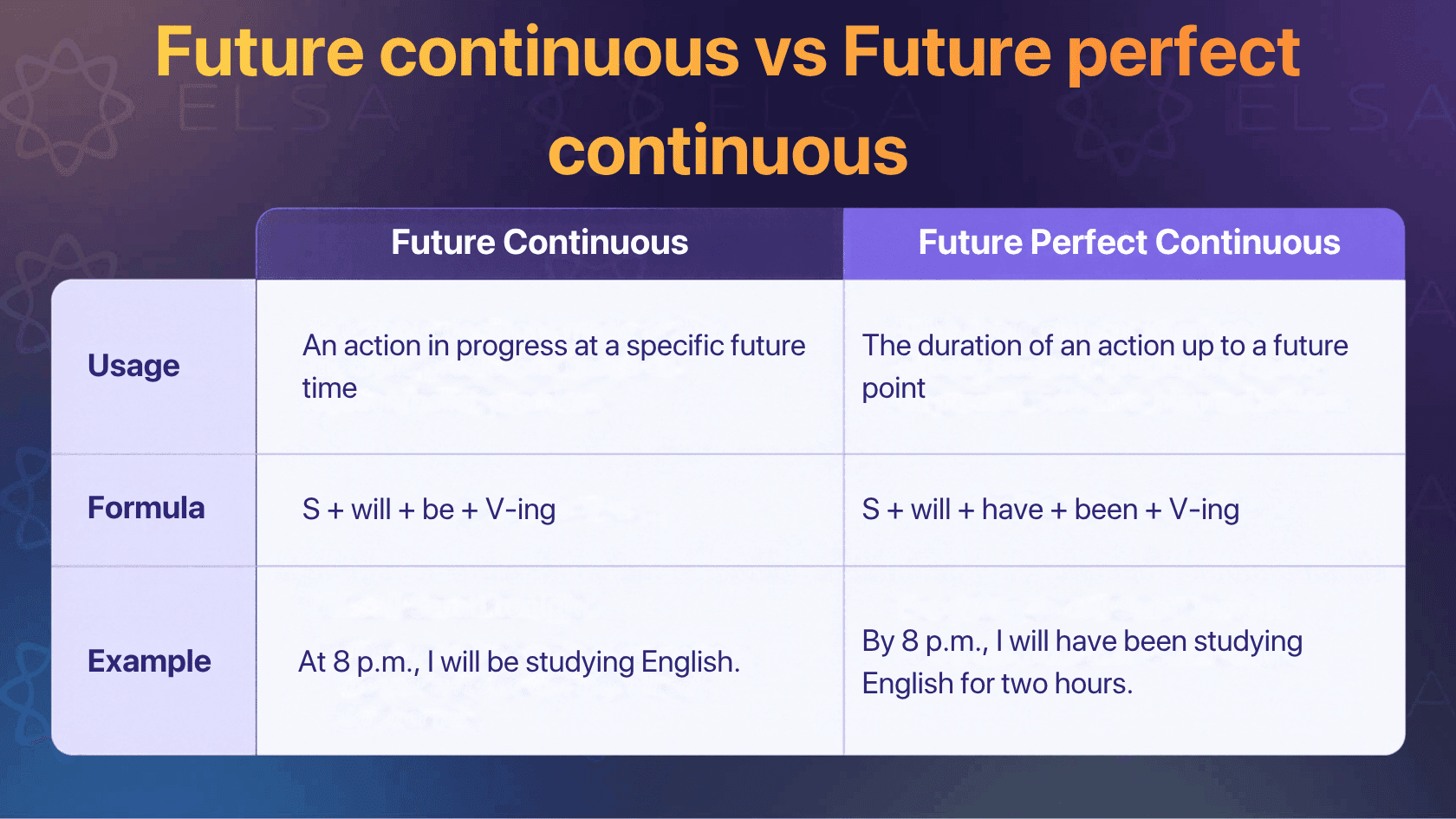
Future continuous vs Future perfect continuous
The future continuous and future perfect continuous both describe ongoing activities in the future. The main difference is their focus: the future continuous emphasizes what will be happening at a particular moment, while the future perfect continuous emphasizes how long an activity will have continued by a future point.
| Comparison criterion | Future Continuous | Future Perfect Continuous |
| Main focus | An action in progress at a specific future time | The duration of an action up to a future point |
| Core formula | S + will + be + V-ing | S + will + have + been + V-ing |
| Common time expressions | At 8 p.m. tomorrow, this time next week | For two hours by 8 p.m., by the time, by then |
| Example | At 8 p.m., I will be studying English. | By 8 p.m., I will have been studying English for two hours. |
Let's compare the examples:
- Future continuous: At 8 p.m. tomorrow, I will be working on my report. The sentence describes an activity in progress at that time.
- Future perfect continuous: By 8 p.m. tomorrow, I will have been working on my report for three hours. The sentence emphasizes the duration of the work up to 8 p.m.
The future perfect continuous often includes a duration such as for three hours, but this is not an absolute requirement in every sentence. The essential distinction is whether the speaker emphasizes the ongoing activity at a future moment or the length of time leading up to a future point.
Practice exercises on future perfect continuous tense
Test your understanding with two exercises. The first focuses on forming the future perfect continuous, while the second helps you distinguish it from the future continuous.
Exercise 1: Conjugate the verbs in brackets
Complete each sentence using the future perfect continuous tense of the verb in brackets
- By next June, I __________ (study) English for three years.
- By the end of this month, she __________ (work) at the company for five years.
- They __________ (not / travel) for more than six hours by the time they reach the hotel.
- __________ you __________ (wait) for an hour by the time the bus arrives?
- By 2028, we __________ (live) in this neighborhood for a decade.
- He __________ (practice) the piano for two hours by 7 p.m.
- By next Friday, I __________ (not / train) for a full month.
- How long __________ she __________ (teach) at this school by the end of the year?
- By the time the meeting ends, the team __________ (discuss) the proposal for three hours.
- __________ they __________ (develop) the application for six months by December?
Answers and explanations
Exercise 2: Choose the correct tense (future continuous vs future perfect continuous)
Choose A or B to complete each sentence.
1. At 9 p.m. tomorrow, I _____ for my English exam.
A. will be studying
B. will have been studying for three hours
2. By 9 p.m. tomorrow, I _____ for three hours.
A. will be studying
B. will have been studying
3. This time next week, they _____ to Singapore.
A. will be flying
B. will have been flying for six hours
4.By the time the plane lands, the passengers _____ for nearly twelve hours.
A. will be traveling
B. will have been traveling
5. At 10 a.m. tomorrow, she _____ with her manager.
A. will be meeting
B. will have been meeting for two hours
6. By noon, we _____ on this project for five hours.
A. will have been working
B. will be working
7. At this time tomorrow, the students _____ their final examination.
A. will have been taking it for two hours
B. will be taking
8. By the time the concert begins, the fans _____ outside the venue for hours.
A. will have been waiting
B. will be waiting
9. At 6 p.m. tomorrow, he _____ dinner with his colleagues.
A. will be having
B. will have been having it for three hours
10. By the end of the year, my sister _____ at the hospital for a decade.
A. will be working
B. will have been working
FAQs about future perfect continuous
How often is the future perfect continuous tense used in daily English?
The future perfect continuous is less common in everyday conversation than simpler future forms because it has a longer structure and expresses a specific meaning: the duration of an activity up to a future point. However, it is useful when discussing work experience, project progress, study plans, and long-term activities.
Can we use stative verbs in the future perfect continuous tense?
Stative verbs generally do not take the future perfect continuous when they describe states such as knowledge, belief, possession, or feelings. Examples include know, like, love, believe, own, and understand.
Use the future perfect instead when you want to describe how long a state will have lasted by a future point.
- Incorrect: By next month, I will have been knowing Alex for ten years.
- Correct: By next month, I will have known Alex for ten years.
The correct structure is will + have + past participle (V3).
What is the difference between "By" and "For" in this tense?
By identifies a future point or deadline, while for indicates the length of time an activity continues.
- By: By next June, I will have been studying English...
- For: ...for three years.
Together, they provide a complete time reference:
For example: By next June, I will have been studying English for three years.
→ The sentence means that when next June arrives, the duration of the speaker's English studies will be three years.
Ready to build stronger English grammar and communication skills? Explore the Grammar category on the ELSA Speak blog for practical grammar guides, examples, and learning tips to help you communicate more confidently.