

Mastering English tenses: 12 verb tenses & chart guide
elsaspeakadmin
October 15, 2026
English tenses
Understanding verb tenses is essential for building clear sentences in everyday conversation, academic writing, and professional English. In this guide, we cover the 12 tenses in English, with formulas, examples, along with a comprehensive chart and exercises to help you use them more effectively.
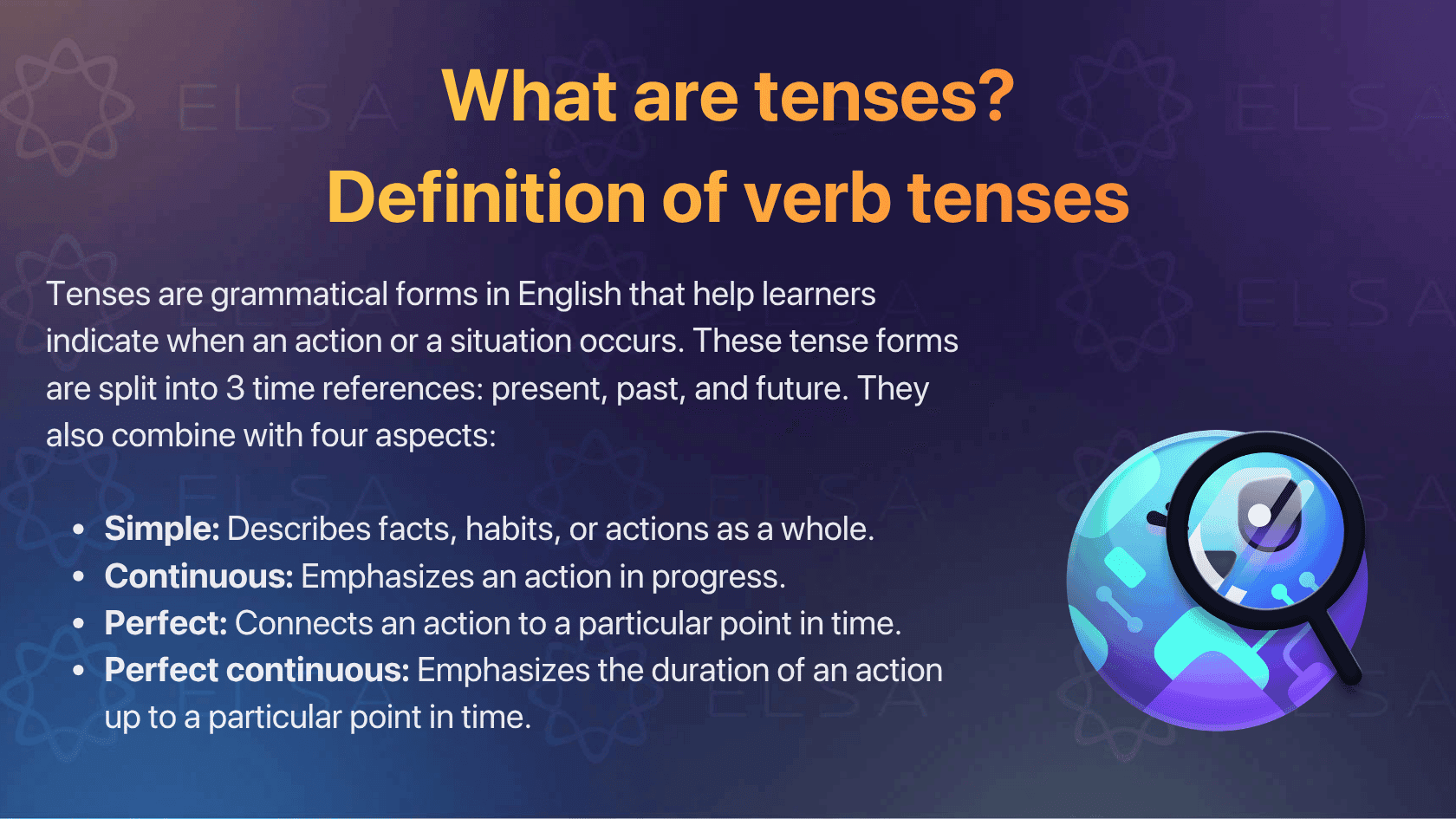
What are tenses? Definition of verb tenses
Tenses are grammatical forms in English that help learners indicate when an action or a situation occurs. These tense forms are split into 3 time references: present, past, and future. These groups also combine with four aspects:
- Simple: Describes facts, habits, or actions as a whole.
- Continuous: Emphasizes an action in progress.
- Perfect: Connects an action to a particular point in time.
- Perfect continuous: Emphasizes the duration of an action up to a particular point in time.
Morphologically speaking, even though English has 2 main tenses: present, and past, learning materials traditionally teach 12 tense forms by including future constructions and different aspects.
English tenses chart: Summary of 12 tenses in English
The tenses chart below summarizes the 12 common tense forms, including their basic usages with examples. We also combined the three time references (present, past, and future) with four grammatical aspects to make it easier to compare the forms.
| Time \ Aspect | Simple | Continuous | Perfect | Perfect Continuous |
|---|---|---|---|---|
| Present | Habits and general facts. (I write a letter.) | Actions happening now. (I am writing a letter.) | Past actions connected to the present. (I have written a letter.) | Actions that started in the past and continue to the present. (I have been writing a letter.) |
| Past | Completed past actions. (I wrote a letter.) | Actions in progress at a specific past time. (I was writing a letter.) | Actions completed before another past event. (I had written a letter.) | Actions continuing over a period before a past event. (I had been writing a letter.) |
| Future | Predictions and spontaneous decisions. (I will write a letter.) | Actions in progress at a specific future time. (I will be writing a letter.) | Actions completed before a future time. (I will have written a letter.) | Actions continuing up to a specific future time. (I will have been writing a letter.) |
Present tenses: Formulas, uses, and examples
The present tense forms are commonly used to describe habits, current activities or events, experiences, and actions that began in the past and continue into the present.
1. Simple present tense
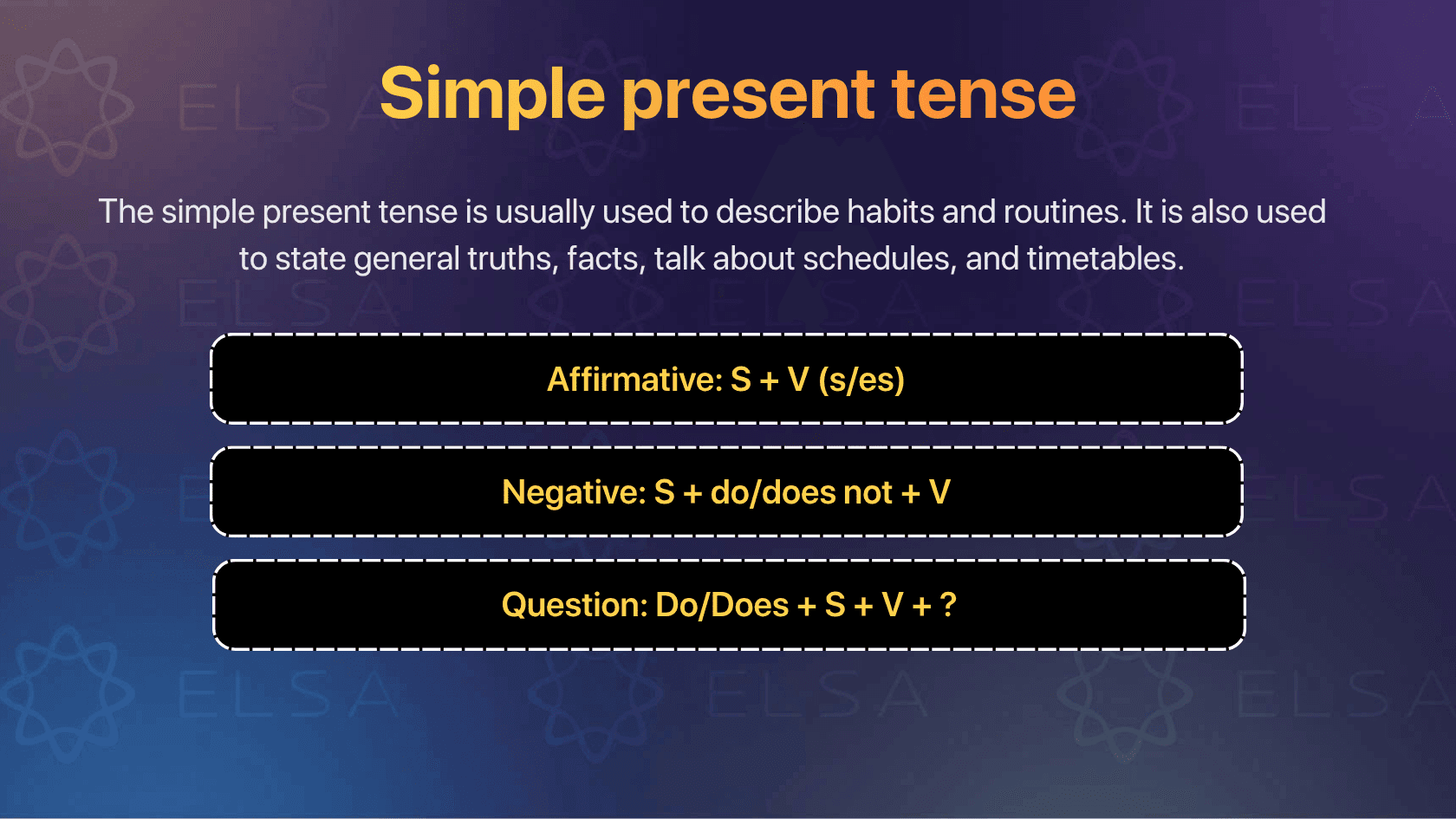
The simple present tense is usually used to describe habits and routines. It is also used to state general truths, facts, talk about schedules, and timetables.
Formulas:
| Affirmative: S + V (s/es) |
For example: He goes to school everyday.
| Negative: S + do/does not + V |
For example: He doesn’t go to school everyday.
| Question: Do/Does + S + V + ? |
For example: Does he go to school everyday?
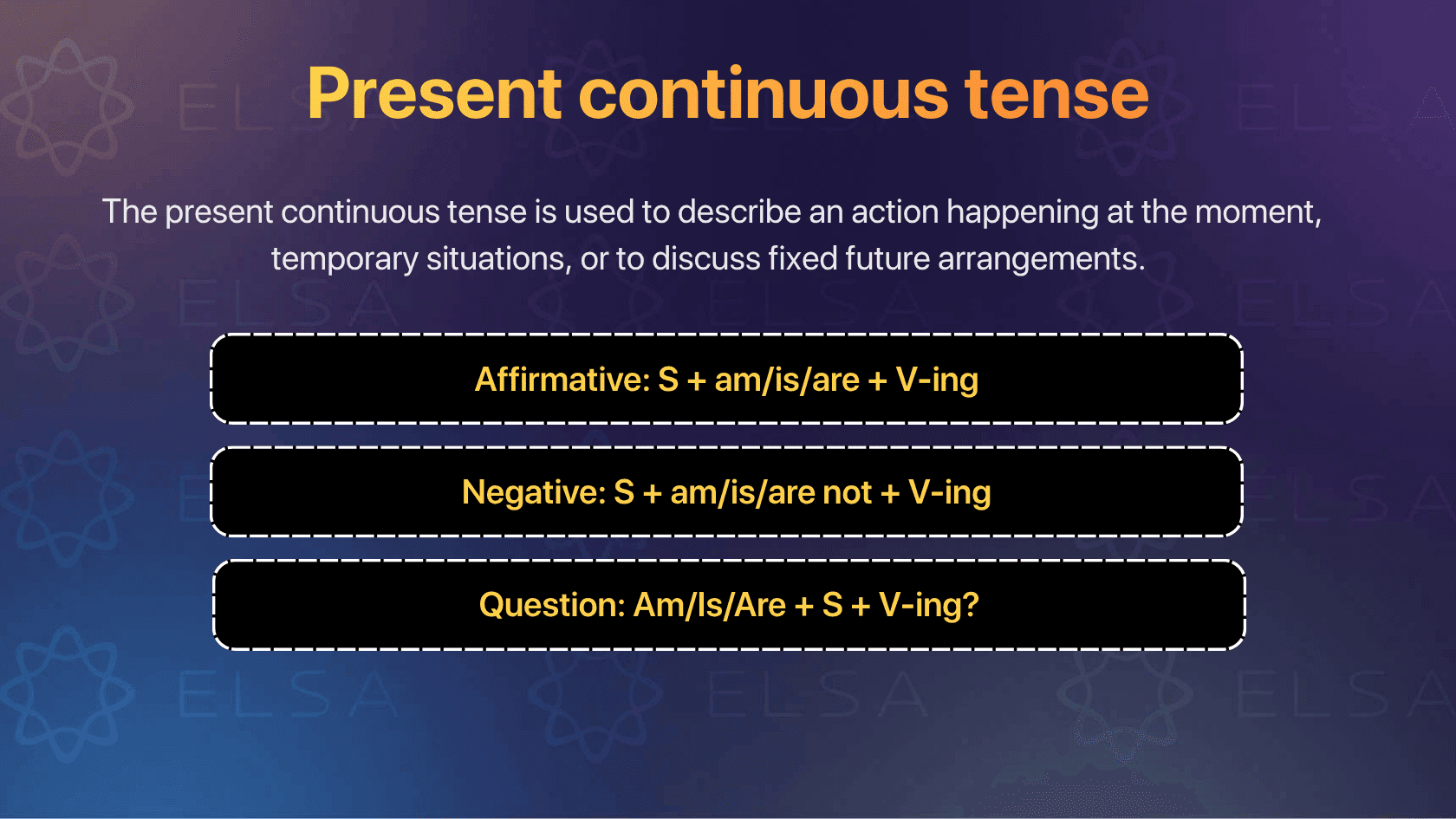
2. Present continuous tense
The present continuous tense is used to describe an action happening at the moment, temporary situations, or to discuss fixed future arrangements.
Formulas:
| Affirmative: S + am/is/are + V-ing |
For example: They are working right now.
| Negative: S + am/is/are not + V-ing |
For example: They aren’t working right now.
| Question: Am/Is/Are + S + V-ing? |
For example: Are they studying right now?
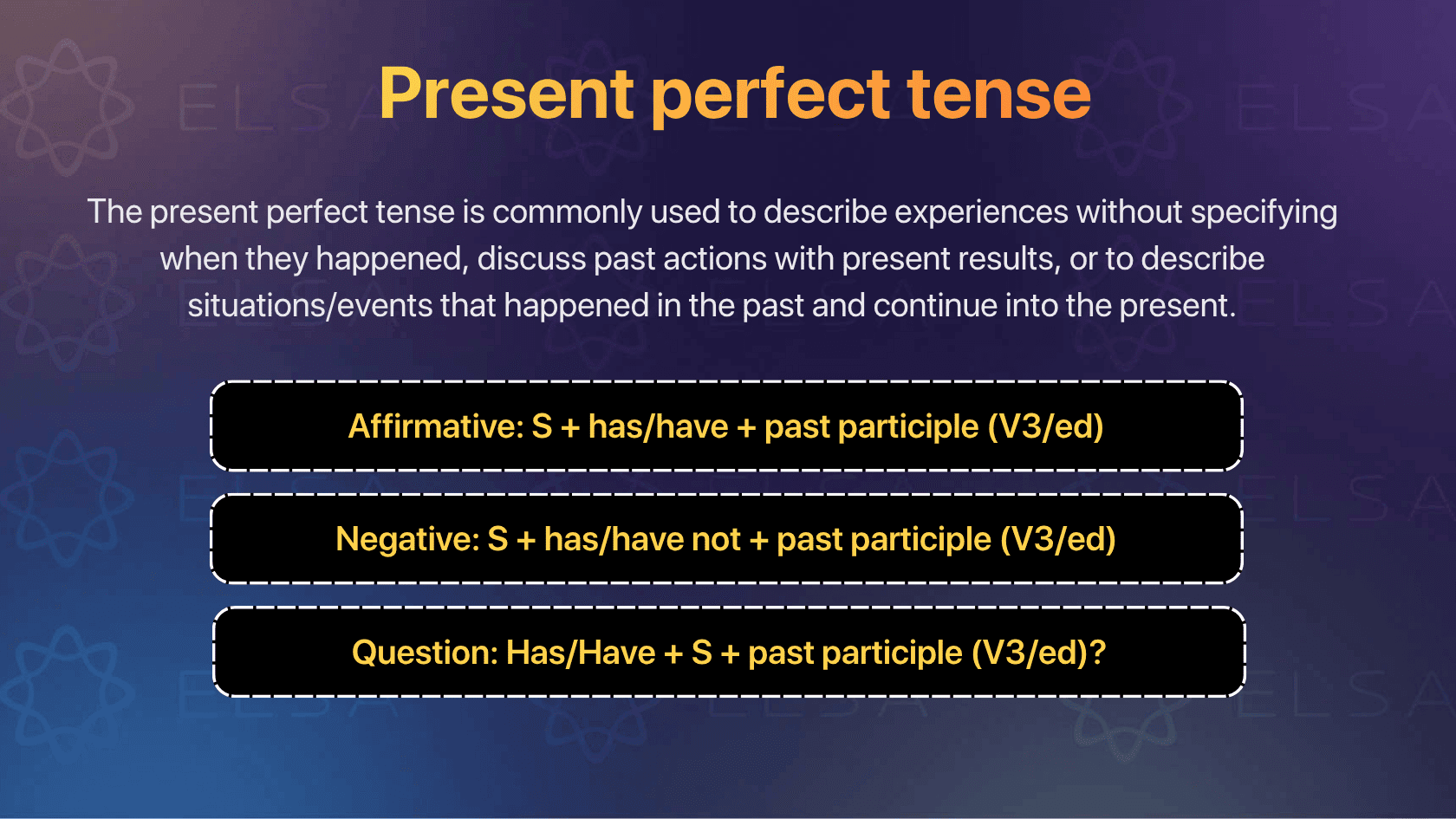
3. Present perfect tense
The present perfect tense is commonly used to describe experiences without specifying when they happened, discuss past actions with present results, or to describe situations/events that happened in the past and continue into the present.
Formulas:
| Affirmative: S + has/have + past participle (V3/ed) |
For example: Harry has lost his car keys.
| Negative: S + has/have not + past participle (V3/ed) |
For example: Harry hasn’t lost his car keys.
| Question: Has/Have + S + past participle (V3/ed)? |
For example: Has Harry lost his car keys?
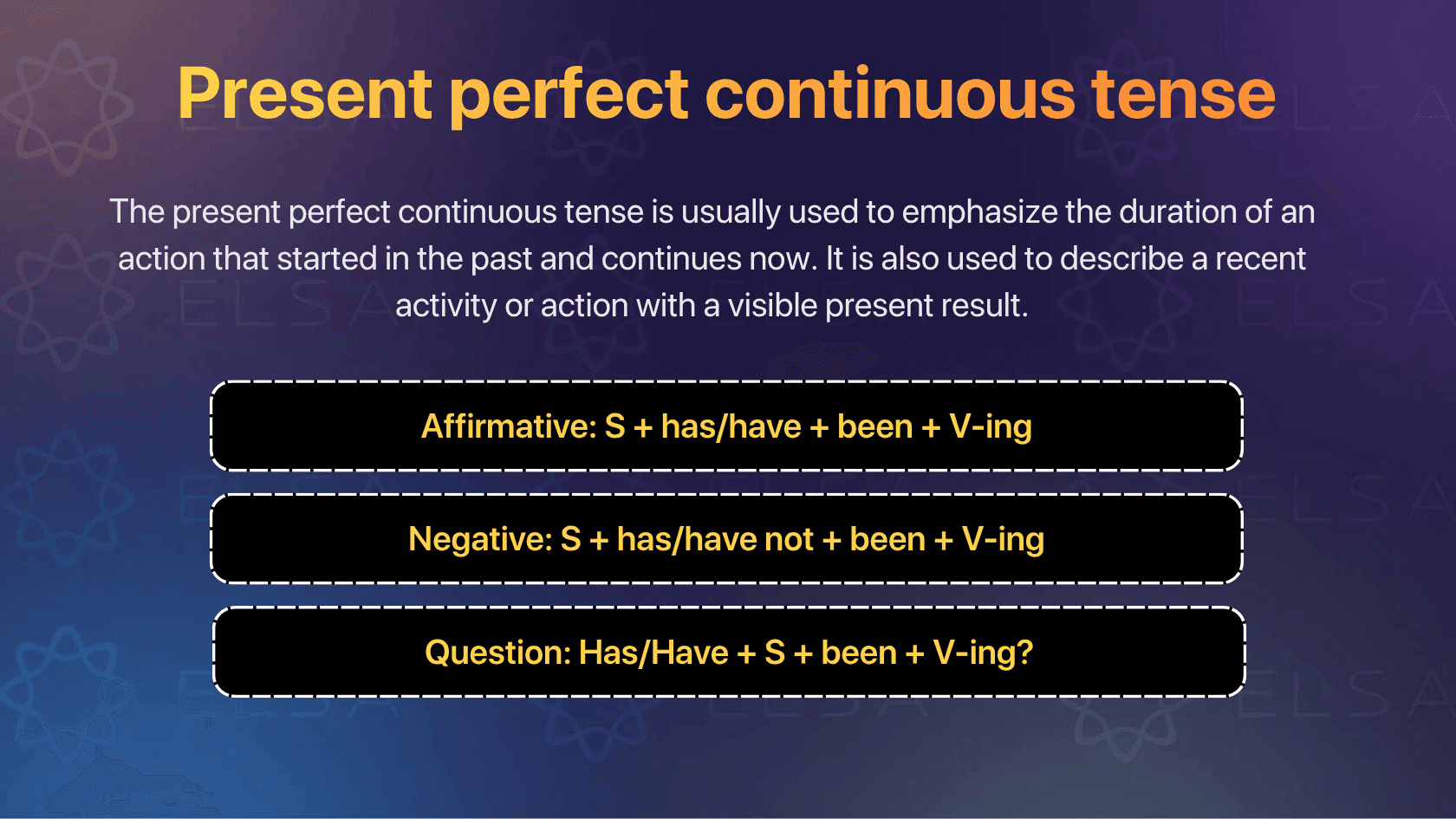
4. Present perfect continuous tense
The present perfect continuous tense is usually used to emphasize the duration of an action that started in the past and continues now. It is also used to describe a recent activity or action with a visible present result.
Formulas:
| Affirmative: S + has/have + been + V-ing |
For example: It has been raining all morning.
| Negative: S + has/have not + been + V-ing |
For example: It hasn’t been raining all morning.
| Question: Has/Have + S + been + V-ing? |
For example: Has it been raining all morning?
Past tenses: Formulas, uses, and examples
The past form of English tenses usually describes completed actions, ongoing activities at a certain past time, and events that happened before other past events.
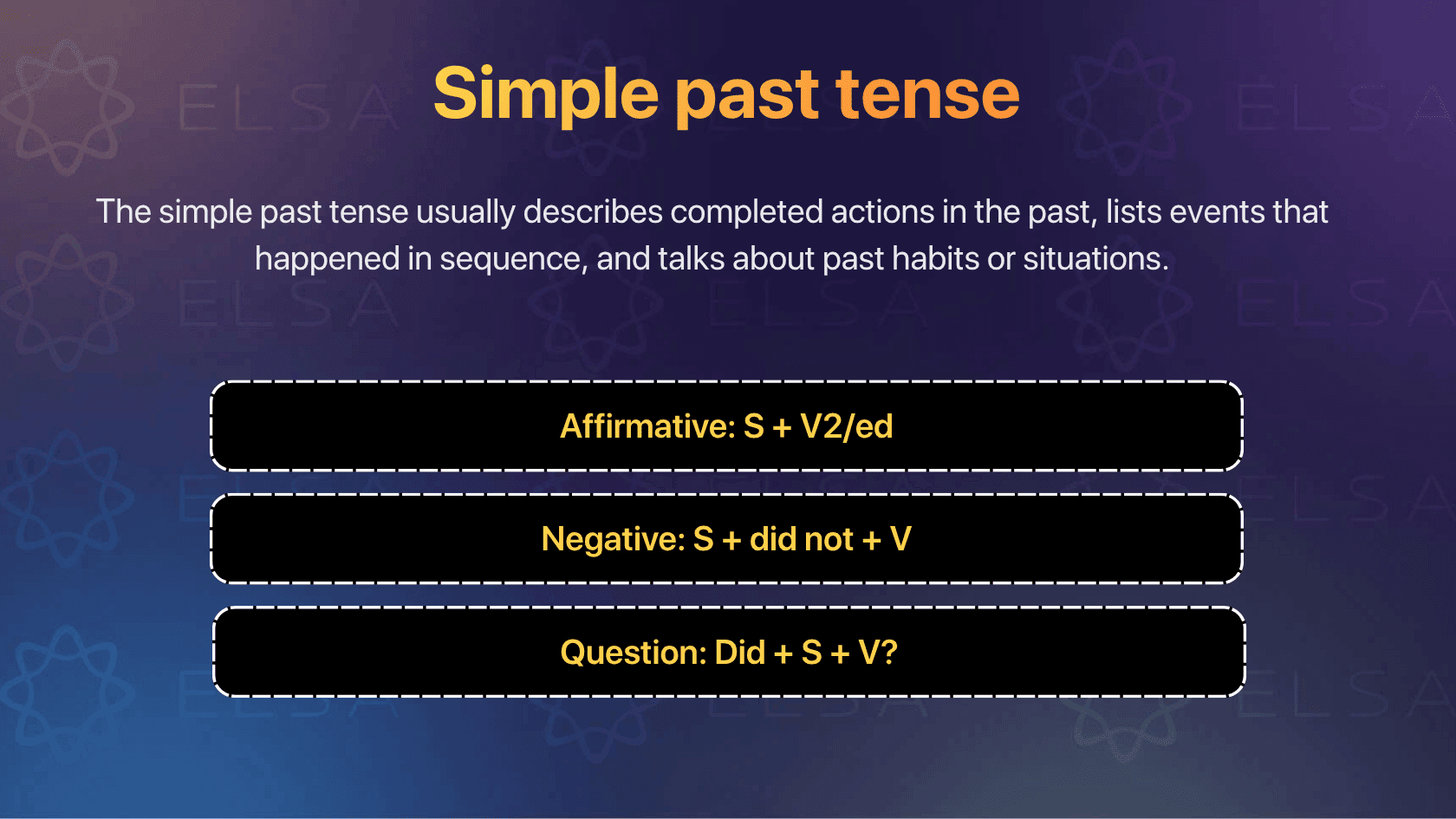
5. Simple past tense
The simple past tense usually describes completed actions in the past, lists events that happened in sequence, and talks about past habits or situations.
Formulas:
| Affirmative: S + V2/ed |
For example: They graduated in 2021.
| Negative: S + did not + V |
For example: They didn’t graduate in 2021.
| Question: Did + S + V? |
For example: Did they graduate in 2021?
6. Past continuous tense
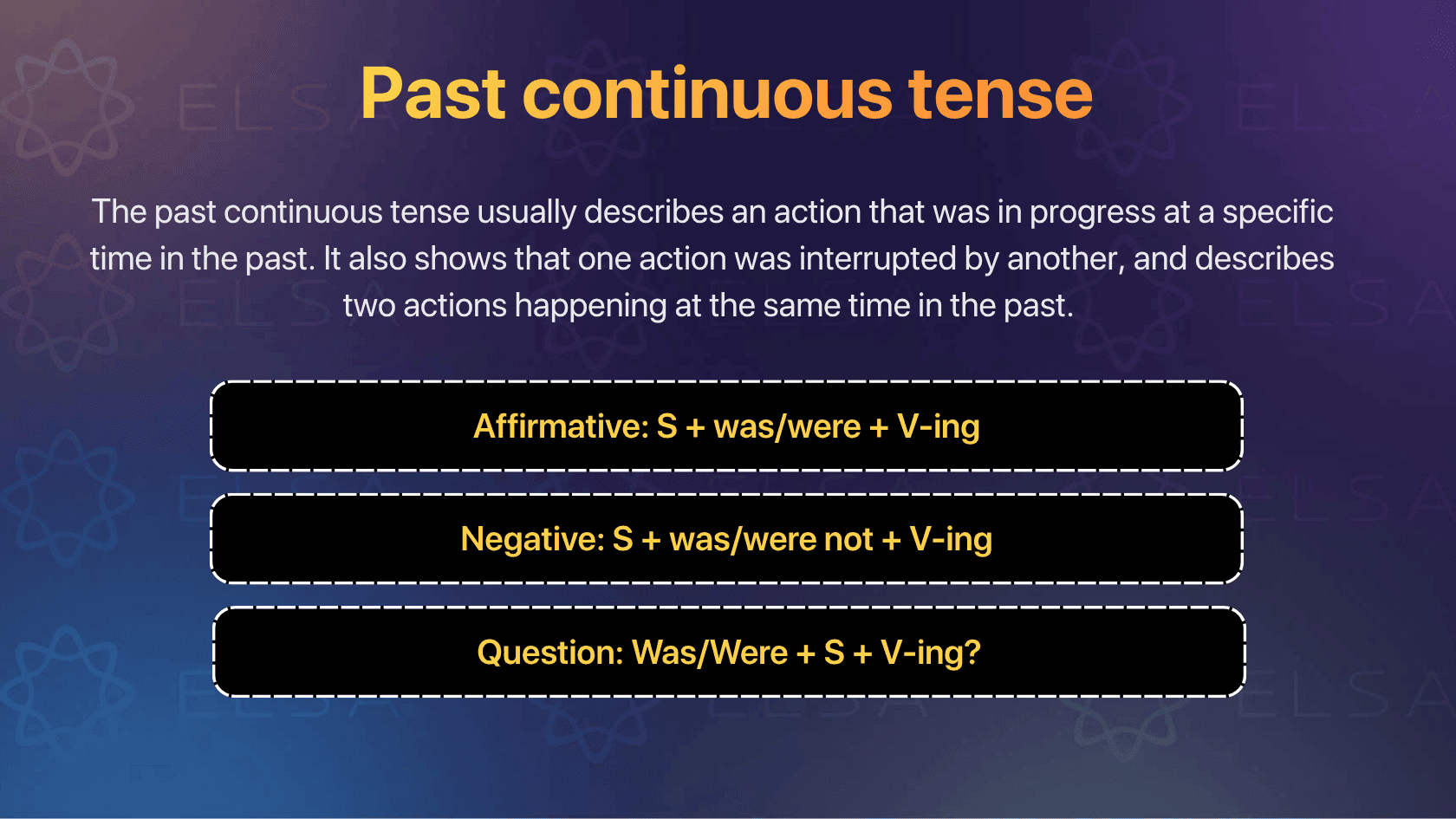
The past continuous tense usually describes an action that was in progress at a specific time in the past. It also shows that one action was interrupted by another, and describes two actions happening at the same time in the past.
Formulas:
| Affirmative: S + was/were + V-ing |
For example: I was sleeping when John arrived.
| Negative: S + was/were not + V-ing |
For example: I wasn’t sleeping when John arrived.
| Question: Was/Were + S + V-ing? |
For example: Were you sleeping when John arrived?
7. Past perfect tense
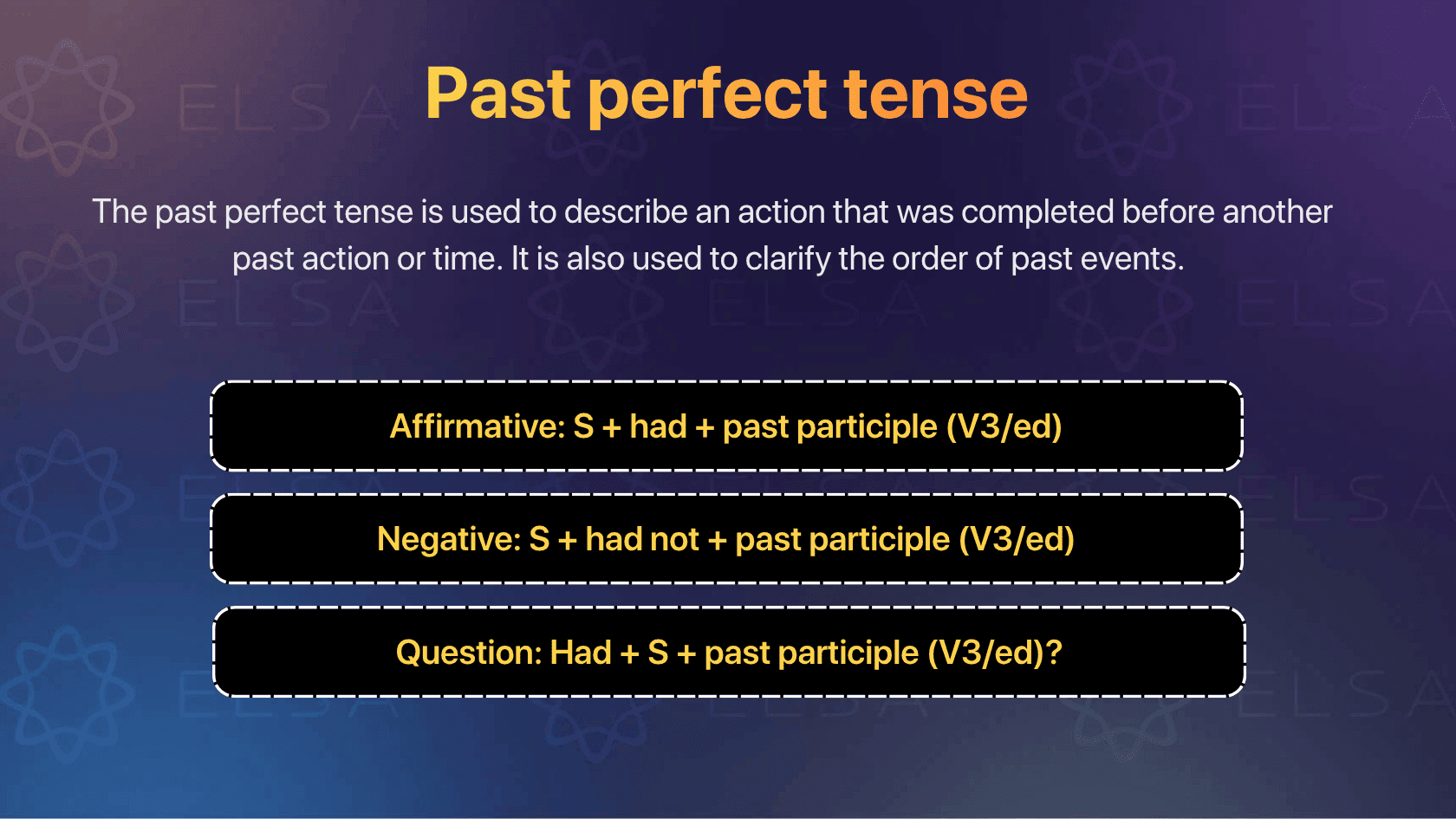
The past perfect tense is used to describe an action that was completed before another past action or time. It is also used to clarify the order of past events.
Formulas:
| Affirmative: S + had + past participle (V3/ed) |
For example: We had tried fish and chips before.
| Negative: S + had not + past participle (V3/ed) |
For example: We hadn’t tried fish and chips before.
| Question: Had + S + past participle (V3/ed)? |
For example: Had you tried fish and chips before?
8. Past perfect continuous tense
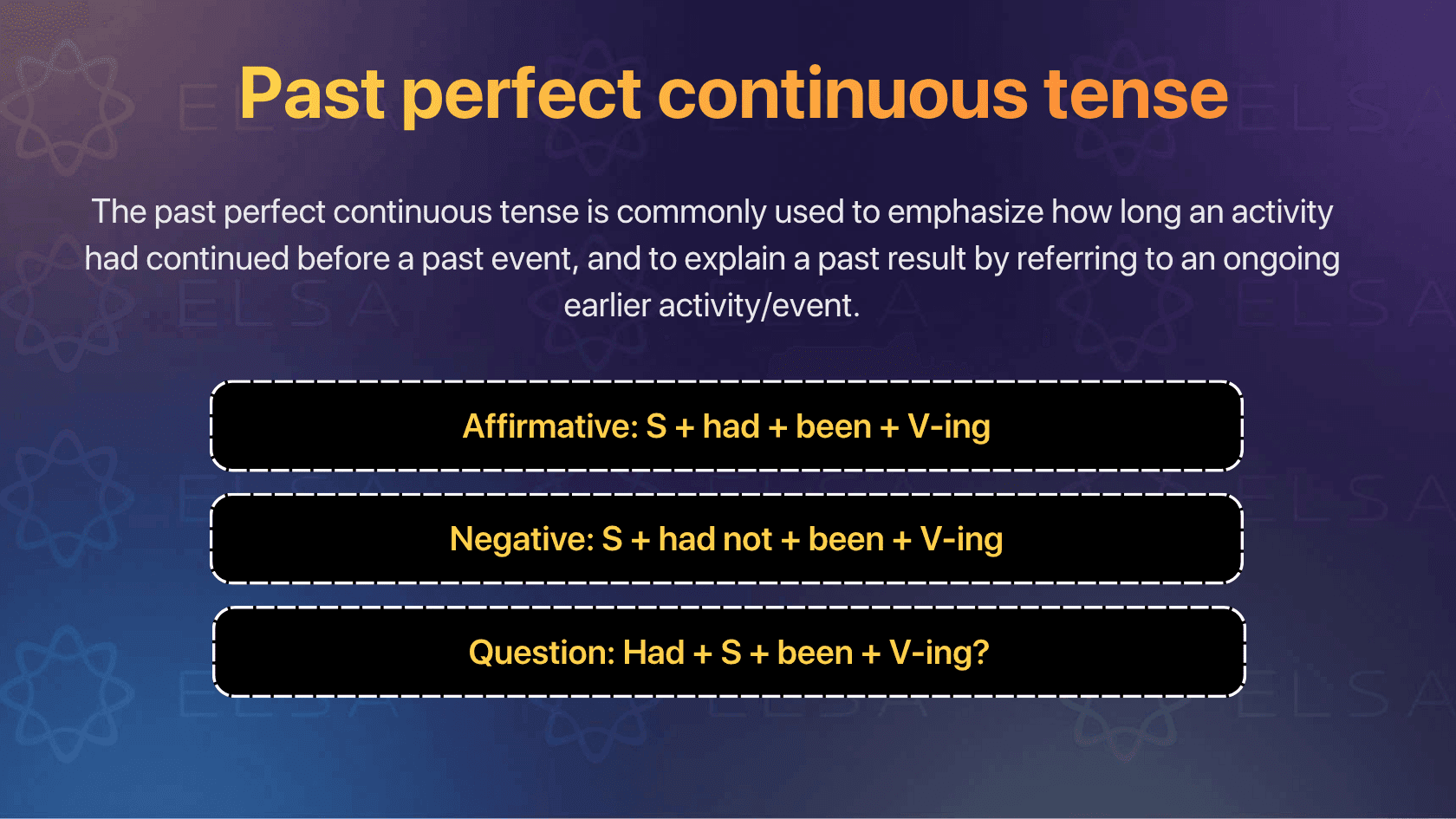
The past perfect continuous tense is commonly used to emphasize how long an activity had continued before a past event, and to explain a past result by referring to an ongoing earlier activity/event.
Formulas:
| Affirmative: S + had + been + V-ing |
For example: Mary had been studying for three hours before she took a break.
| Negative: S + had not + been + V-ing |
For example: Mary hadn’t been studying for three hours before she took a break.
| Question: Had + S + been + V-ing? |
For example: Had Mary been studying for three hours before she took a break?
Future tenses: Formulas, uses, and examples
English tenses’ future forms are usually used to describe predictions, plans, ongoing future activities, and actions expected to be completed by a future point. There are several structures used to express these future meanings, but the most commonly used are “will” and “be going to”.
9. Simple future tense
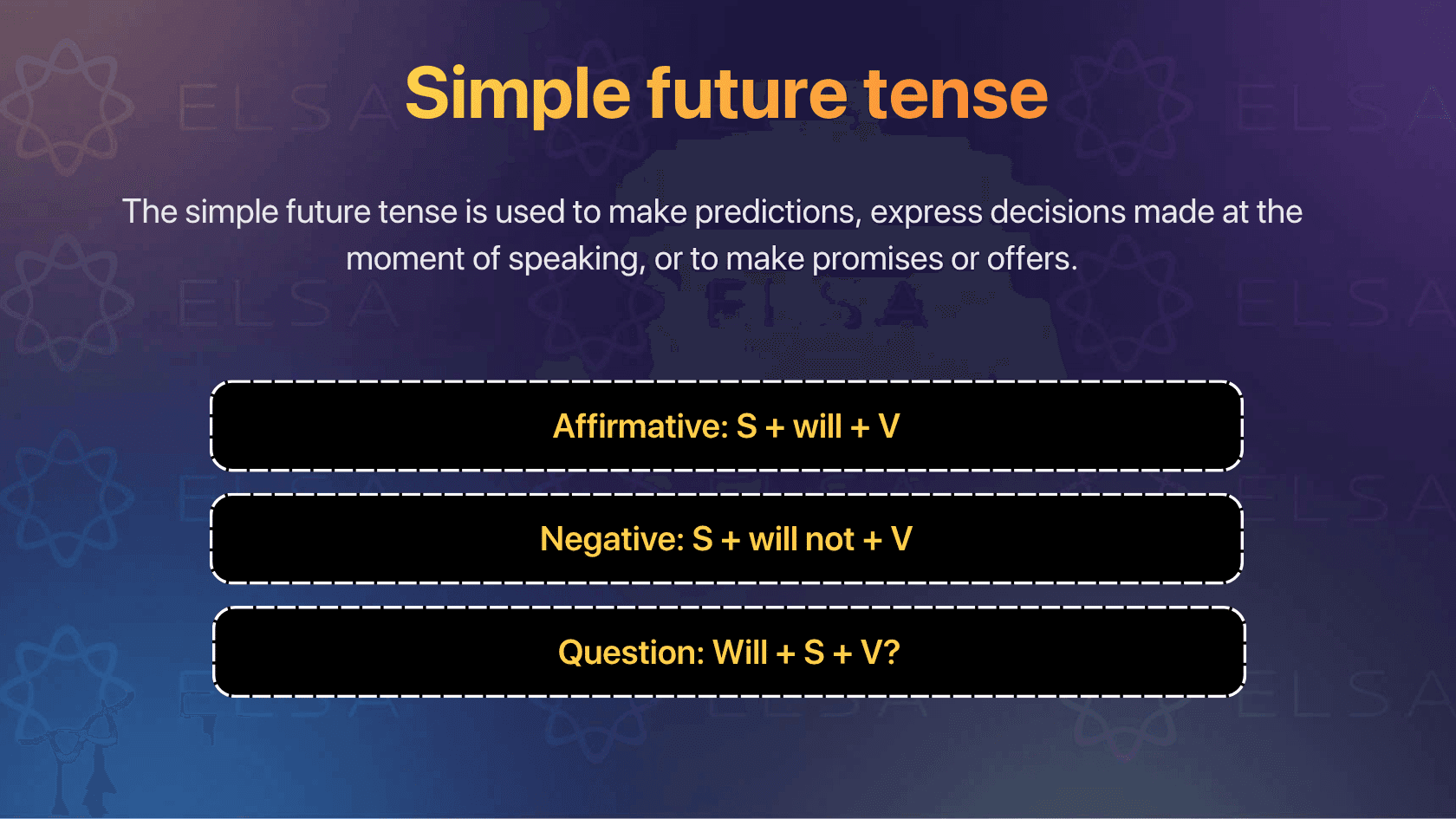
The simple future tense is used to make predictions, express decisions made at the moment of speaking, or to make promises or offers.
Formulas:
| Affirmative: S + will + V |
For example: They will call you after dinner.
| Negative: S + will not + V |
For example: They will not call you after dinner.
| Question: Will + S + V? |
For example: Will they call you after dinner?
10. Future continuous tense
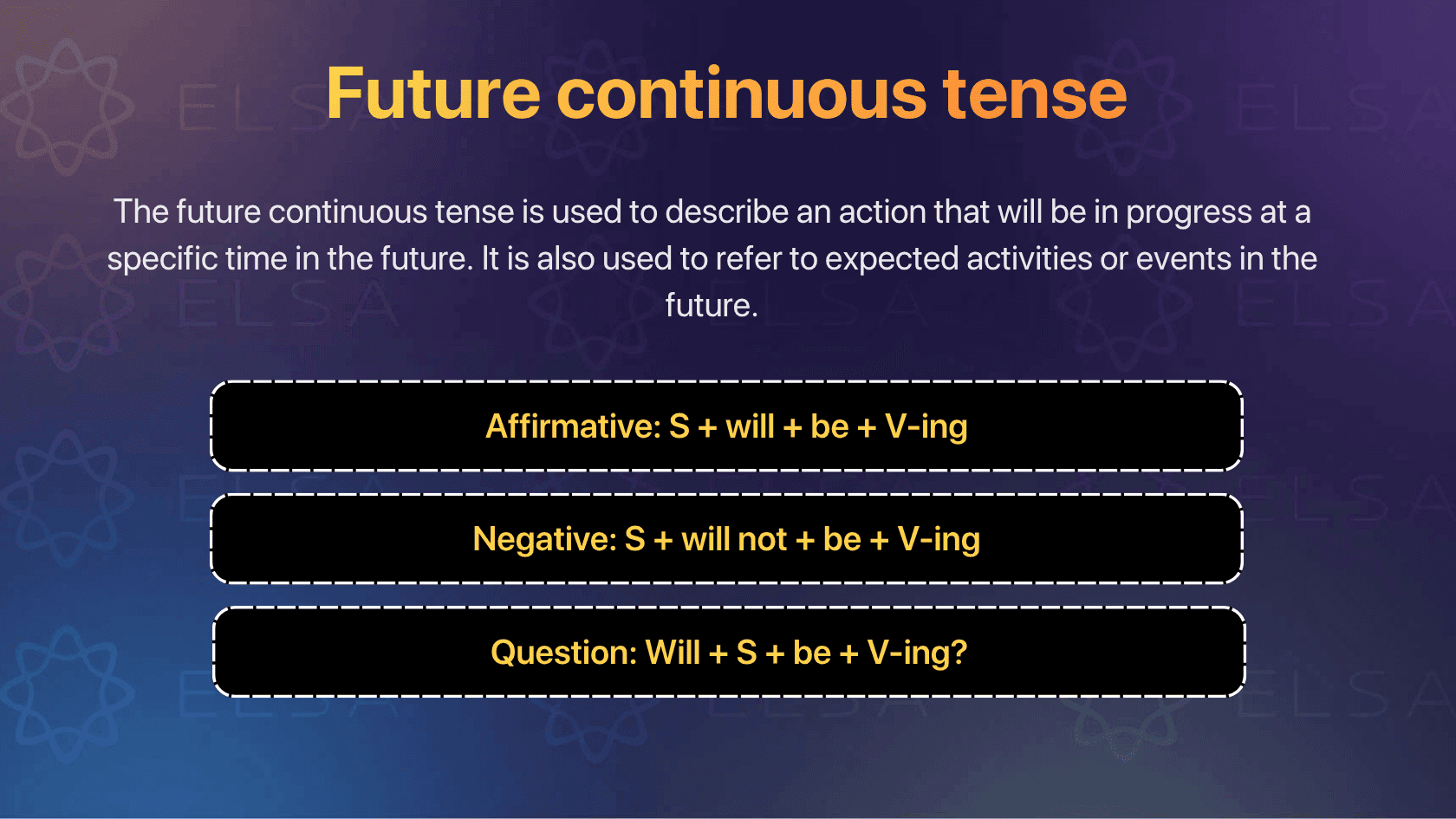
The future continuous tense is used to describe an action that will be in progress at a specific time in the future. It is also used to refer to expected activities or events in the future.
Formulas:
| Affirmative: S + will + be + V-ing |
For example: She will be staying at the hotel tonight.
| Negative: S + will not + be + V-ing |
For example: She will not be staying at the hotel tonight.
| Question: Will + S + be + V-ing? |
For example: Will she be staying at the hotel tonight?
11. Future perfect tense
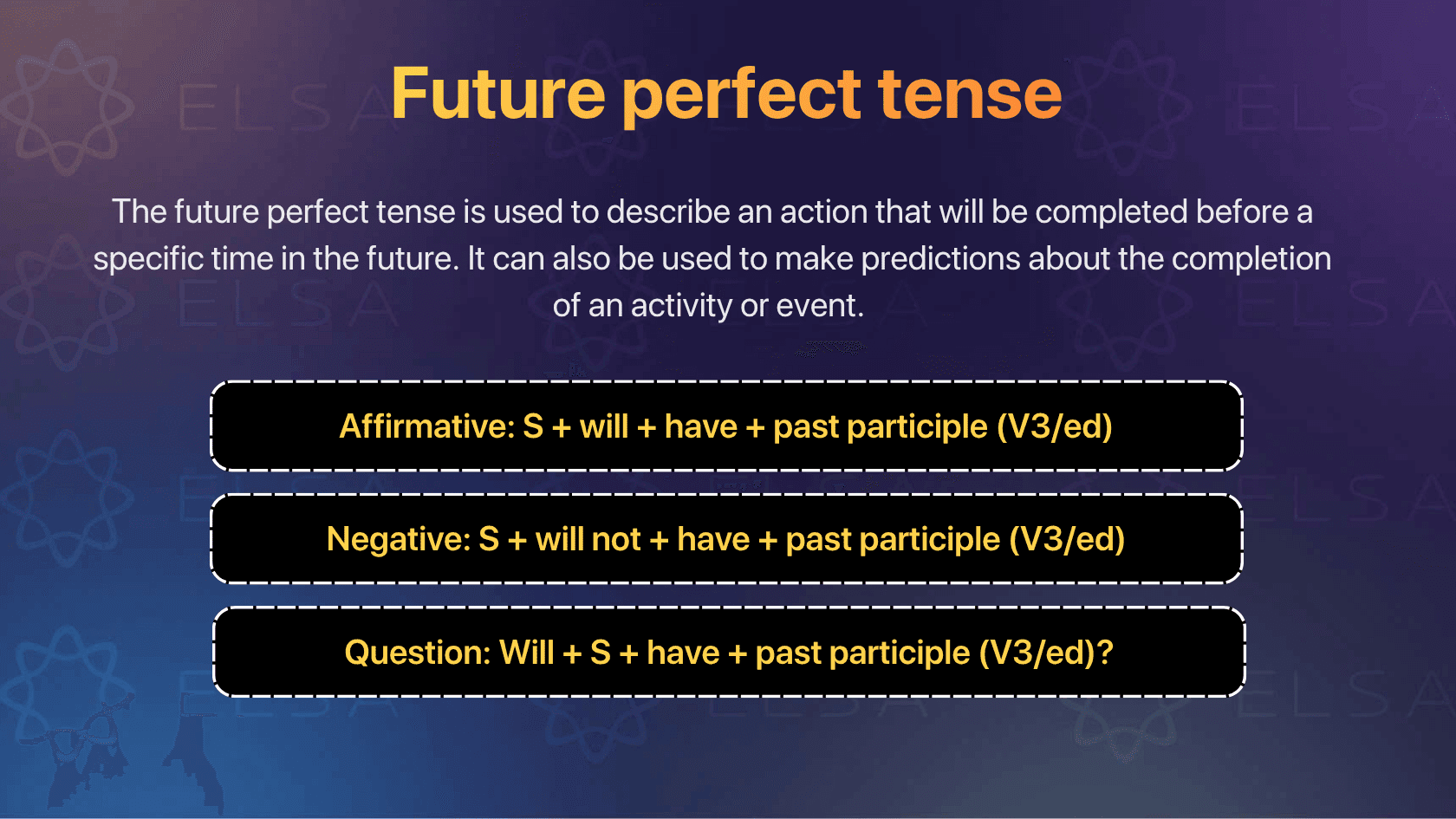
The future perfect tense is used to describe an action that will be completed before a specific time in the future. It can also be used to make predictions about the completion of an activity or event.
Formulas:
| Affirmative: S + will + have + past participle (V3/ed) |
For example: Dave will have finished the report by Wednesday.
| Negative: S + will not + have + past participle (V3/ed) |
For example: Dave will not have finished the report by Wednesday.
| Question: Will + S + have + past participle (V3/ed)? |
For example: Will Dave have finished the report by Wednesday?
12. Future perfect continuous tense
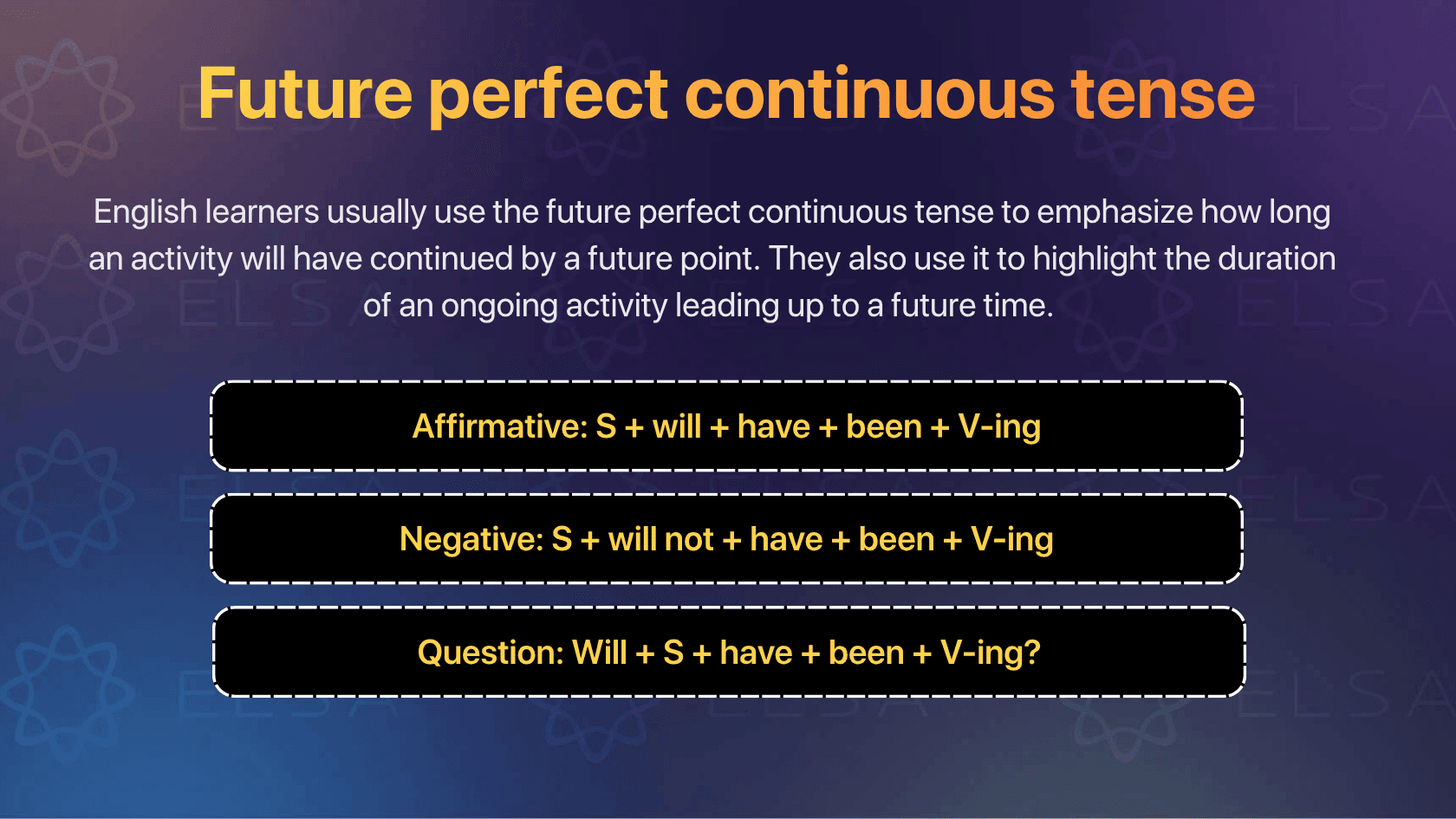
English learners usually use the future perfect continuous tense to emphasize how long an activity will have continued by a future point. They also use it to highlight the duration of an ongoing activity leading up to a future time.
Formulas:
| Affirmative: S + will + have + been + V-ing |
For example: By April, I will have been working here for three years.
| Negative: S + will not + have + been + V-ing |
For example: By April, I will not have been working here for three years.
| Question: Will + S + have + been + V-ing? |
For example: Will you have been working here for three years by April?
Common tense comparisons
By understanding how similar tense forms differ can help you select the correct form in context. You can use the tenses chart above as a quick reference when comparing meanings and examples.
Present Perfect vs. Simple Past
| Feature | Present Perfect | Simple Past |
|---|---|---|
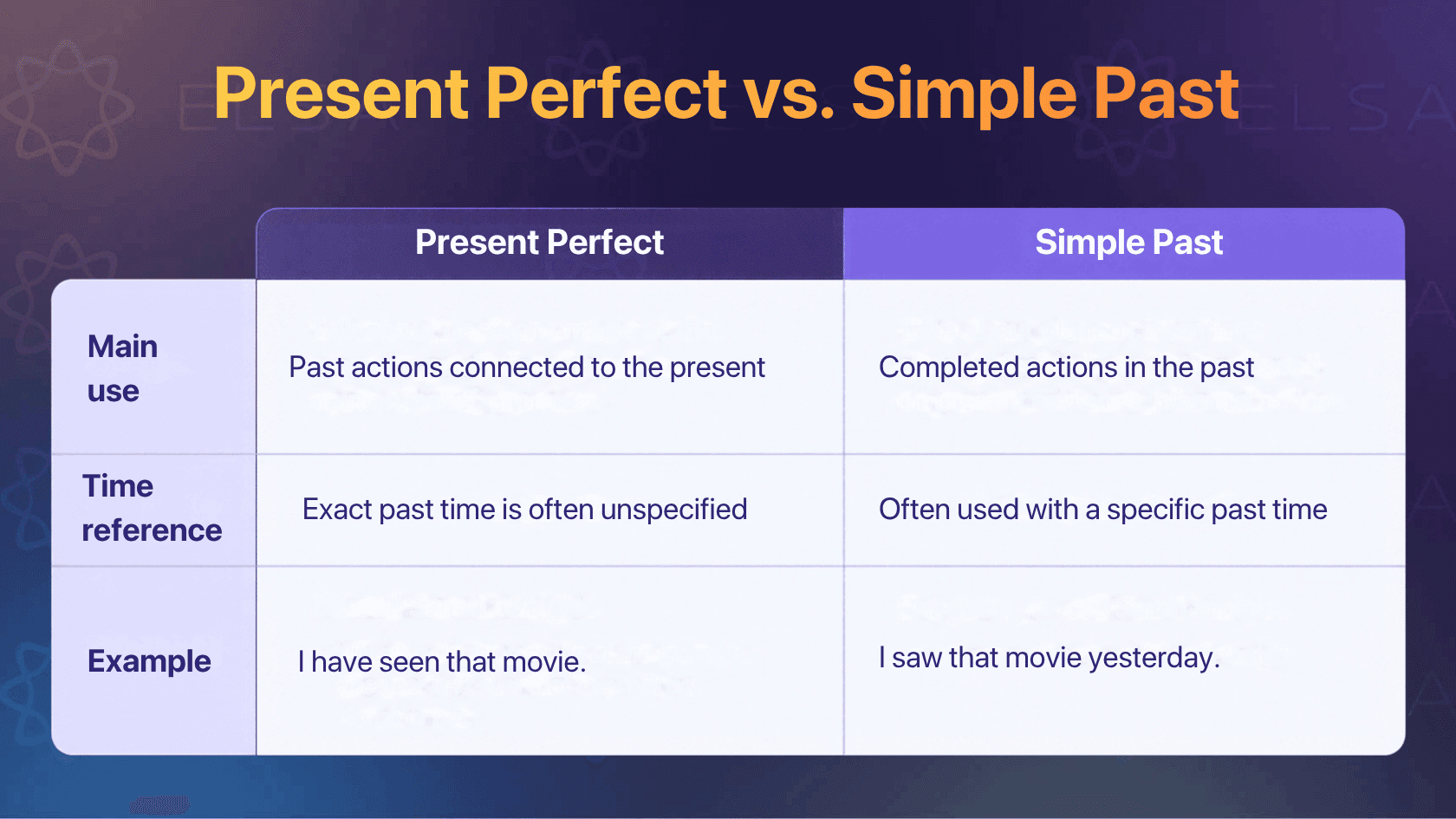
| Main use | Past actions connected to the present | Completed actions in the past |
| Time reference | Exact past time is often unspecified | Often used with a specific past time |
| Example | I have seen that movie. | I saw that movie yesterday. |
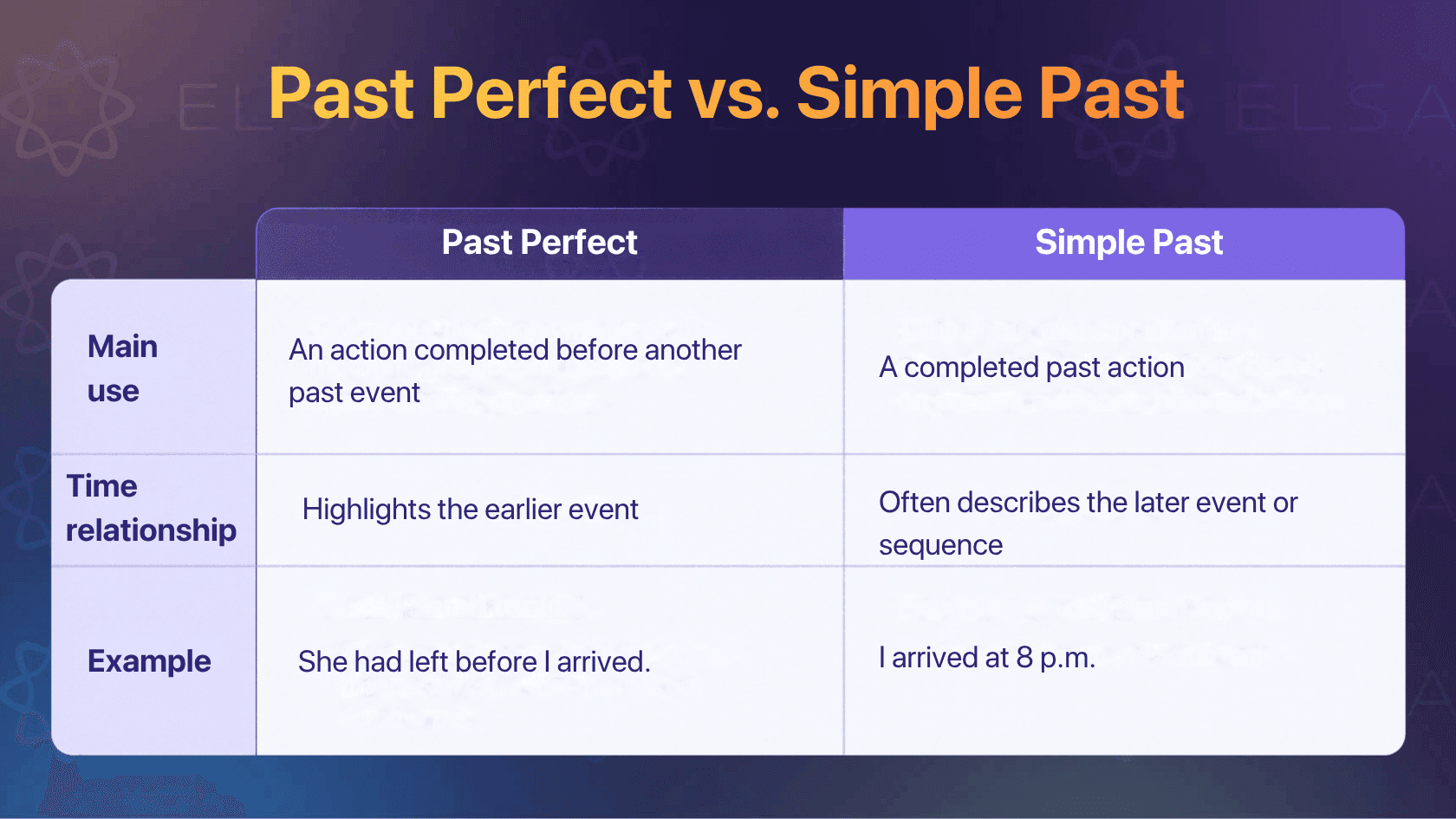
Past Perfect vs. Simple Past
| Feature | Past Perfect | Simple Past |
|---|---|---|
| Main use | An action completed before another past event | A completed past action |
| Time relationship | Highlights the earlier event | Often describes the later event or sequence |
| Example | She had left before I arrived. | I arrived at 8 p.m. |
Common irregular verbs in English
Irregular verbs do not form their past simple and past participle forms by simply adding -ed. Learning their forms is important for using different verb tenses accurately.
| Base form (V1) | Past simple (V2) | Past participle (V3) |
|---|---|---|
| Be | Was/were | Been |
| Begin | Began | Begun |
| Do | Did | Done |
| Eat | Ate | Eaten |
| Go | Went | Gone |
| Have | Had | Had |
| Make | Made | Made |
| See | Saw | Seen |
| Speak | Spoke | Spoken |
| Write | Wrote | Written |
Practice exercises: English tenses
Practice these exercises to review common verb tenses, reinforce sentence structures, and learn to recognize time expressions in context.
Exercise 1: Fill in the blanks
Complete each sentence with the correct form of the verb in parentheses.
- She usually _____ (take) the bus to work.
- They _____ (watch) a movie right now.
- I _____ (finish) my homework already.
- He _____ (study) for two hours, and he is still studying.
- We _____ (visit) our grandparents last weekend.
- At 9 p.m. yesterday, I _____ (read) a book.
- The train _____ (leave) before we reached the station.
- She _____ (work) for three hours before she took a break.
- I think they _____ (arrive) tomorrow.
- By next month, he _____ (work) here for five years.
Answer key and explanations:
Exercise 2: Choose the correct answer
1. She _____ English every evening.
A. studies
B. is studying
C. studied
D. has studied
2. They _____ dinner when I called.
A. have
B. were having
C. had
D. will have
3. I _____ that book three times.
A. read
B. am reading
C. have read
D. had read
4. By the time we arrived, the show _____.
A. starts
B. has started
C. had started
D. will start
5. At this time tomorrow, we _____ to Japan.
A. fly
B. flew
C. will be flying
D. have flown
6. By Friday, she _____ the assignment.
A. completes
B. completed
C. will have completed
D. is completing
7. He was tired because he _____ all day.
A. works
B. has worked
C. had been working
D. will work
8. Look at those dark clouds! It _____.
A. rains
B. is going to rain
C. rained
D. has rained
9. We _____ here since 2020.
A. live
B. lived
C. have lived
D. had lived
10. By 10 a.m., I _____ for three hours.
A. will study
B. will be studying
C. will have studied
D. will have been studying
Answer key and explanations:
FAQs about English tenses
How many tenses are there in English: 12 or 2?
English has two main morphological tenses: present and past. However, English-learning materials commonly teach 12 tenses in English by combining three time references: present, past, and future; with four aspects: simple, continuous, perfect, and perfect continuous.
What is the easiest way to learn English tenses?
Start by understanding when each tense is used, then learn its formula and practice with example sentences. Pay attention to time expressions such as every day, yesterday, since, for, and by the time. Regular practice can help you recognize patterns and choose the appropriate tense.
Do I need to memorize all 12 tenses?
You should learn the basic formulas and uses, but memorization alone is not enough. Practice creating sentences about your routines, past experiences, current activities, and future plans to understand how each tense works in context.
Understanding the 12 common English tenses helps you describe daily routines, past experiences, ongoing activities, and future plans more accurately. Review their formulas and examples, then practice using each tense in your own sentences. For more tips and exercises, explore the Grammar category on the ELSA Speak blog and keep building your English skills.