

Pronouns in English: A complete guide to all 9 types with examples
elsaspeakadmin
August 7, 2026
English clauses
Pronouns are one of the most essential parts of English grammar because they help make your sentences clearer, smoother, and less repetitive. In this guide, you’ll learn the different types of pronouns, their rules, common mistakes, and pronouns examples to help you use them with confidence.
| Key Takeaways |
Pronouns meaning: A pronoun is a word that replaces a noun or noun phrase in a sentence. Types of pronouns:
|
What are pronouns?
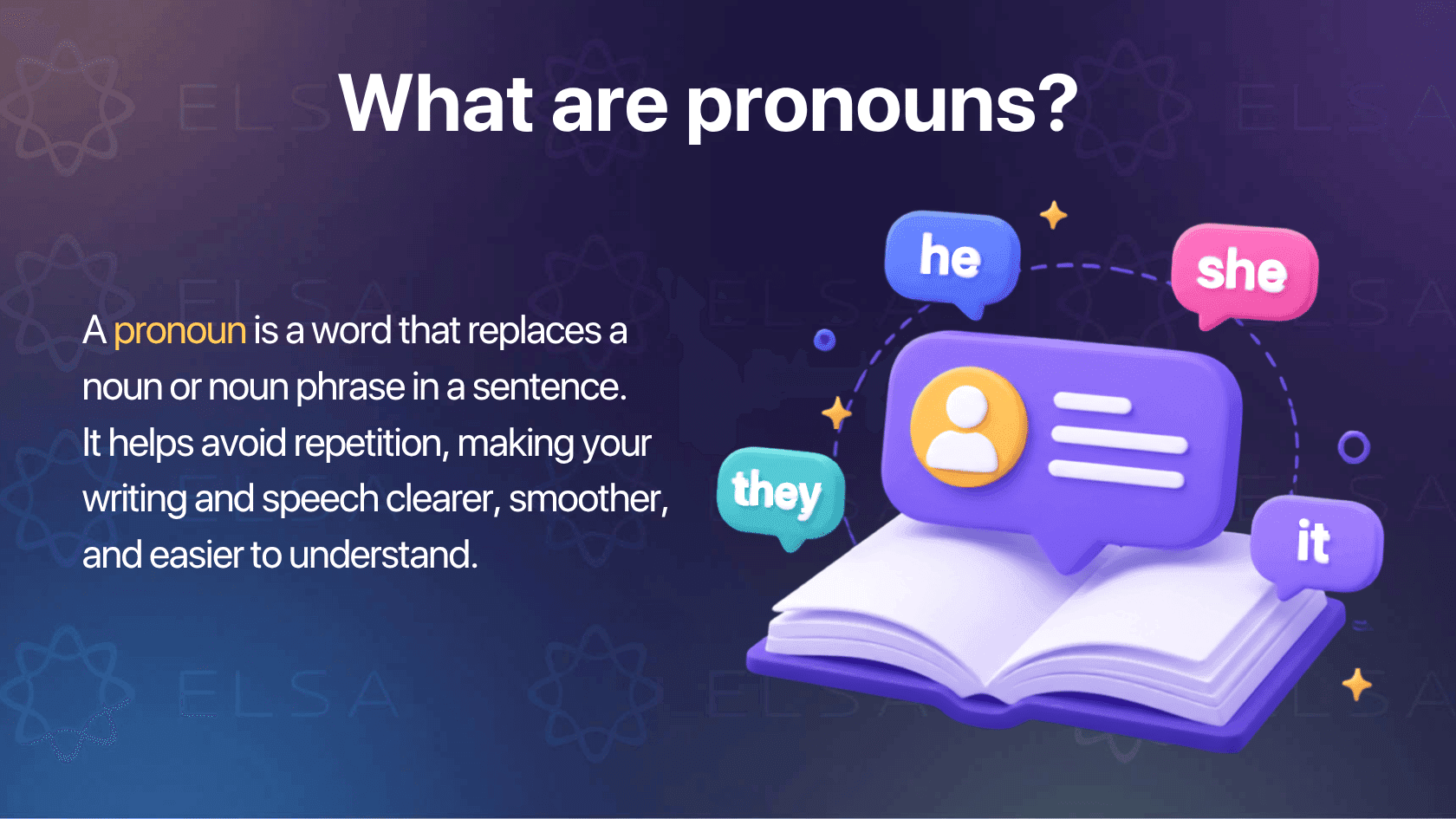
A pronoun is a word that replaces a noun or noun phrase in a sentence. It helps avoid repetition, making your writing and speech clearer, smoother, and easier to understand.
What is an antecedent?
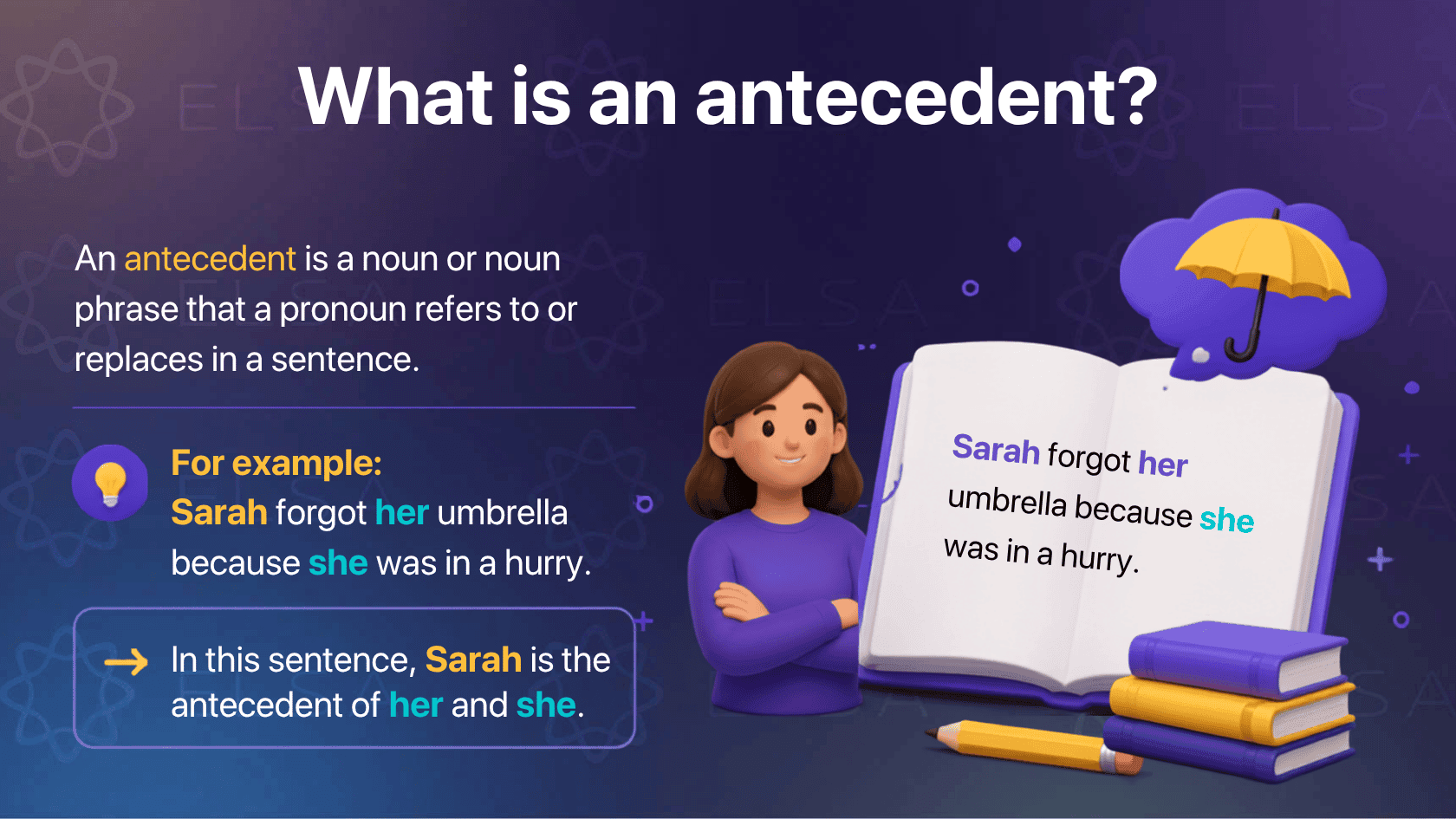
An antecedent is a noun or noun phrase that a pronoun refers to or replaces in a sentence. In other words, the antecedent tells us who or what the pronoun is talking about.
For example: Sarah forgot her umbrella because she was in a hurry.
→ In this sentence, Sarah is the antecedent of her and she.
A pronoun should generally agree with its antecedent in number and, when relevant, gender. Use the following guide:
| Antecedent | Pronoun |
| Singular, male | He, him, his |
| Singular, female | She, her, hers |
| Singular, thing | It, its |
| Plural | They, them, their |
9+ types of pronouns in English
Personal pronouns
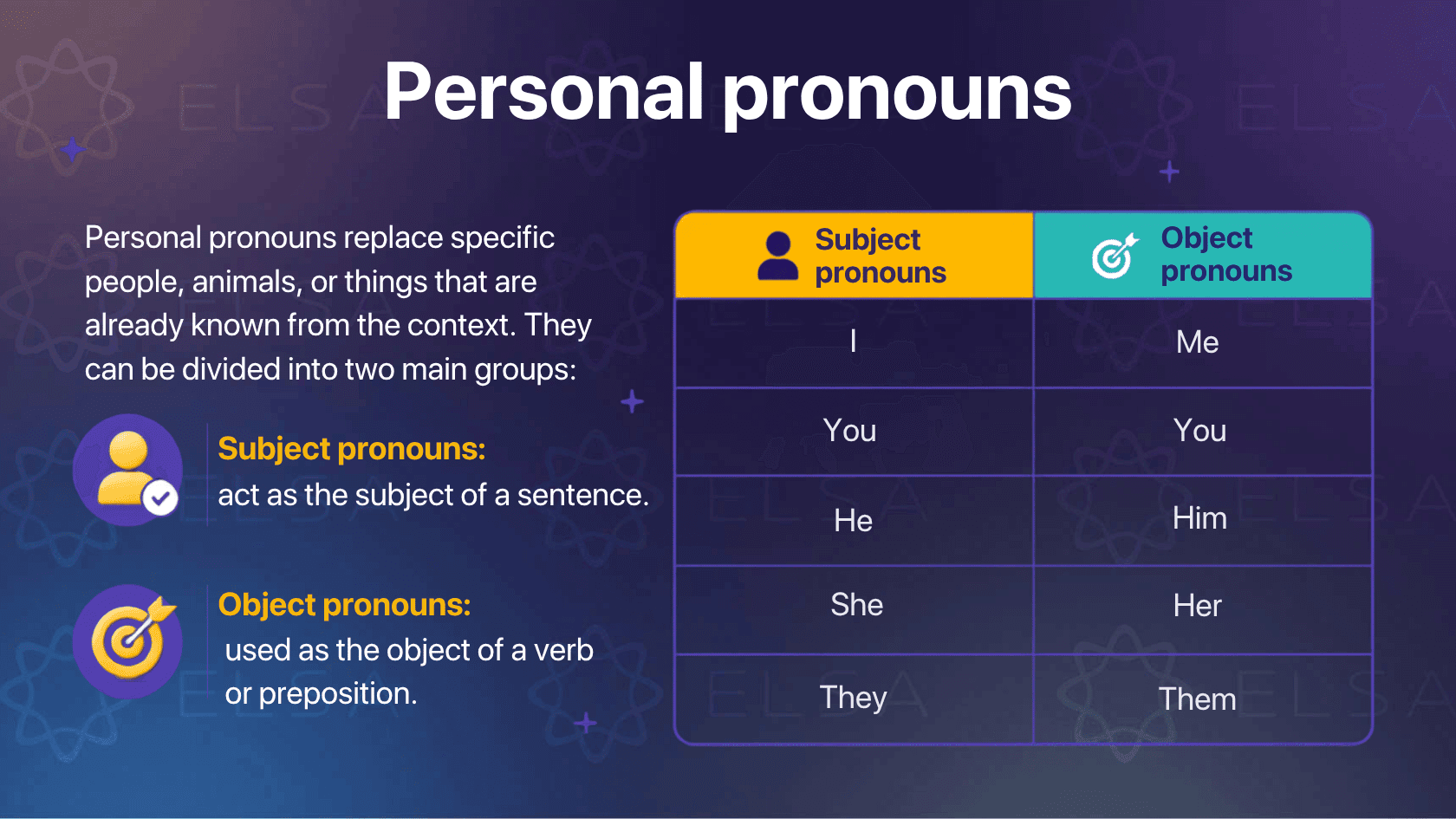
Personal pronouns replace specific people, animals, or things that are already known from the context. They can be divided into two main groups:
- Subject pronouns: act as the subject of a sentence.
- Object pronouns: used as the object of a verb or preposition.
Here is a list of pronouns:
| Subject pronoun | Object pronoun | Example |
| I | Me | I called her, and she called me back. |
| You | You | You helped me, so I thanked you. |
| He | Him | Someone invited him to the party. |
| She | Her | She called me at midnight. |
| It | It | I found the book and put it on the shelf. |
| We | Us | They welcomed us warmly. |
| They | Them | We joined them for the picnic. |
Relative pronouns
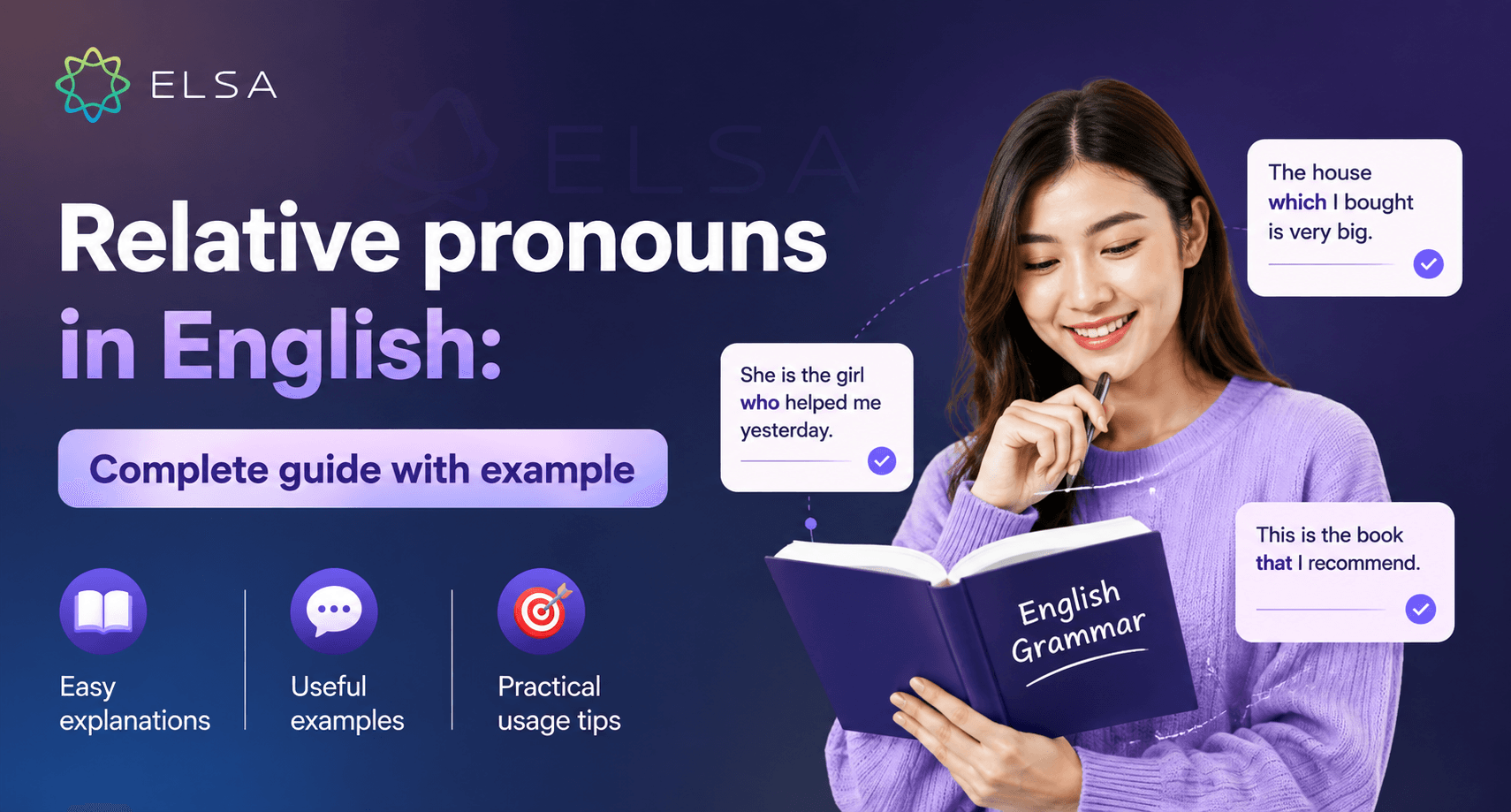
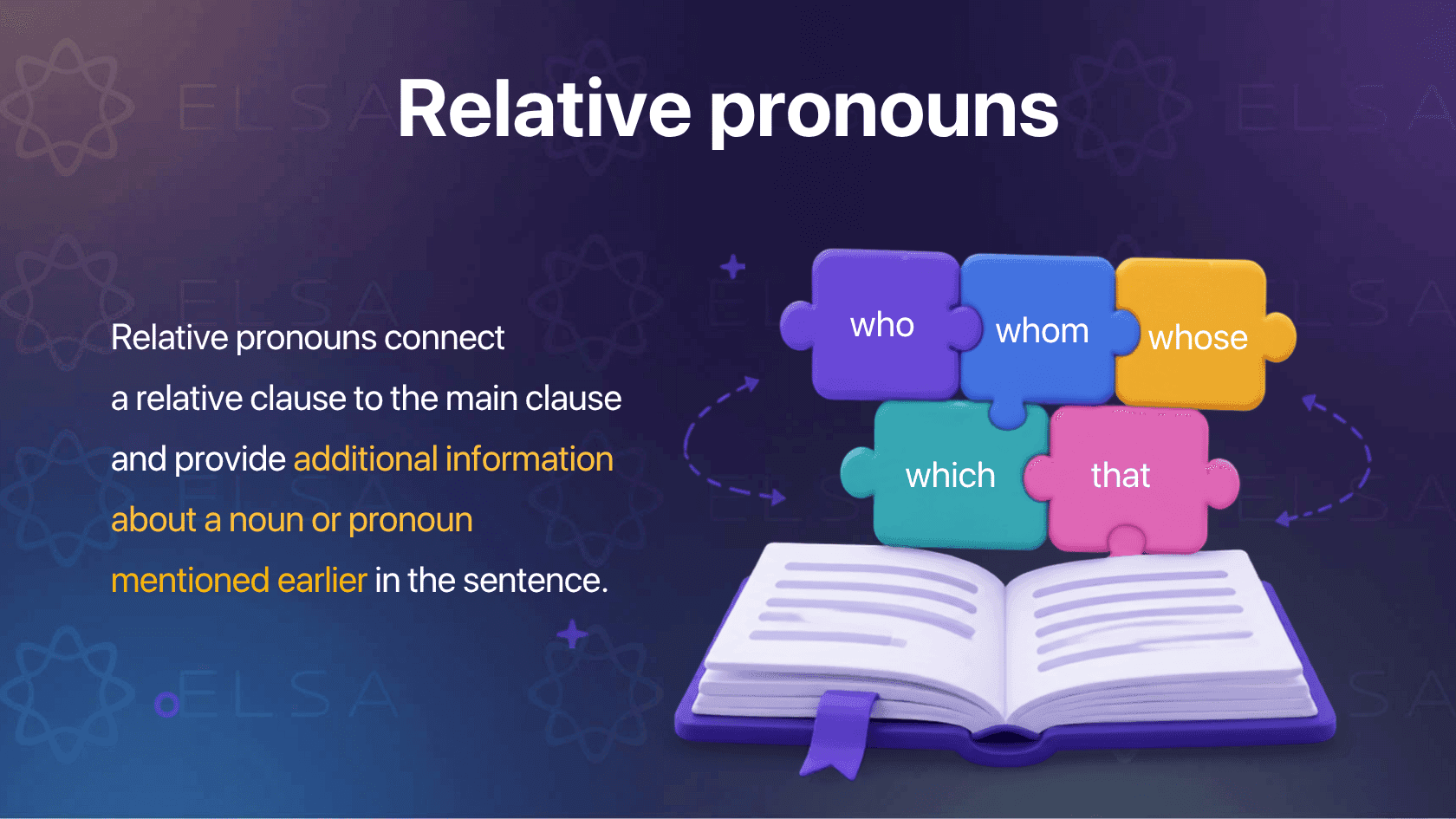
Relative pronouns connect a relative clause to the main clause and provide additional information about a noun or pronoun mentioned earlier in the sentence.
| Relative pronoun | Use for | Example |
| Who | People (subject) | The woman who lives next door is my teacher. |
| Whom | People (object) | The people whom I contacted arrived quickly. |
| Whose | Possession | I know a girl whose father is a famous actor. |
| Which | Things or animals | The book which is on the shelf belongs to me |
| That | People or things | The movie that we watched was scary. |
Demonstrative pronouns
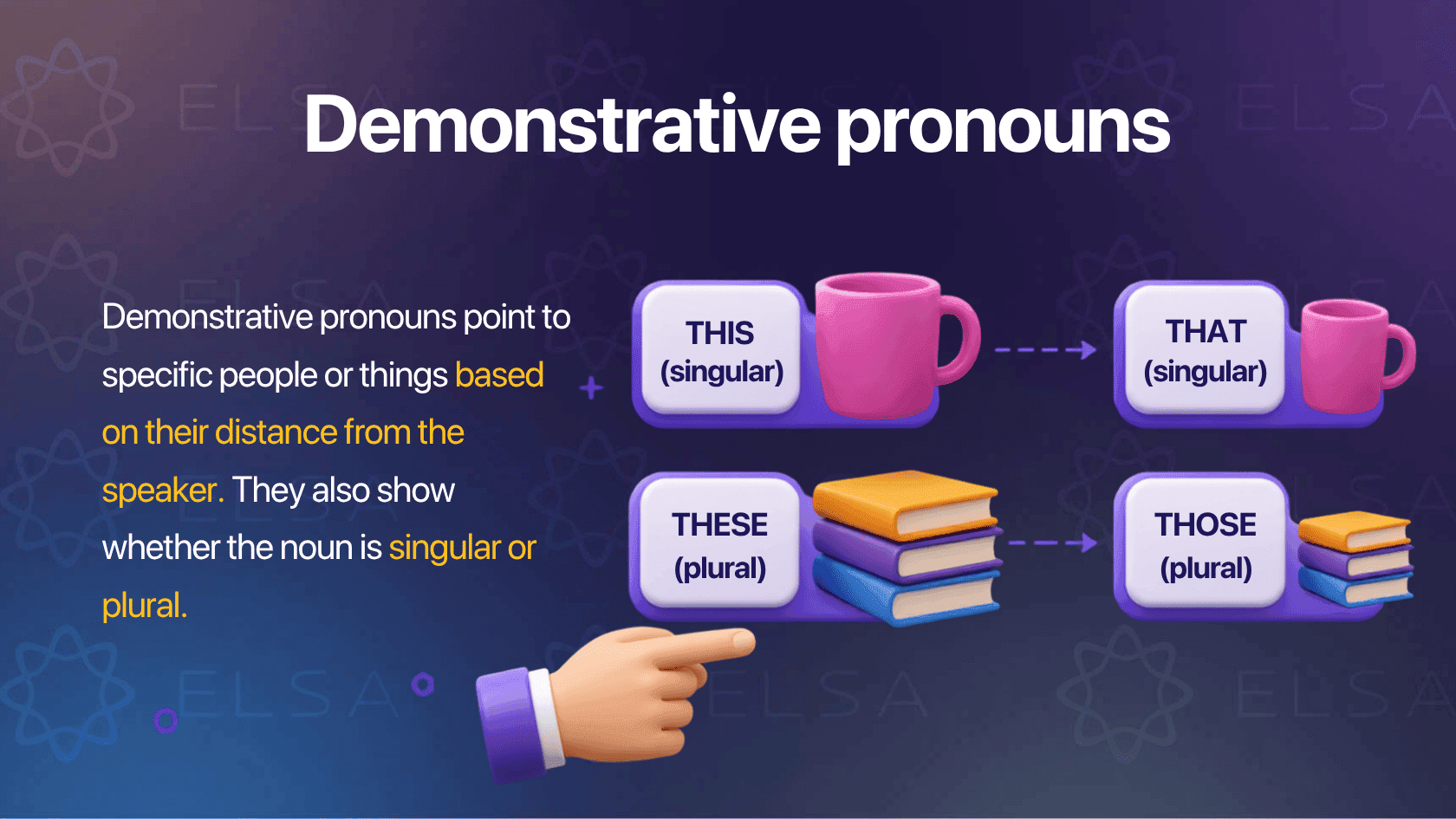
Demonstrative pronouns point to specific people or things based on their distance from the speaker. They also show whether the noun is singular or plural.
| Distance (near) | Distance (far) | Example |
| This | That | This is my favorite bag, but that is yours. |
| These | Those | These are my books, and those are yours. |
Indefinite pronouns
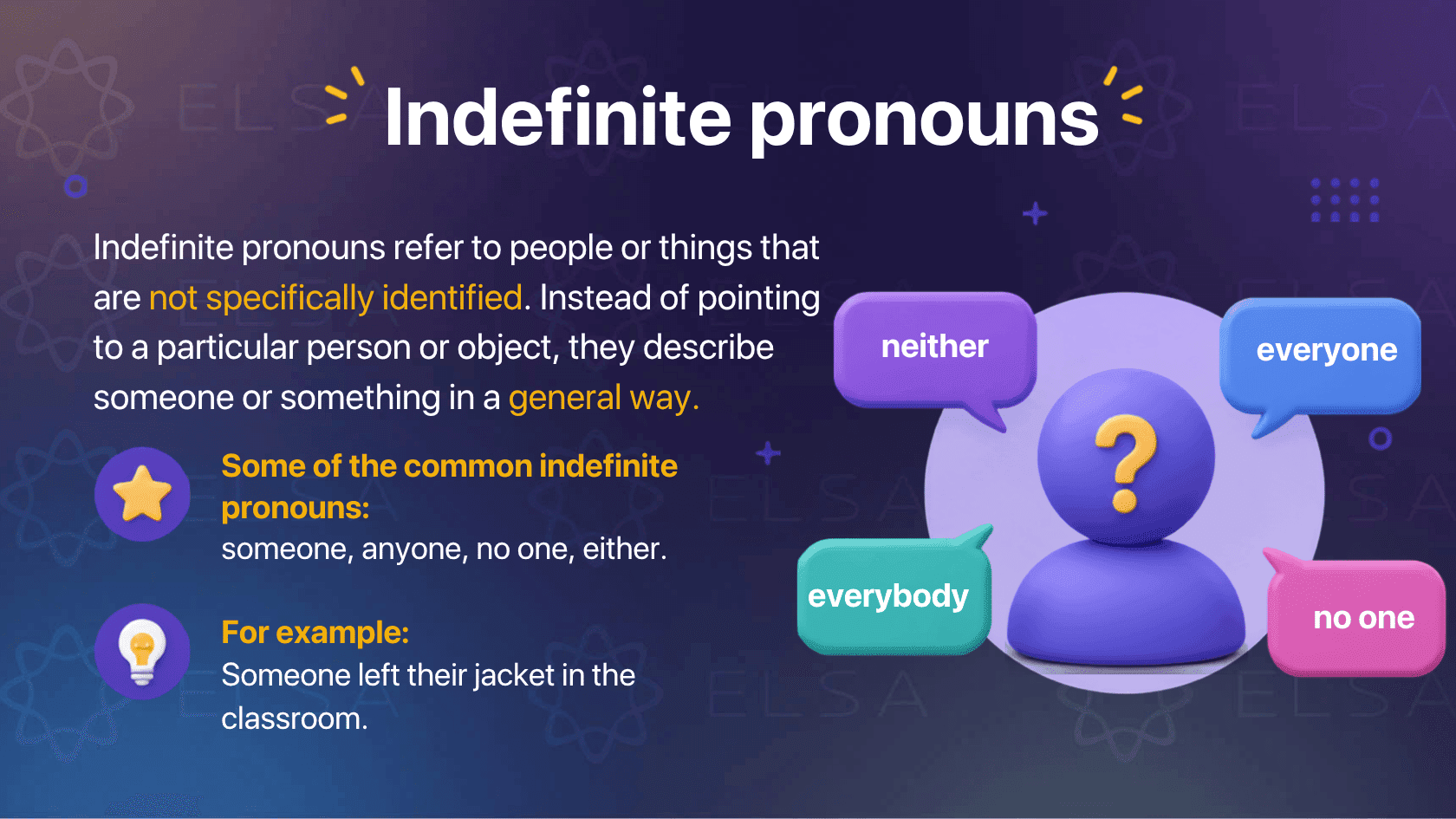
Indefinite pronouns refer to people or things that are not specifically identified. Instead of pointing to a particular person or object, they describe someone or something in a general way.
Some of the common indefinite pronouns: someone, anyone, no one, either.
For example: Someone left their jacket in the classroom.
Reflexive pronouns
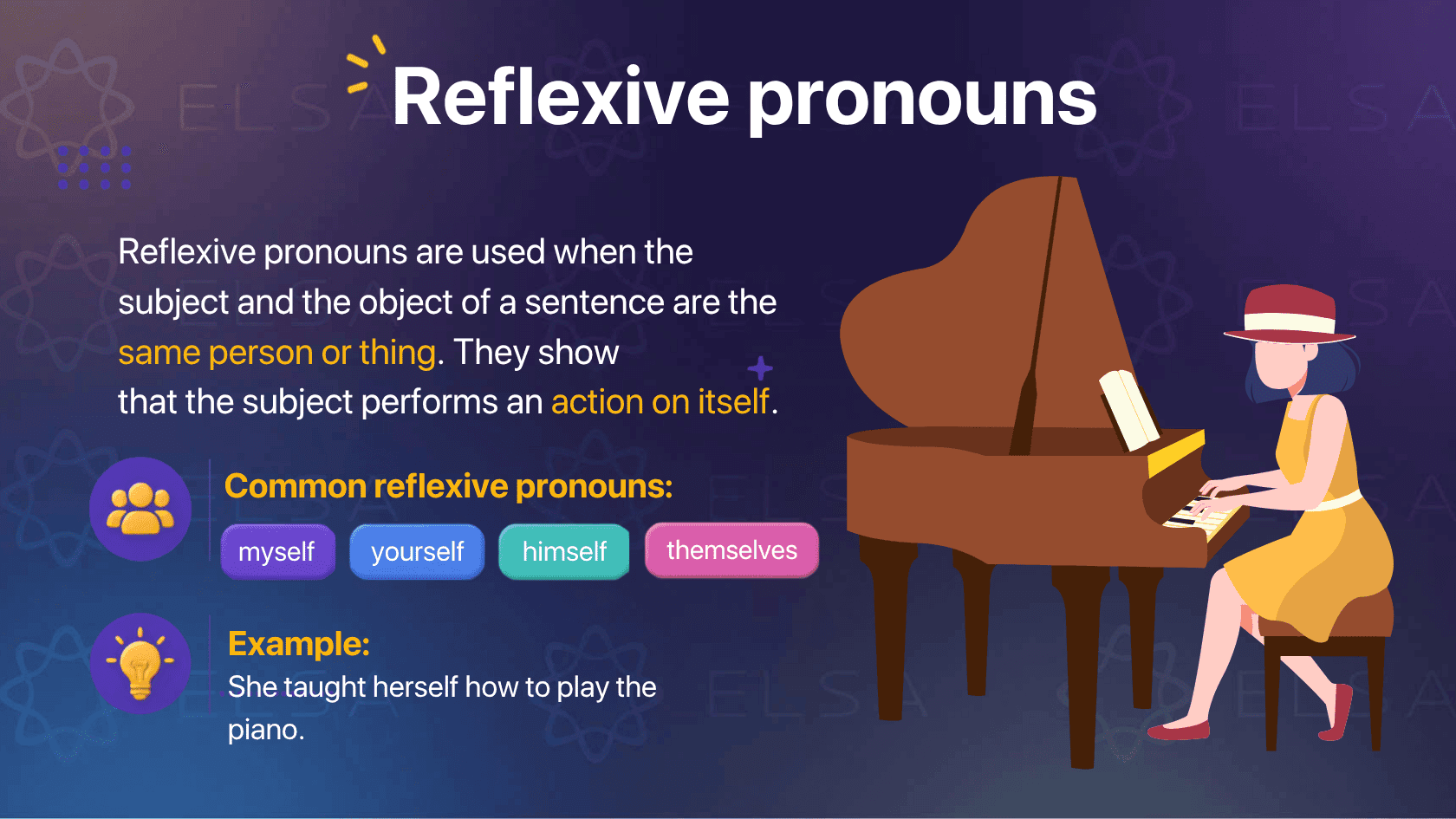
Reflexive pronouns are used when the subject and the object of a sentence are the same person or thing. They show that the subject performs an action on itself.
Common reflexive pronouns: myself, yourself, himself, themselves
Example: She taught herself how to play the piano.
Intensive pronouns
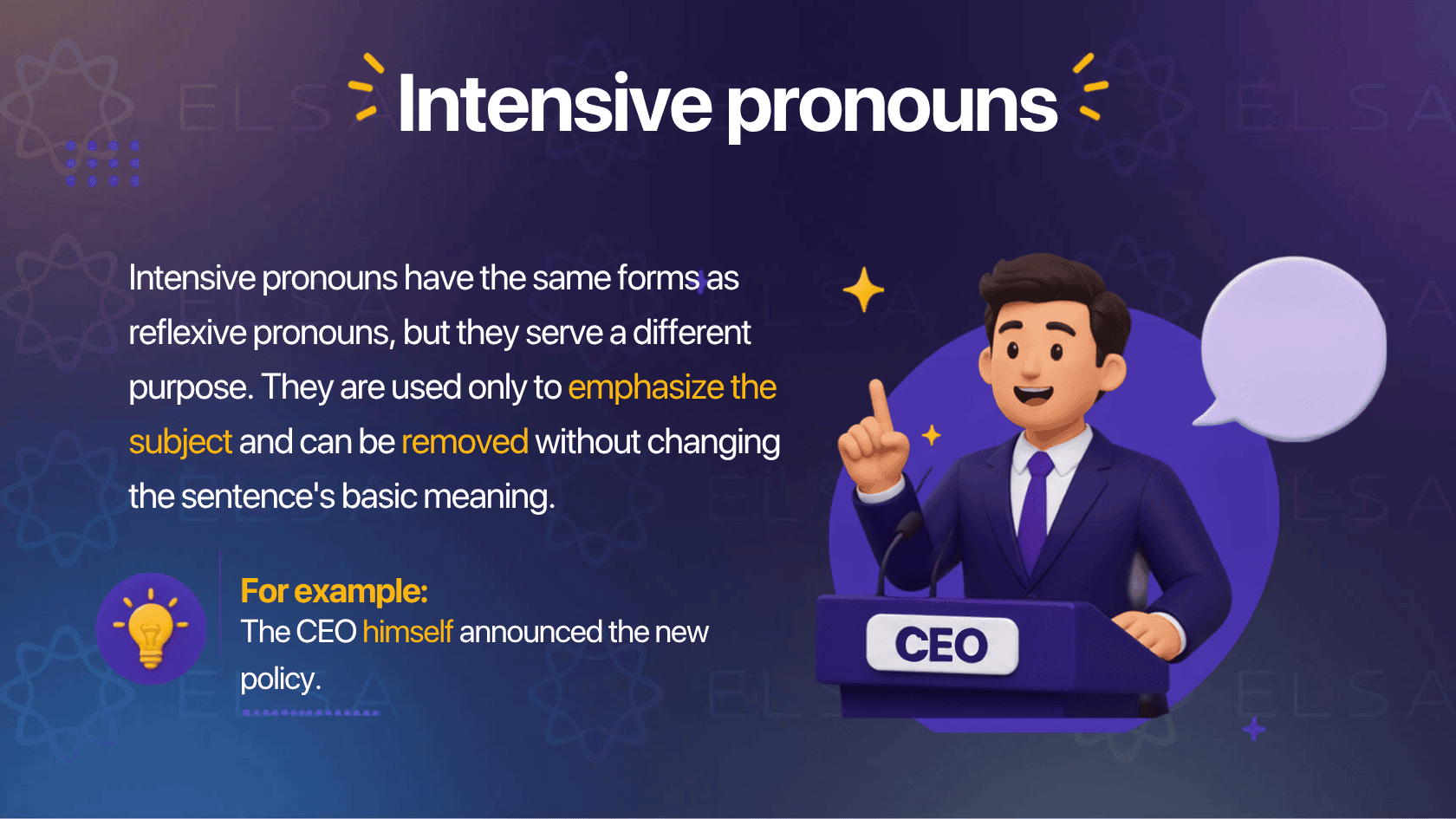
Intensive pronouns have the same forms as reflexive pronouns, but they serve a different purpose. They are used only to emphasize the subject and can be removed without changing the sentence's basic meaning.
For example: The CEO himself announced the new policy.
Possessive pronouns
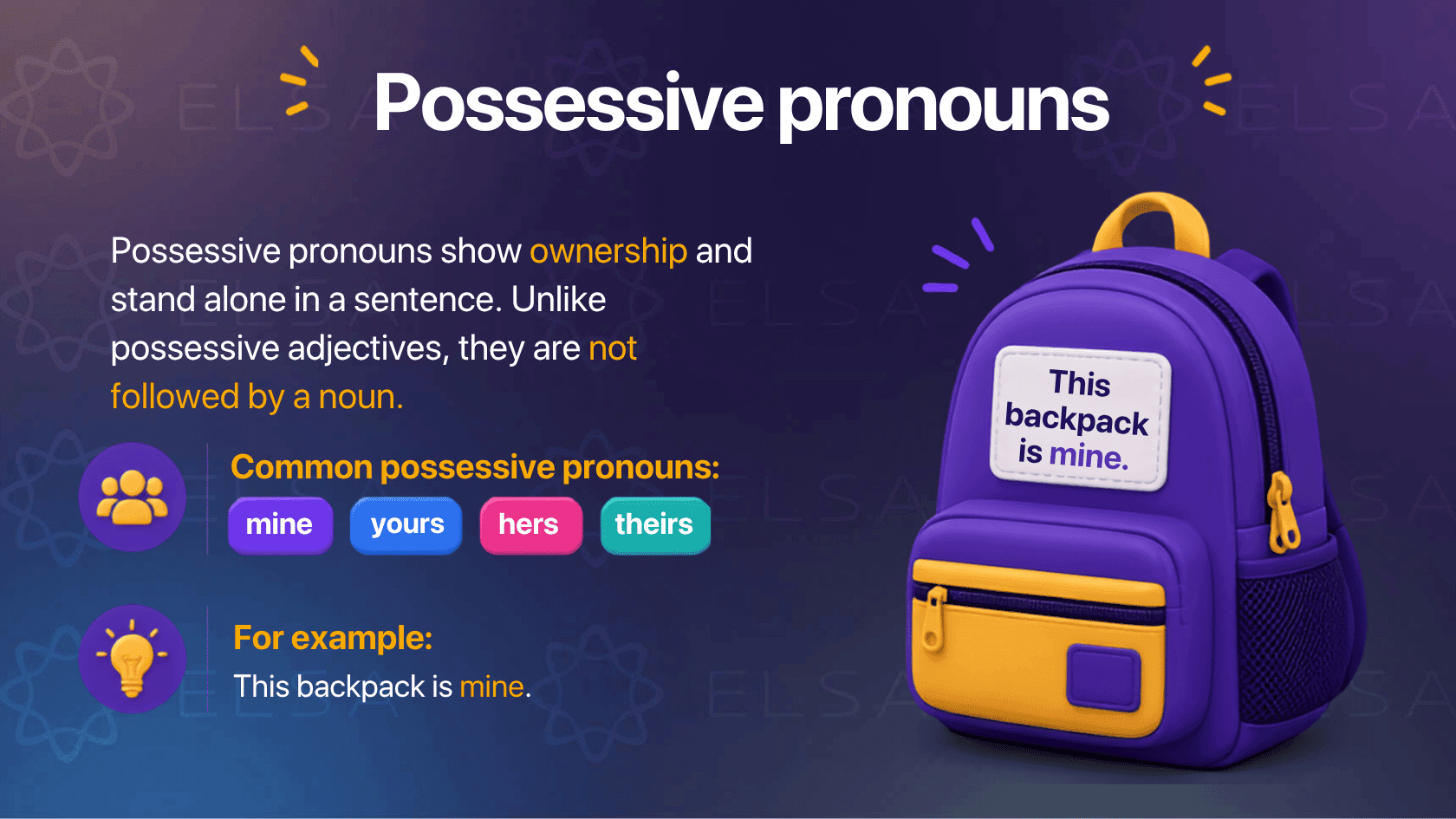
Possessive pronouns show ownership and stand alone in a sentence. Unlike possessive adjectives, they are not followed by a noun.
Common possessive pronouns: mine, yours, hers, theirs
For example: This backpack is mine.
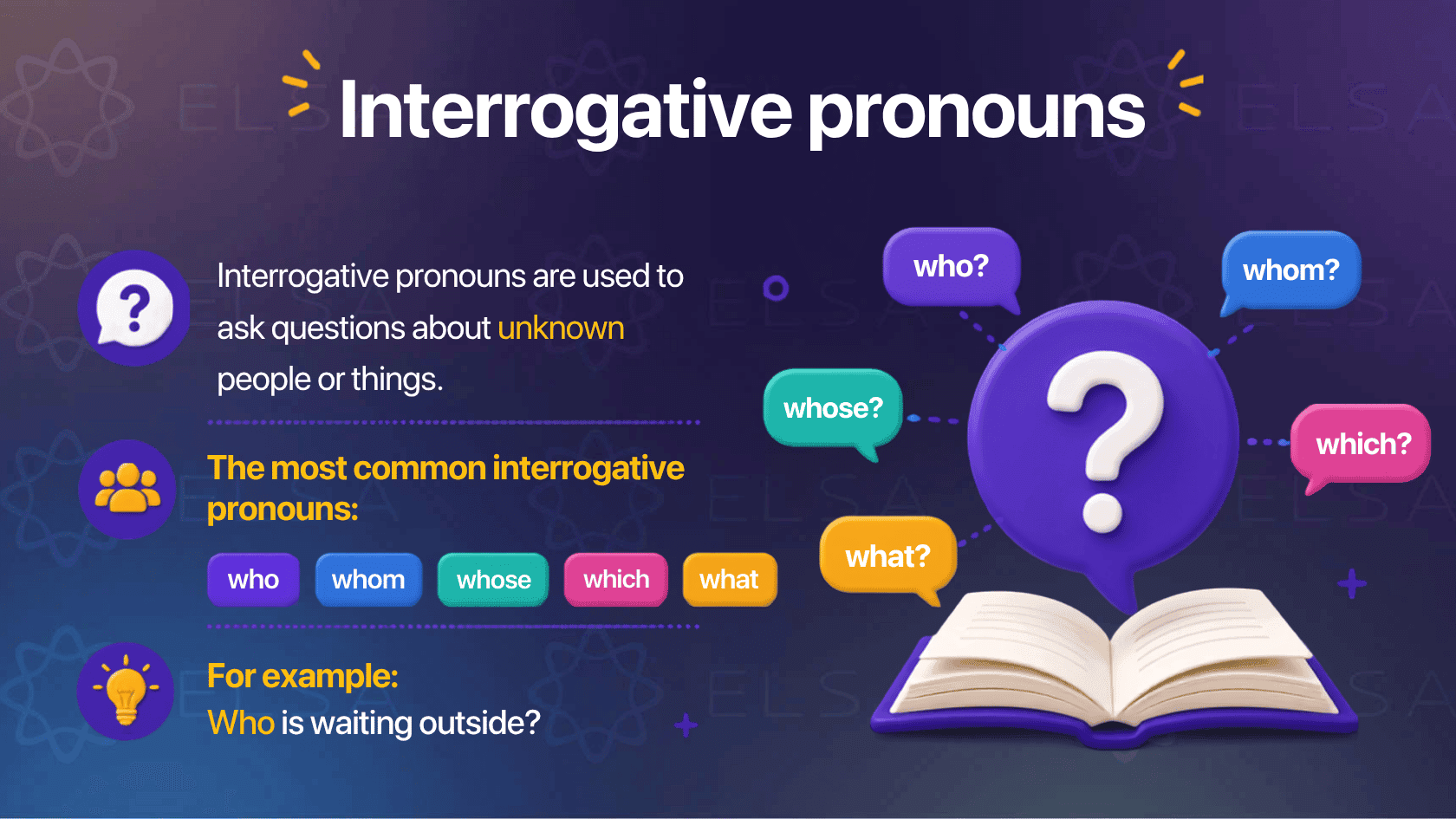
Interrogative pronouns
Interrogative pronouns are used to ask questions about unknown people or things. The most common interrogative pronouns are who, whom, whose, which, and what.
For example: Who is waiting outside?
Reciprocal pronouns
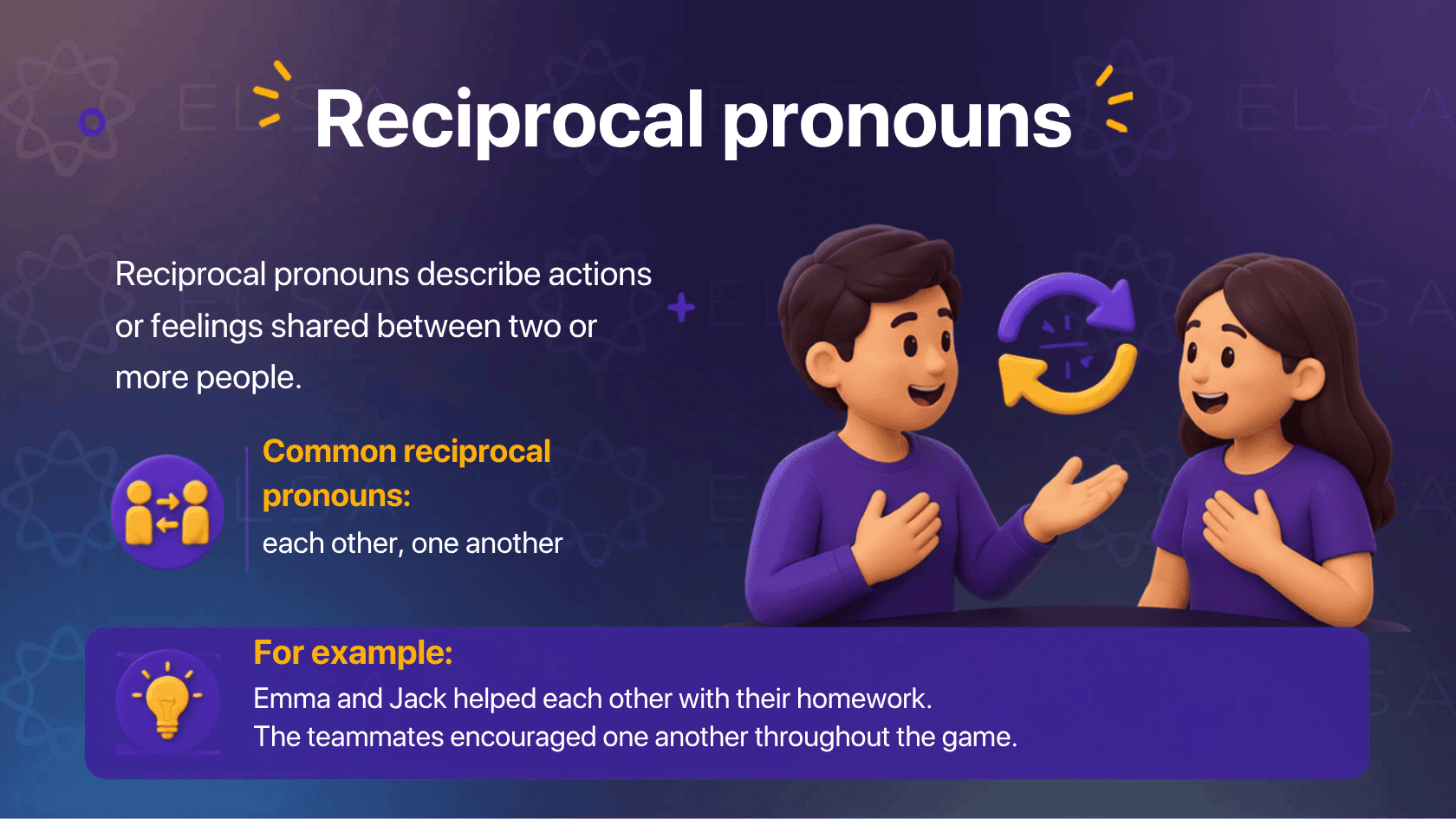
Reciprocal pronouns describe actions or feelings shared between two or more people. Here are some examples of pronouns:
| Pronoun | Use for | Example |
| Each other | Two people | Emma and Jack helped each other with their homework. |
| One another | More than two people | The teammates encouraged one another throughout the game. |
Distributive pronouns
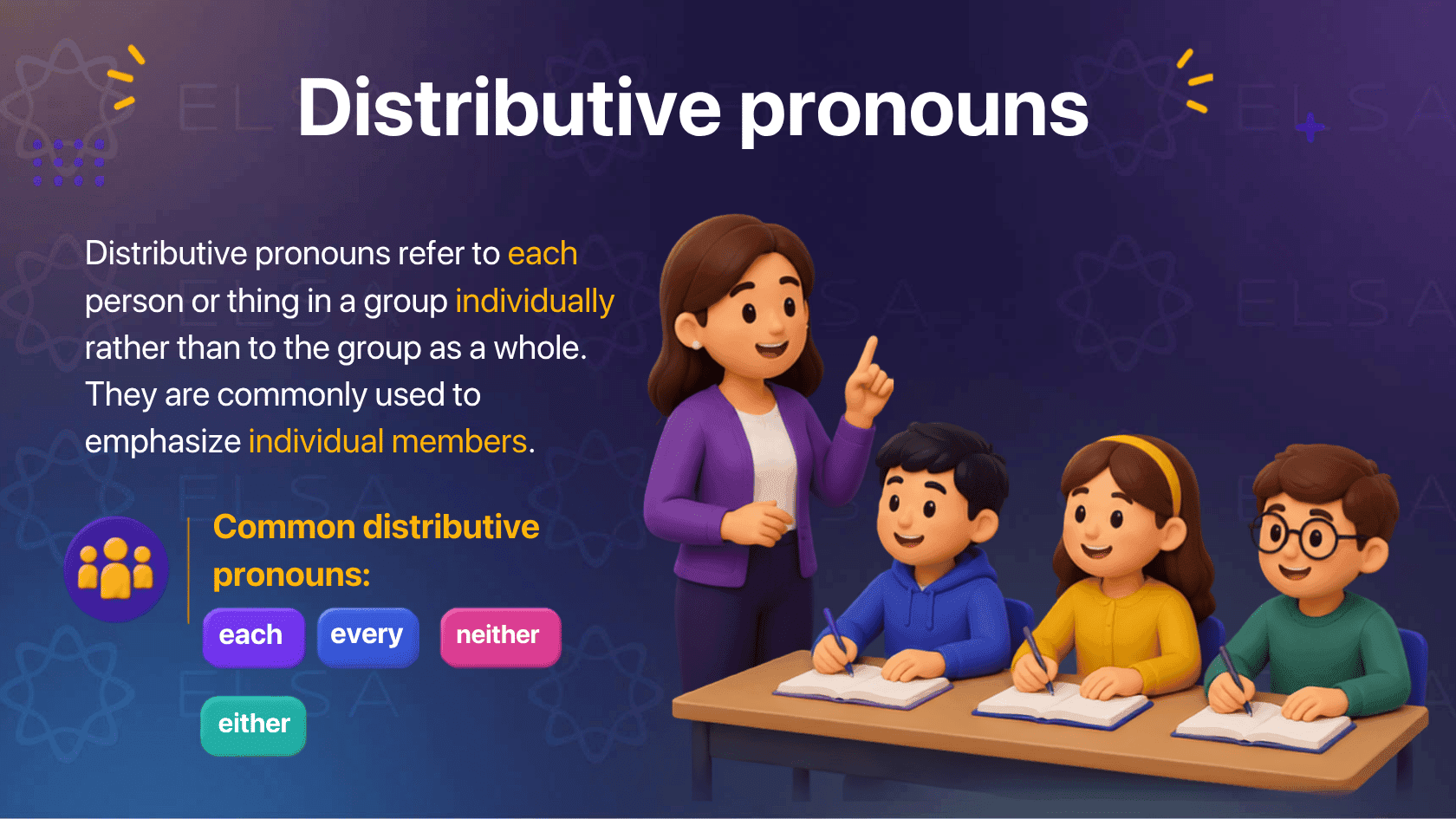
Distributive pronouns refer to each person or thing in a group individually rather than to the group as a whole. They are commonly used to emphasize individual members.
Here are the pronouns list about distributive pronouns:
| Pronoun | Use for | Example |
| Each | Every person or thing in a group, emphasizing individuality | Each is responsible for completing the task. |
| Either | One of two choices (positive meaning) | Either is a good option. |
| Neither | Not one of two choices (negative meaning) | Neither is available today. |
Important:
- Distributive pronouns always take a singular verb.
- Either and neither are used only for two people or things.
- Neither already has a negative meaning, so do not use not with it.
Common mistakes: Unclear pronoun reference
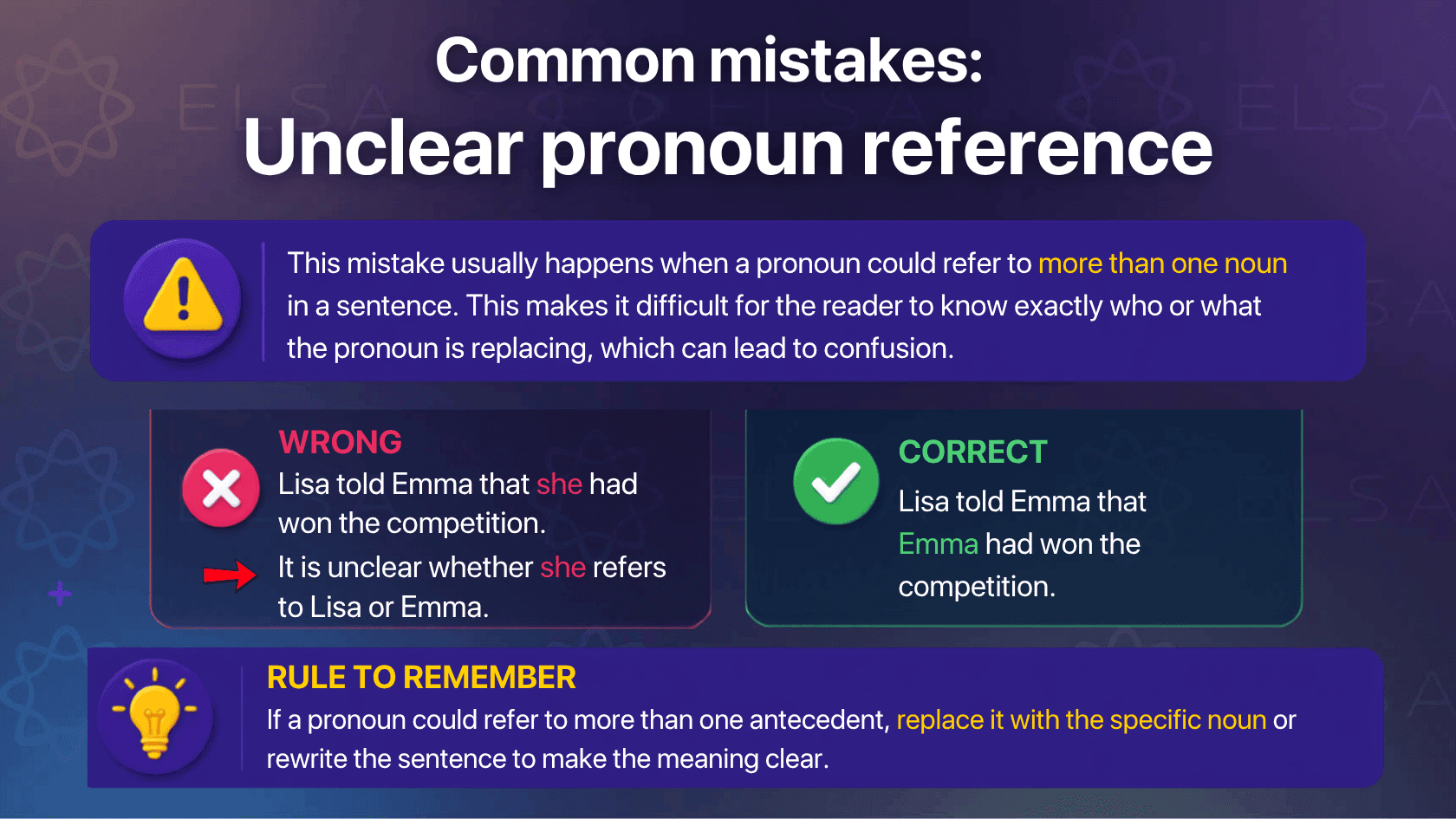
This mistake usually happens when a pronoun could refer to more than one noun in a sentence. This makes it difficult for the reader to know exactly who or what the pronoun is replacing, which can lead to confusion.
For example:
Wrong: Lisa told Emma that she had won the competition.
→ Why is it wrong: It is unclear whether she refers to Lisa or Emma.
Correct: Lisa told Emma that Emma had won the competition.
Rule to remember:
| If a pronoun could refer to more than one antecedent, replace the pronoun with the specific noun or rewrite the sentence to make the meaning clear. Although repeating a noun may seem less elegant, clarity is always more important than avoiding repetition. |
Understanding the different types of pronouns and knowing how to use them correctly will make your English more natural, accurate, and easier to understand. To keep improving, explore ELSA Speak’s Grammar category for practical grammar guides, expert tips, and more lessons to strengthen your communication skills.