

Relative pronouns in English: Complete guide with example
elsaspeakadmin
August 20, 2026
English clauses
Relative pronouns are essential for connecting ideas and adding information about people, animals, and things without repeating the same noun.In this guide, you'll learn how to use who, whom, whose, which, that, and what, how to choose the right relative pronoun, when you can leave one out, and how to avoid common mistakes.
What are relative pronouns?
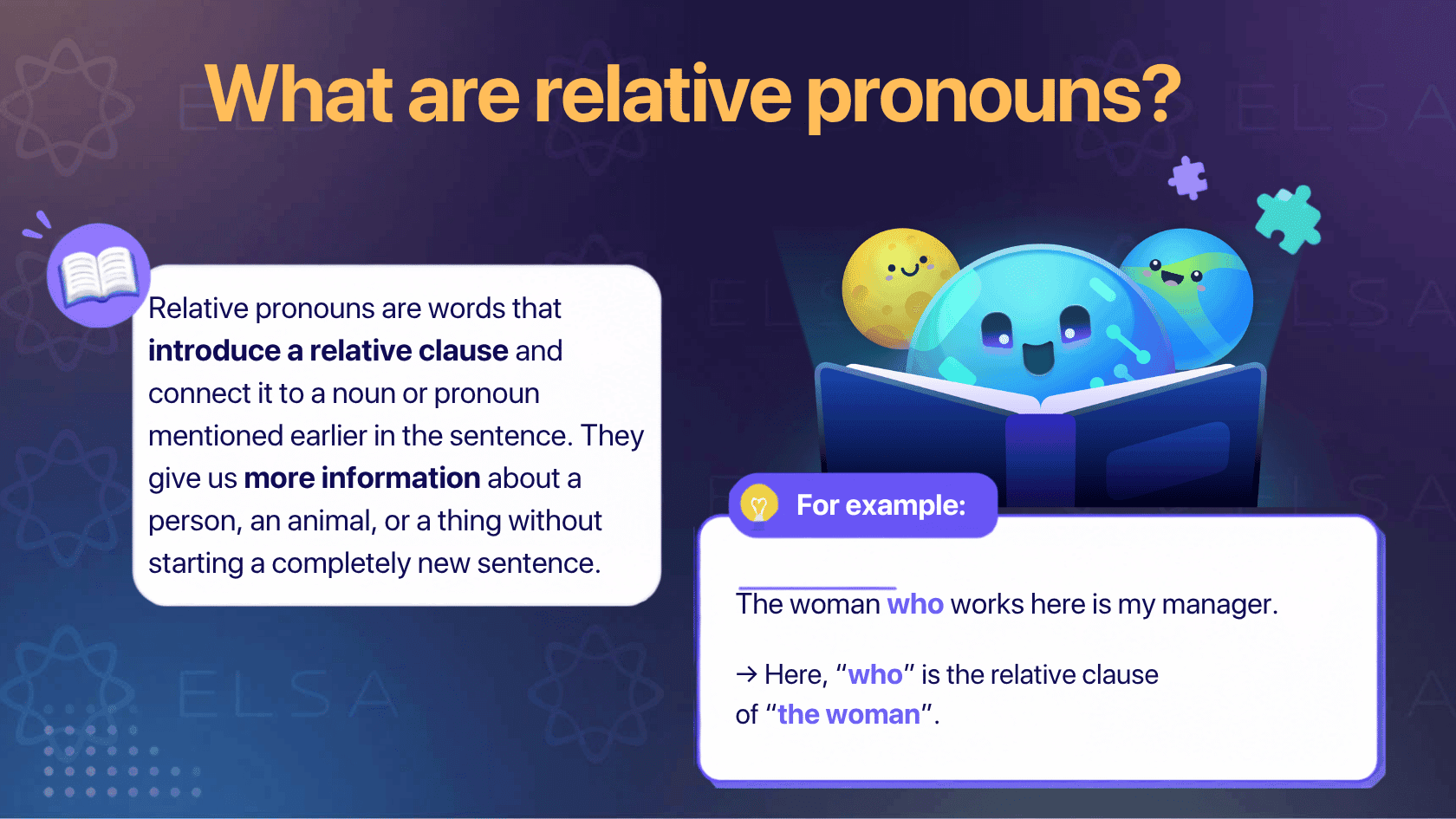
Relative pronouns are words that introduce a relative clause and connect it to a noun or pronoun mentioned earlier in the sentence. They give us more information about a person, animal, or thing without starting a completely new sentence.
For example: The woman who works here is my manager.
→ Here, “who” is the relative pronoun of “the woman”.
Quick reference: Which relative pronoun to use?
| Criteria | Who | Whom | Whose | Which | That |
| People | ✓ | ✓ | ✓ | ✗ | ✓ |
| Animals/things | Sometimes for pets | ✓ for possession | ✓ | ✓ | |
| Defining clauses | ✓ | ✓ | ✓ | ✓ | ✓ |
| Non-defining clauses | ✓ | ✓ | ✓ | ✓ | ✗ |
| Subject | ✓ | ✗ | ✓ | ✓ | ✓ |
| Object | ✓ | ✓ | ✓ | ✓ | ✓ |
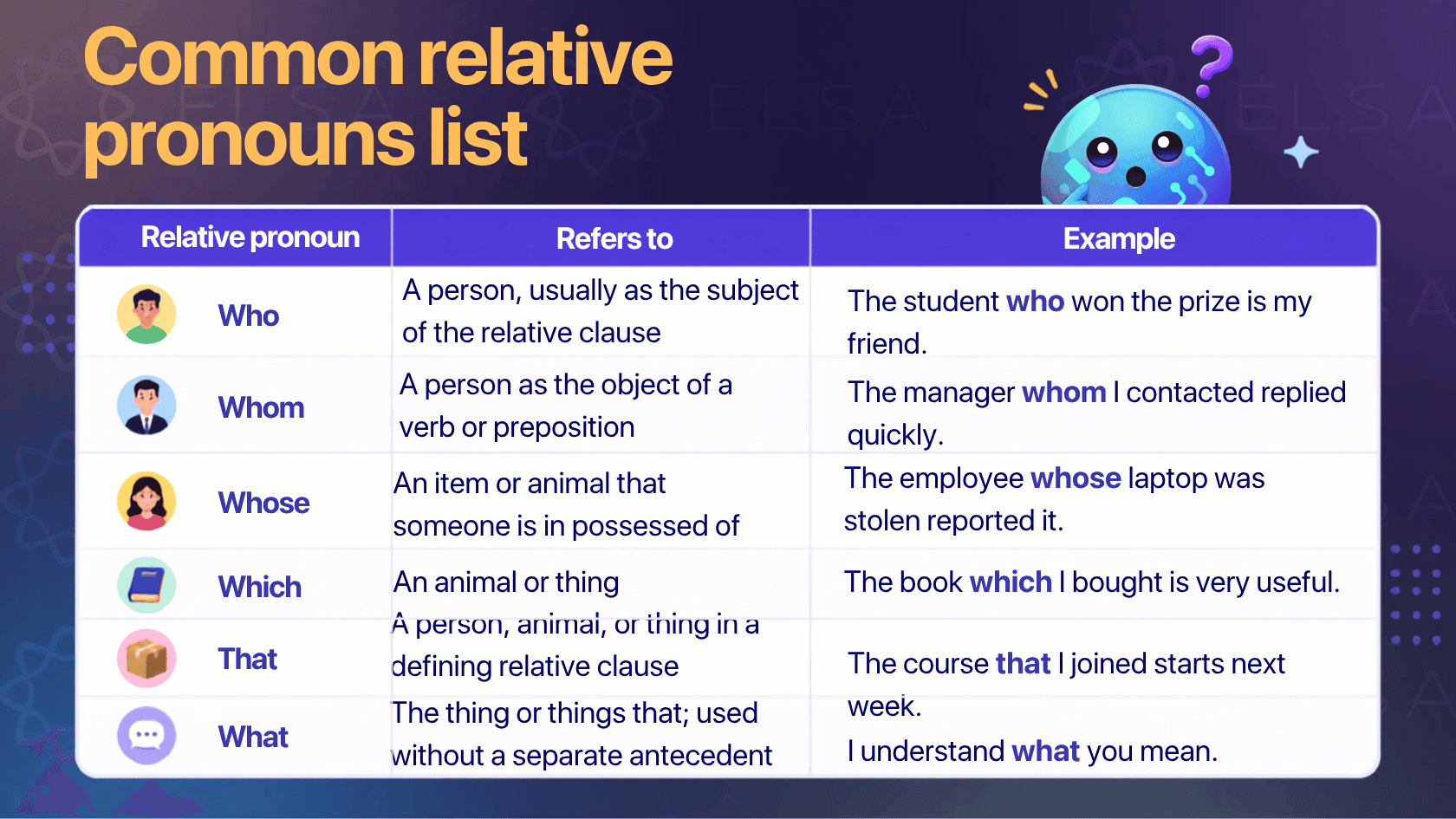
Common relative pronouns list
| Relative pronoun | Refers to | Example |
| Who | A person, usually as the subject of the relative clause | The student who won the prize is my friend. |
| Whom | A person as the object of a verb or preposition; more common in formal English | The manager whom I contacted replied quickly. |
| Whose | A person, animal, or sometimes thing that has a particular relationship or possession | The employee whose laptop was stolen reported it. |
| Which | An animal or thing | The book which I bought is very useful. |
| That | A person, animal, or thing in a defining relative clause | The course that I joined starts next week. |
| What | The thing or things that; used without a separate antecedent | I understand what you mean. |
Compound relative pronouns
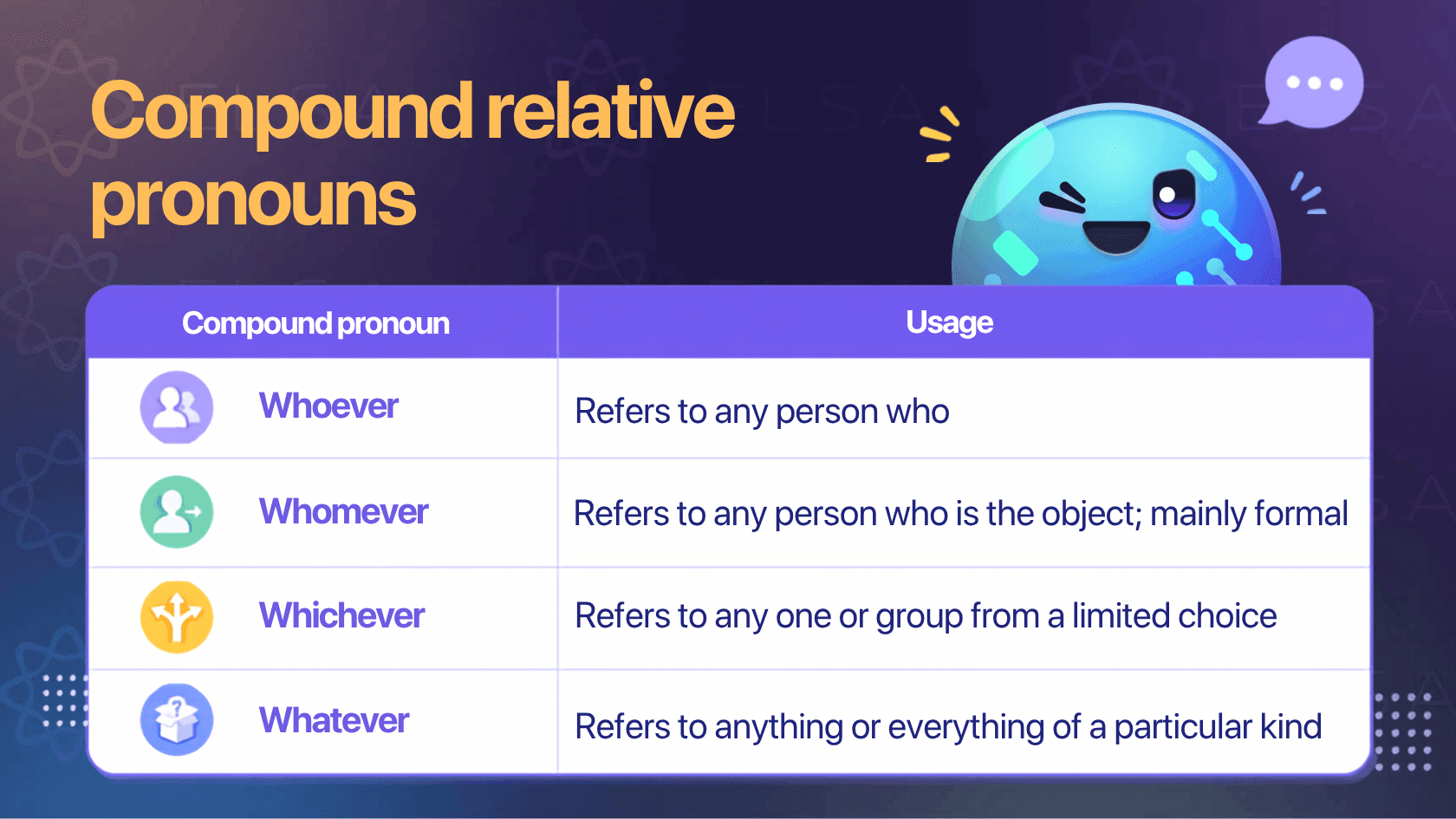
| Compound pronoun | Usage | Example |
| Whoever | Refers to any person who | Whoever finishes first can leave early. |
| Whomever | Refers to any person who is the object; mainly formal | You can invite whomever you choose. |
| Whichever | Refers to any one or group from a limited choice | Choose whichever option works best for you. |
| Whatever | Refers to anything or everything of a particular kind | Take whatever you need. |
Defining vs non-defining relative clauses
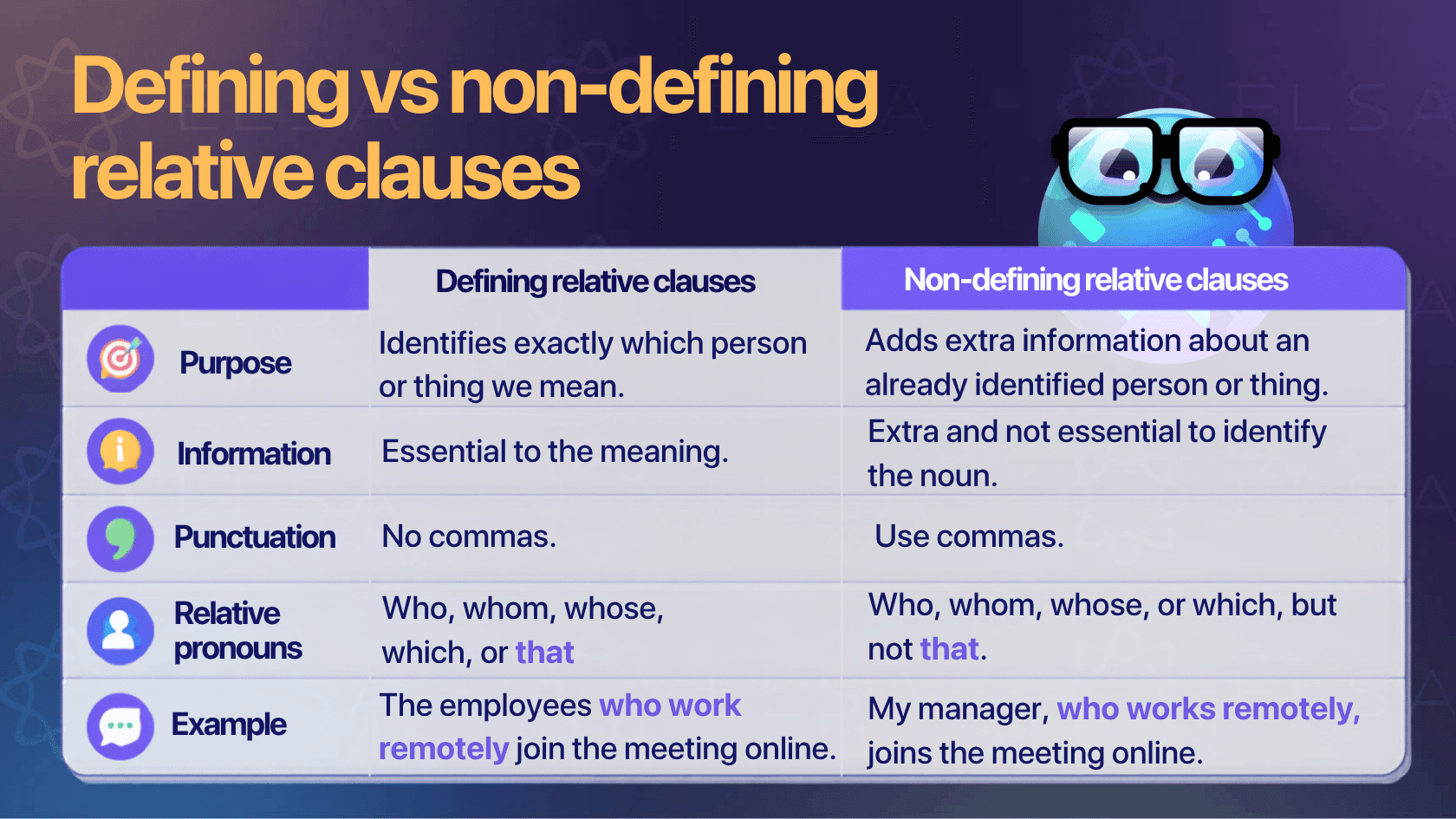
| Defining relative clauses | Non-defining relative clauses | |
| Purpose | Identifies exactly which person or thing we mean. | Adds extra information about an already identified person or thing. |
| Information | Essential to the meaning. | Extra and not essential to identify the noun. |
| Punctuation | No commas. | Use commas. |
| Relative pronouns | Who, whom, whose, which, or that | Who, whom, whose, or which, but not that. |
| Example | The employees who work remotely join the meeting online. | My manager, who works remotely, joins the meeting online. |
When can you omit the relative pronoun?
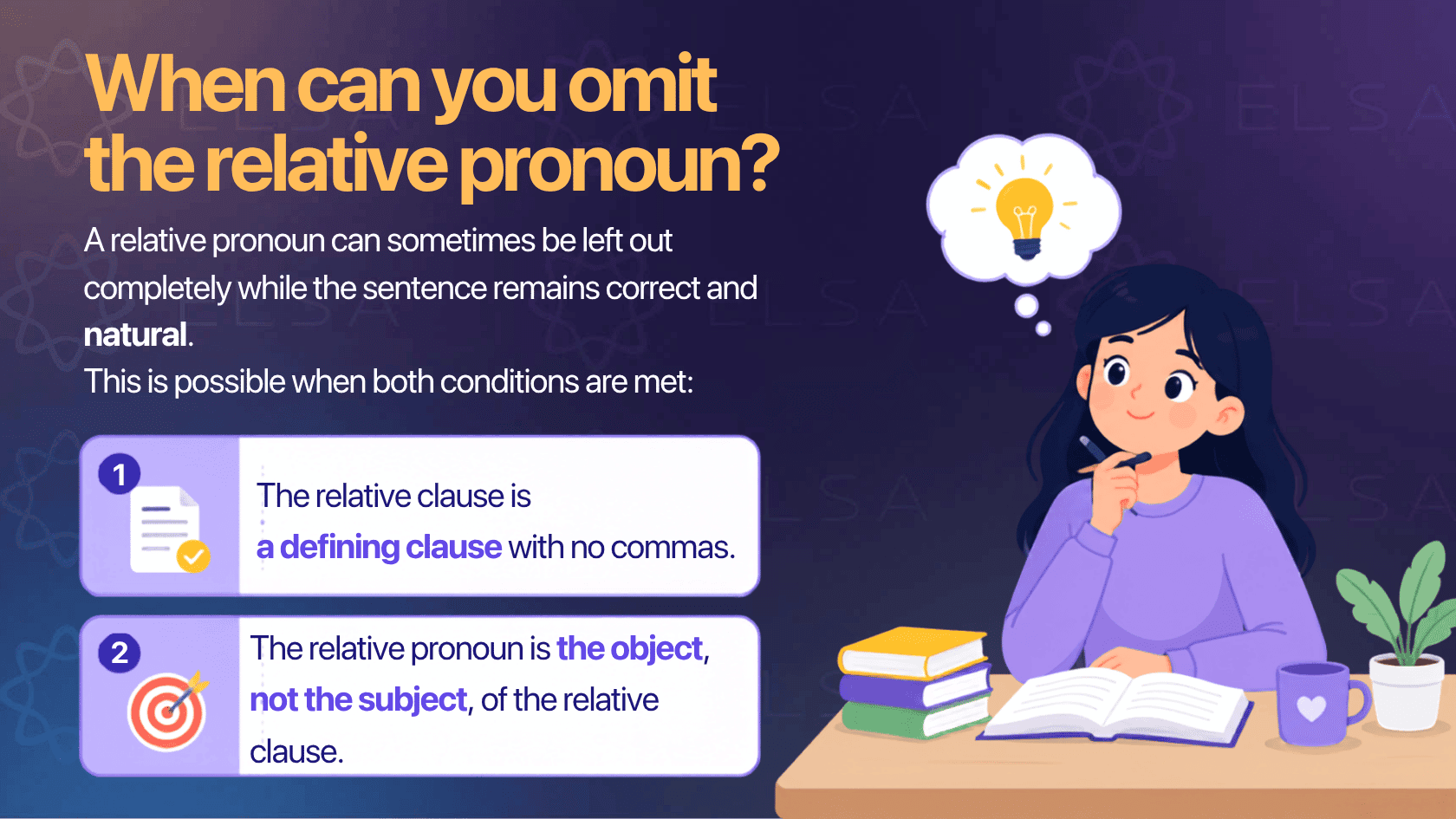
A relative pronoun can sometimes be left out completely while the sentence remains correct and natural. This is possible when both conditions are met:
1. The relative clause is a defining clause with no commas.
For example: The book that I bought was expensive.
Here, “I” is the subject and “that” is the object of “bought”.
→ So we can omit that: The book I bought was expensive.
2. The relative pronoun is the object, not the subject, of the relative clause.
For example: The employee whom I interviewed yesterday got the job.
Here, “whom” is the object of the verb “interviewed,” while “I” is the subject.
→ So we can omit that: The employee I interviewed yesterday got the job.
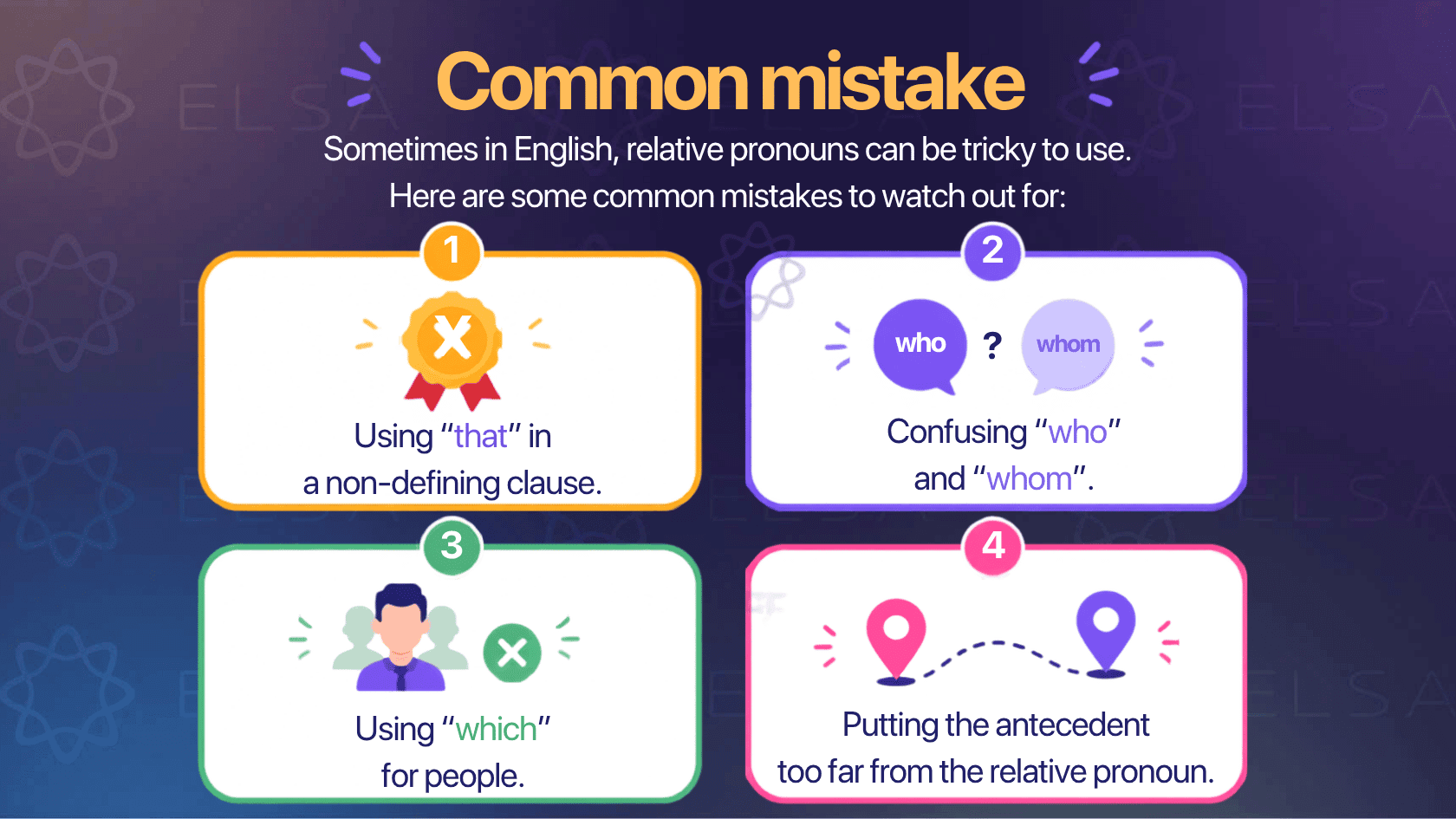
Common mistake
Sometimes in English, relative pronouns can be tricky to use. Here are some common mistakes to watch out for:
- Using “that” in a non-defining clause.
- Confusing “who” and “whom”: Remember, you can use who for the subject and whom for the object in formal English. In everyday English, who is often used for both.
- Using “which” for people.
- Putting the antecedent too far from the relative pronoun: Keep the noun and its relative clause close together so the reader can easily understand what the pronoun refers to.
Relative pronouns worksheet
Exercise 1: Choose the correct relative pronoun
- The woman ______ works at reception is very helpful.
- I finally found the document ______ I needed.
- The student ______ laptop was stolen reported it to the university.
- The company ______ hired me has offices in three countries.
- The manager ______ I spoke to was very understanding.
- This is the laptop ______ I use for work.
- The colleague ______ helped me with the presentation is on vacation.
- The project ______ we discussed yesterday is due next week.
- The designer ______ work won the competition is from Japan.
- The person ______ you recommended was very helpful.
Answer key:
| 1. who | 2. which | 3. whose | 4. which | 5. whom |
| 6. which | 7. who | 8. which | 9. whose | 10. whom |
Exercise 2: Decide whether each sentence contains a defining or non-defining relative clause. Then choose the correct relative pronoun.
- My cousin, ______ lives in Sydney, is visiting next month.
- The students ______ completed the test can leave.
- The book ______ you recommended was excellent.
- Mary, ______ I met at high school, now works in finance.
- The TV ______ has the largest screen is the most expensive.
- Our office, ______ opened last year, is near the train station.
- Employees ______ work remotely must attend the weekly meeting.
- Mr. Smith, ______ daughter is studying abroad, is my manager.
Answer key:
| 1. who | 2. who | 3. which | 4. whom |
| 5. which | 6. which | 7. who | 8. whose |
Exercise 3: Each sentence contains one mistake. Rewrite it correctly.
- The woman which called me was my manager.
- My car, that I bought last year, is already having problems.
- The book what I borrowed was very useful.
- The person whom helped me was very friendly.
- The students who they passed the exam celebrated together.
- This is the report that I said that we needed.
- My laptop, that is quite old, still works well.
- The employee whose I met yesterday was very helpful.
Answer key:
- The woman who called me was my manager.
- My car, which I bought last year, is already having problems.
- The book that/which I borrowed was very useful.
- The person who helped me was very friendly.
- The students who passed the exam celebrated together.
- This is the report I said that we needed.
- My laptop, which is quite old, still works well.
- The employee whom/who I met yesterday was very helpful.
>>> Read more: Indefinite pronouns: Definition and how to use them
Mastering relative pronouns takes regular practice, but understanding the basic rules is the first step toward using them naturally in English. For more practical lessons and expert tips, explore the Grammar category on the ELSA Speak blog and keep building your English skills with confidence.