

Tag questions in English: Rules, formulas & examples
elsaspeakadmin
October 19, 2026
Advanced Grammar
Tag questions, also known as question tags, are short questions that are commonly used in everyday English conversations, helping speakers sound more natural and keep discussions flowing. In this guide, we explain the tag questions rules, formulas, examples, with practice exercises to help you use them confidently.
What are tag questions in English?
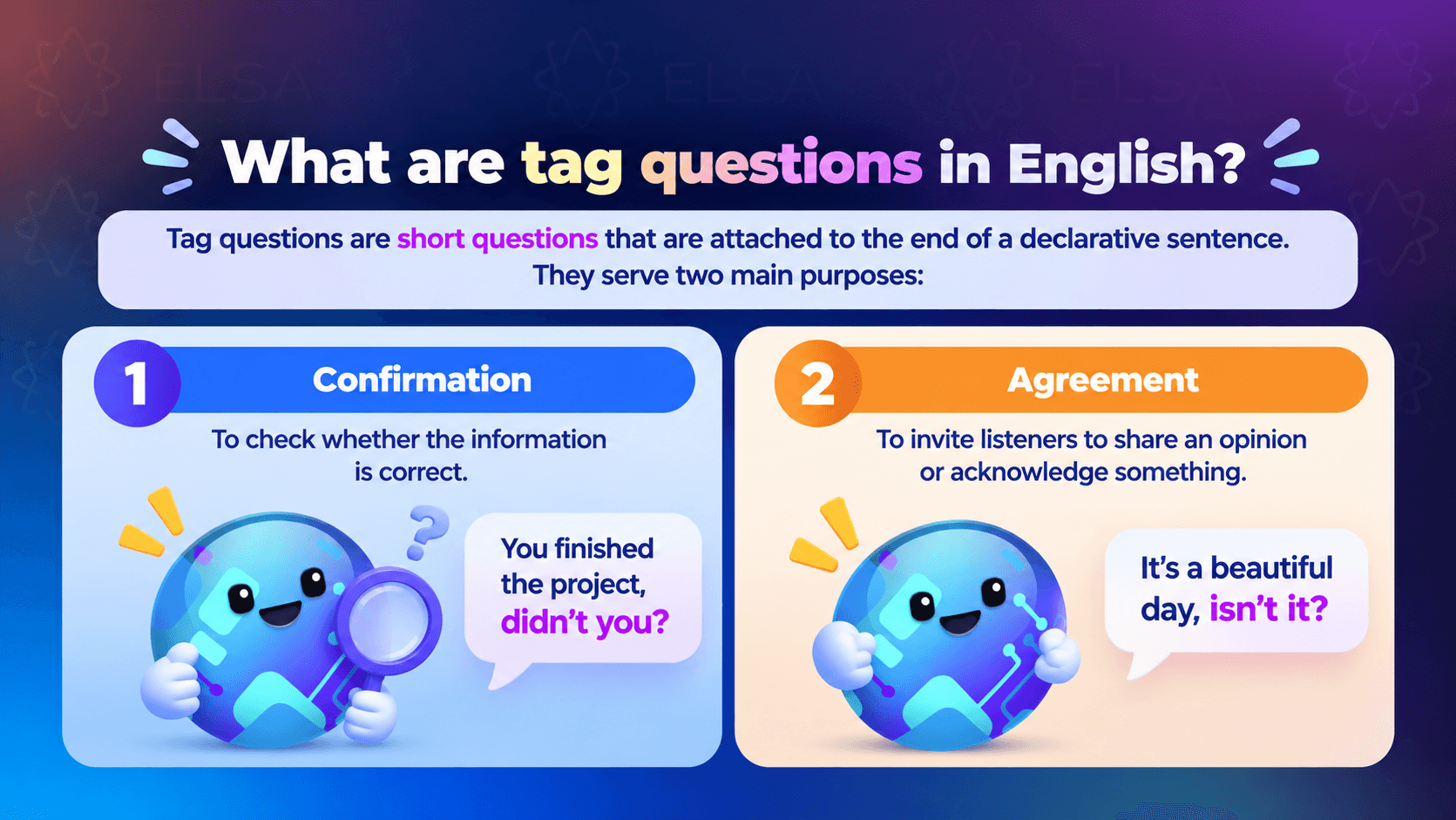
Tag questions are short questions that are attached to the end of a declarative sentence. They serve two main purposes:
- Confirmation: To check whether the information is correct.
- Agreement: To invite listeners to share an opinion or acknowledge something.
For example:
- “You’re a student, aren’t you?”
→ The question indicates the speaker is checking whether the listener is a student.
- “It’s a beautiful day, isn’t it?”
→ The question implies that the speaker is inviting the listener to agree to their opinion.
General formula of tag questions
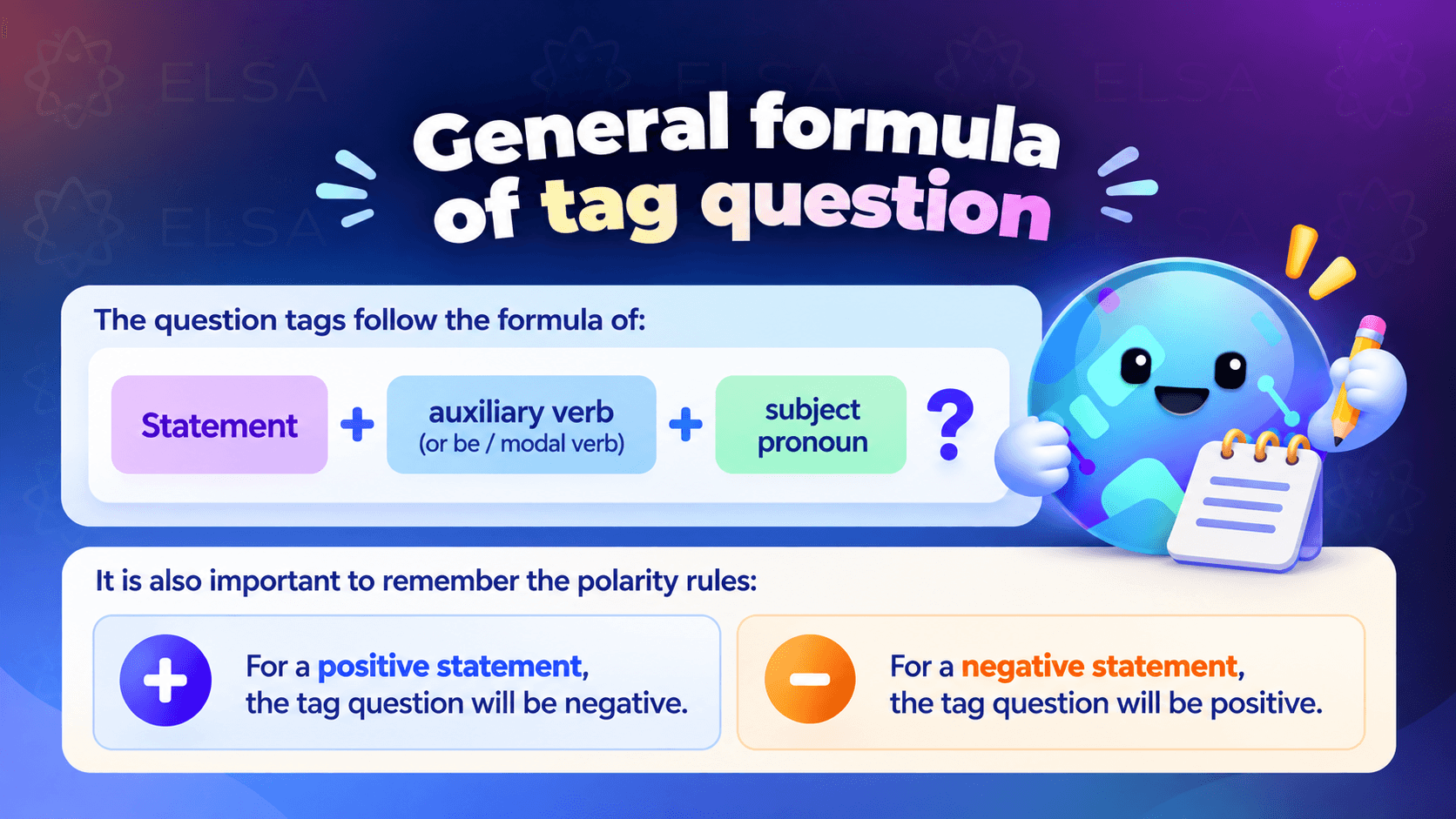
The question tags follow the formula of:
| Statement + auxiliary verb (or be / modal verb) + subject pronoun? |
It is also important to remember the polarity rules:
- For a positive statement, the tag question will be negative.
- For a negative statement, the tag question will be positive.
For example:
- They don’t live here, do they?
- He speaks French, doesn’t he?
General tag questions rules by tenses and verbs
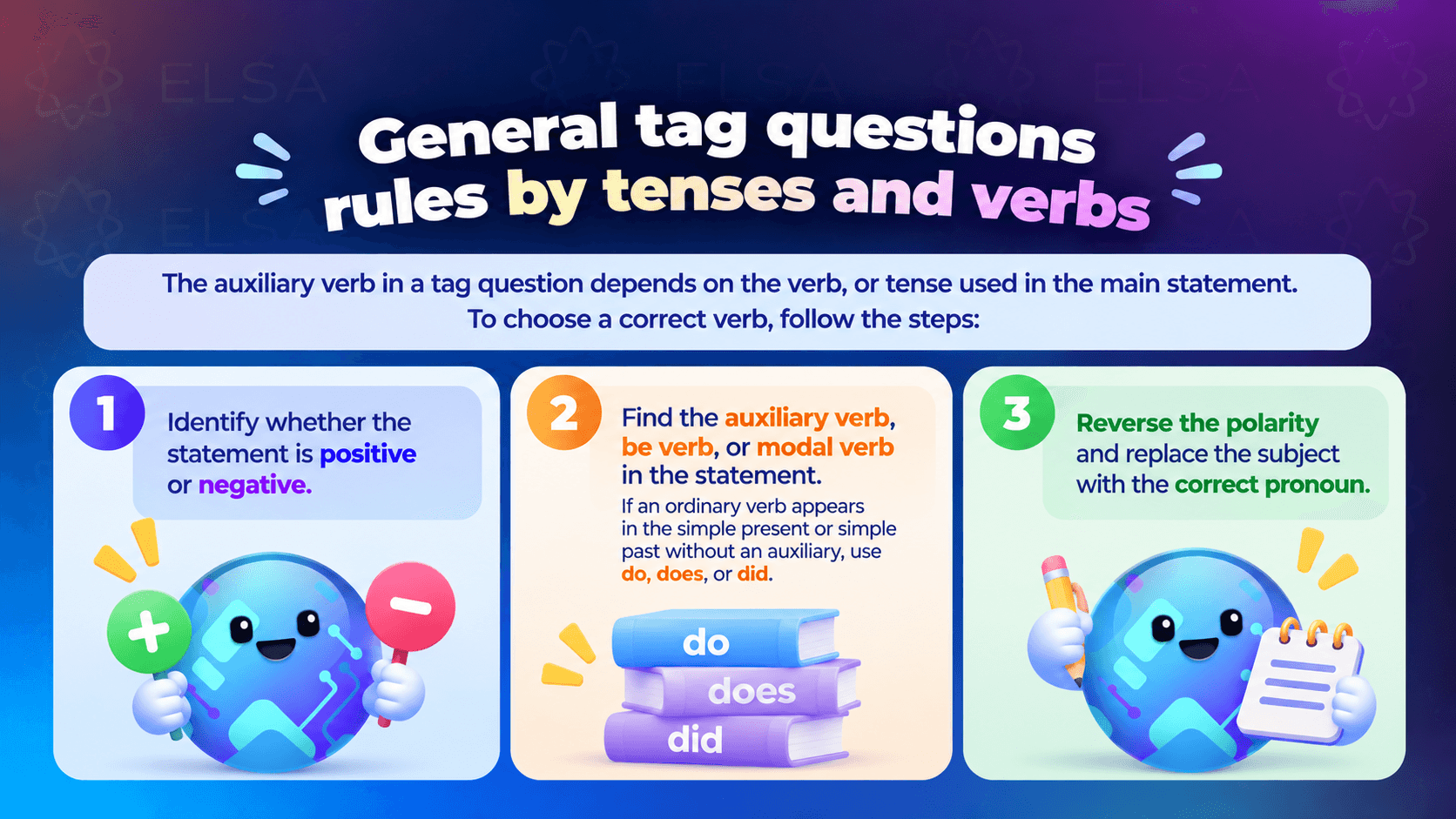
The auxiliary verb in a tag question depends on the verb, or tense used in the main statement. To choose a correct verb, follow the steps:
- Identify whether the statement is positive or negative.
- Find the auxiliary verb, be verb, or modal verb in the statement.
- If an ordinary verb appears in the simple present or simple past without an auxiliary, use do, does, or did.
- Reverse the polarity and replace the subject with the correct pronoun.
| Verb type and tense | Statement form | Tag structure | Example |
|---|---|---|---|
| To be (+) | S + am/is/are | Negative form of be + pronoun | He’s right behind me, isn’t he? |
| To be (-) | S + am/is/are + not | Positive form of be + pronoun | She isn’t happy, is she? |
| Simple present tense (+) | S + V (s/es) | Don’t/doesn’t + pronoun | John goes to work everyday, doesn’t he? |
| Simple present (-) | S + do/does not + V | Do/Does + pronoun | They don’t play tennis, do they? |
| Simple past (+) | S + V2/ed | Didn’t + pronoun | You knew her, didn’t you? |
| Simple past tense (-) | S + didn’t + V | Did + pronoun | He didn’t leave, did he? |
| Perfect tenses (+) | S + have/has/had + past participle | Haven’t/hasn’t/hadn’t + pronoun | Dave has arrived, hasn’t he? |
| Modal verb (+) | S + can/will/should + V | Negative modal + pronoun | Tomorrow will be a beautiful day, won’t it? |
Special cases and exceptions in tag questions
Some tag questions follow special patterns that are not immediately obvious from the general rule. Here are the 5 common exceptions to avoid when using this formula:
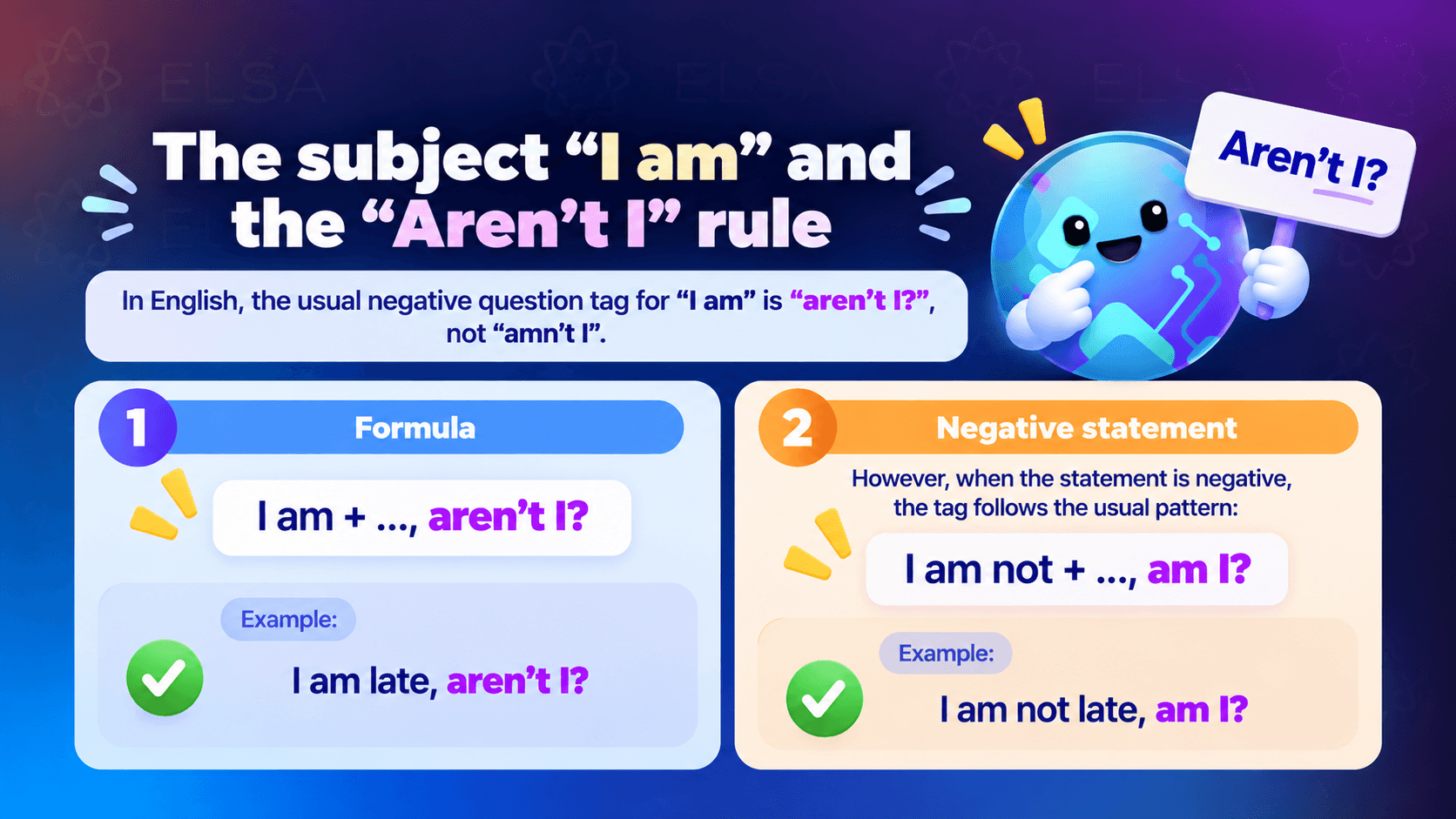
The subject “I am” and the “Aren’t I” rule
In English, the usual negative question tag for “I am” is “aren’t I?”, not “amn’t I?”.
Formula:
| I am + ..., aren’t I? |
However, when the statement is negative, the tag follows the usual pattern:
| I am not + …, am I? |
For example:
- I’m next in line, aren’t I?
- I’m not late, am I?
Remember that “aren’t I?” is a conventional exception in standard English, rather than a form created by applying the opposite-polarity rule mechanically.
Imperative sentences and polite requests
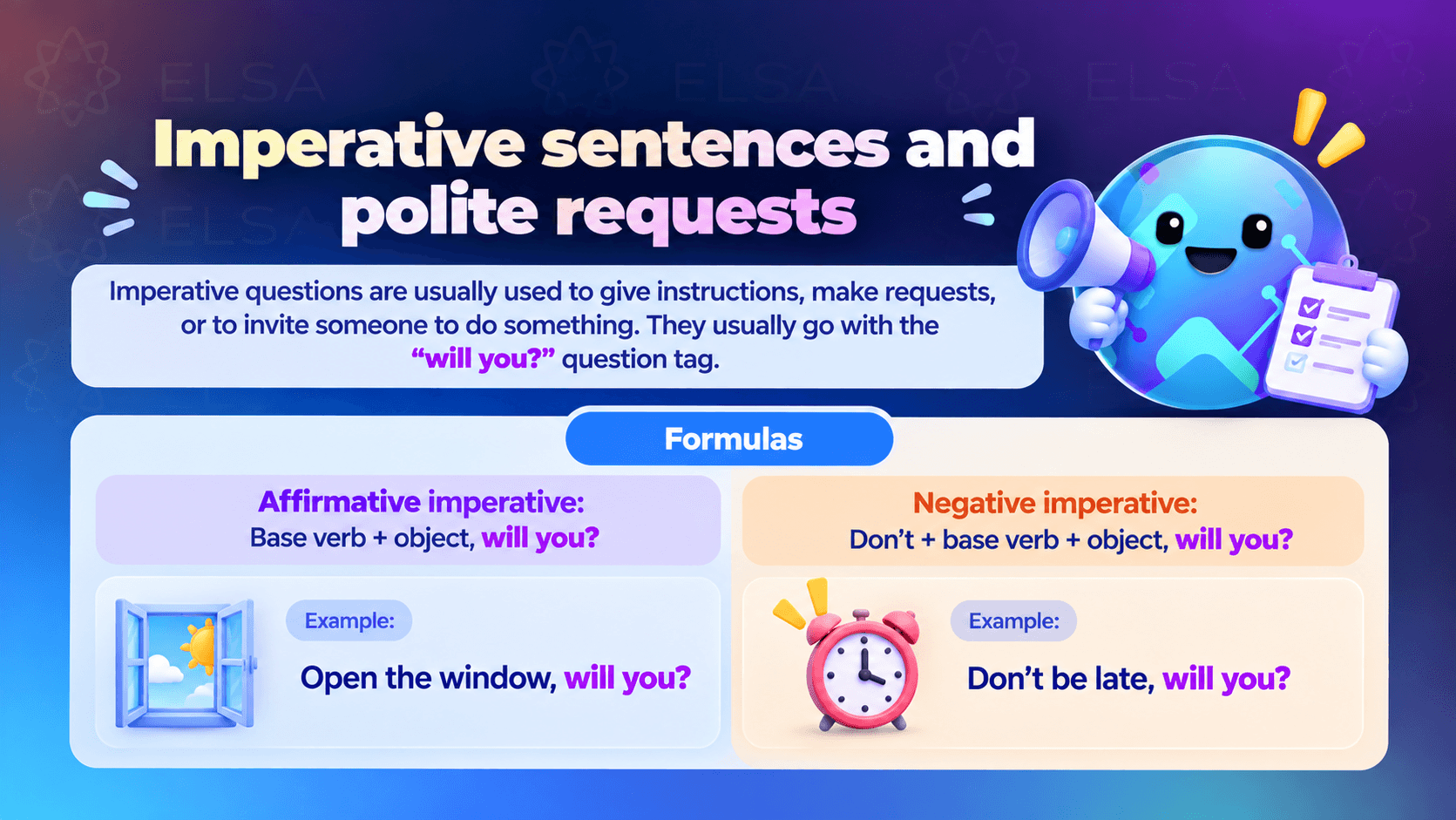
Imperative questions are usually used to give instructions, make requests, or to invite someoneto do something. They usually go with the “will you?” question tag.
Formulas:
Affirmative imperative: Base verb + object, will you? Negative imperative: Don’t + base verb + object, will you? |
Examples:
- Pass me the salt, will you?
- Please close the window, will you?
- Don’t forget your keys, will you?
With affirmative imperatives, we use the tag “won’t you?”, especially when a friendly invitation is is being made.
For instance: Come in and sit down, won’t you?
The exact choice depends on tone and context. Will you? is a useful default for both affirmative and negative imperatives.
Suggestions starting with “Let’s”
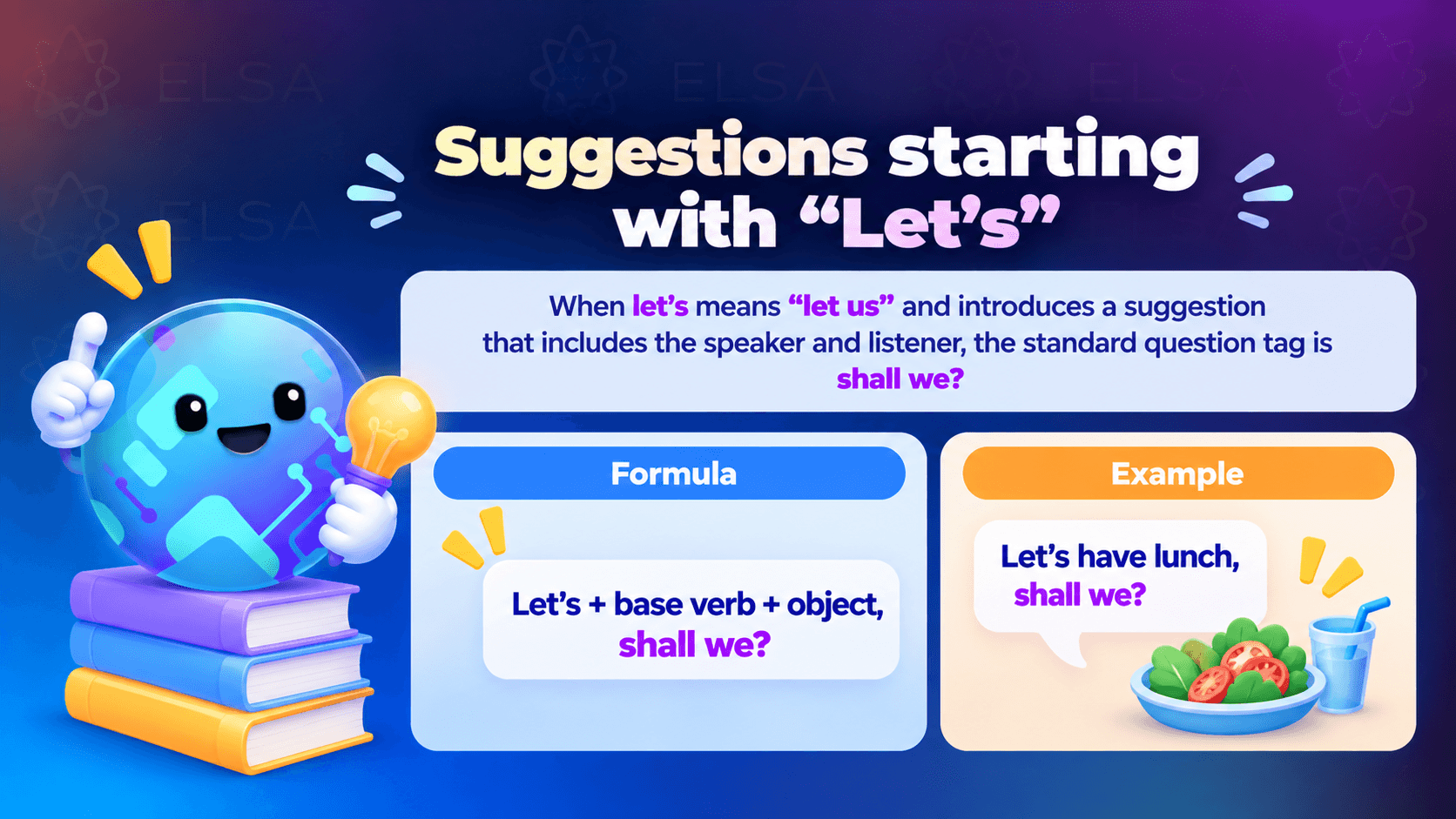
When let’s means “let us” and introduces a suggestion that includes the speaker and listener, the standard question tag is shall we?
Formula:
| Let’s + base verb + object, shall we? |
Examples:
- Let’s take a break, shall we?
- Let’s review the answers, shall we?
- Let’s go for a walk, shall we?
However, distinguish suggestions with let’s from requests using let us. When let us means “allow us to do something,” the tag can be "will you?".
For instance: Let us explain the situation, will you?”
Statements with negative adverbs and negative pronouns
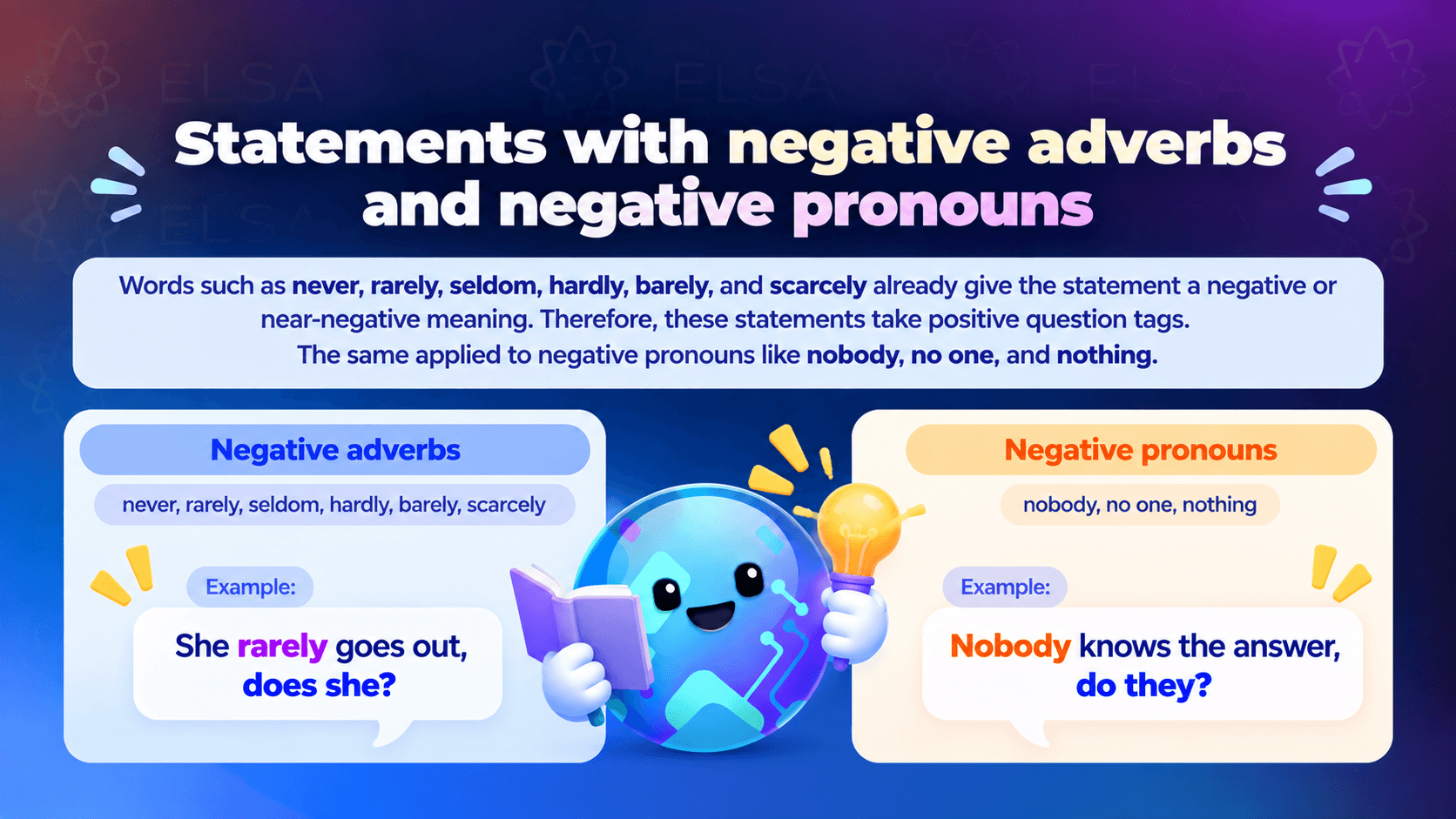
Words such as never, rarely, seldom, hardly, barely, and scarcely already give the statement a negative or near-negative meaning. Therefore, these statements take positive question tags. The same applied to negative pronouns like nobody, no one, and nothing.
For example:
- He never complains, does he?
- Nobody came, did they?
- Nothing happened in this room, did it?
Indefinite pronouns as subjects
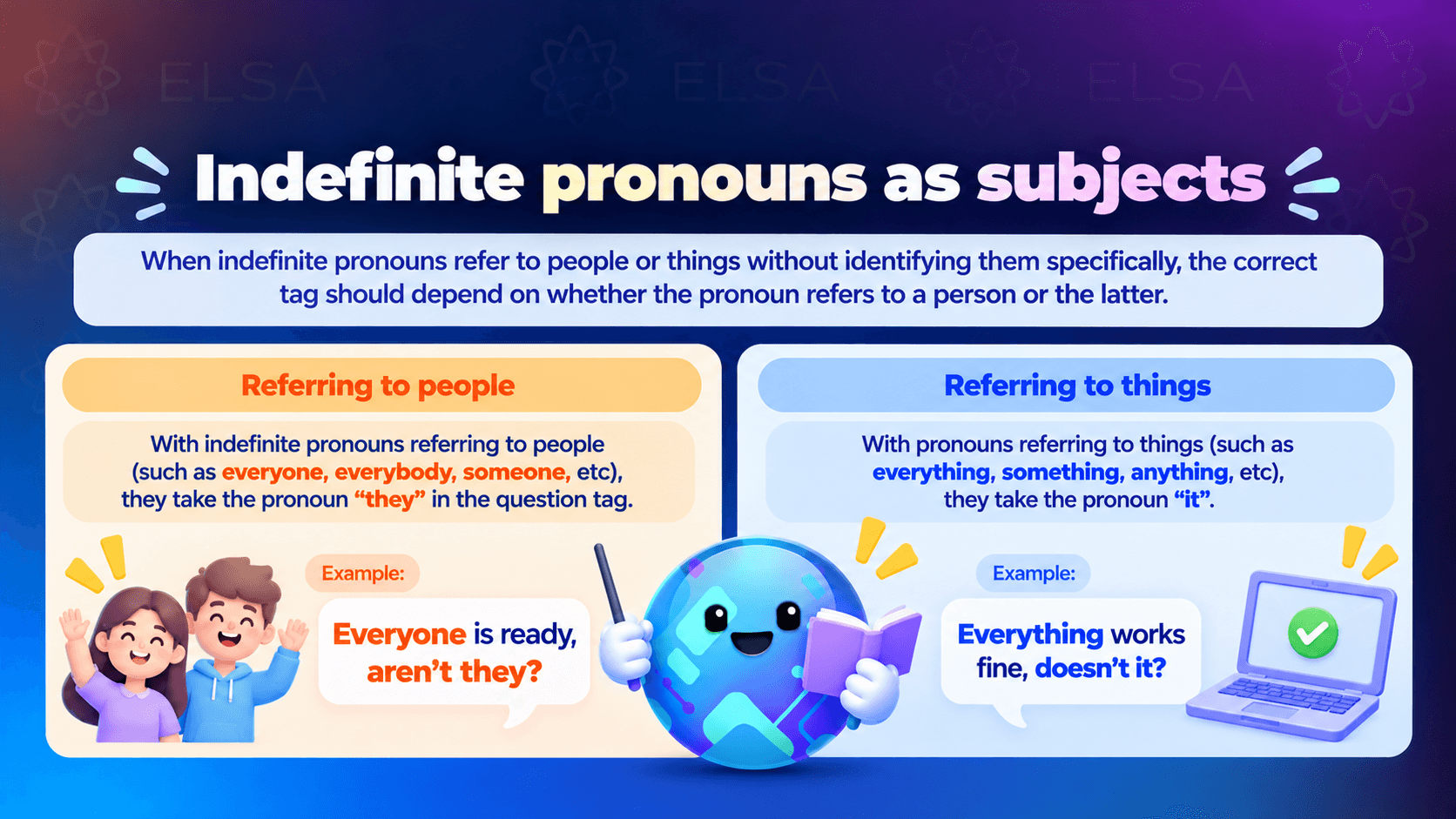
When it comes to indefinite pronouns refer to people or things without identifying them specifically, the correct tag should depend on whether the pronoun refers to a person or the latter.
- With indefinite pronouns referring to people (such as everyone, everybody, someone, etc), they take the pronoun “they” in the question tag.
- With pronouns referring to things (such as everything, something, anything, etc), they take the pronoun “it”.
For example:
- Everything is ready, isn’t it?
- Everyone enjoys the party, don’t they?
Intonation in tag questions: Rising vs. Falling pitch
The intonation of a question tag can change what the speaker communicates. Rising intonation often indicates genuine uncertainty, whereas falling intonation commonly signals that the speaker expects agreement.
| Intonation pattern | Speaker’s intent | Meaning | Example |
|---|---|---|---|
| Rising intonation | Ask a genuine question | The speaker is uncertain and wants an answer. | You haven’t met him, have you? |
| Falling intonation | Invite agreement | The speaker expects agreement or uses the tag to maintain conversation. | It’s a lovely day, isn’t it? |
Rising intonation
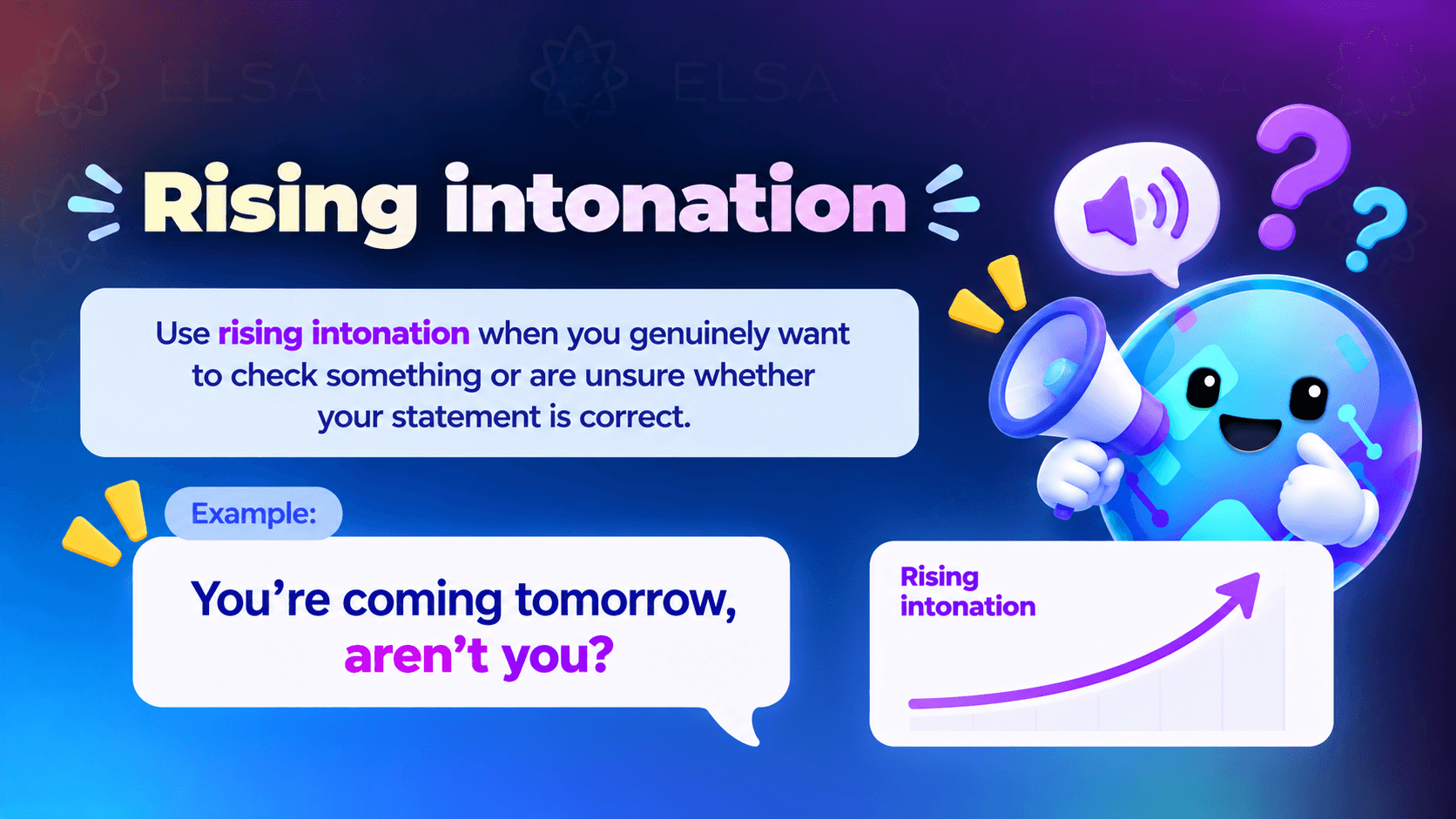
Use rising intonation when you genuinely want to check something or are unsure whether your statement is correct.
For example, “You’re new here, aren’t you? ↗” suggests that the speaker is uncertain and expects confirmation or correction.
Falling intonation
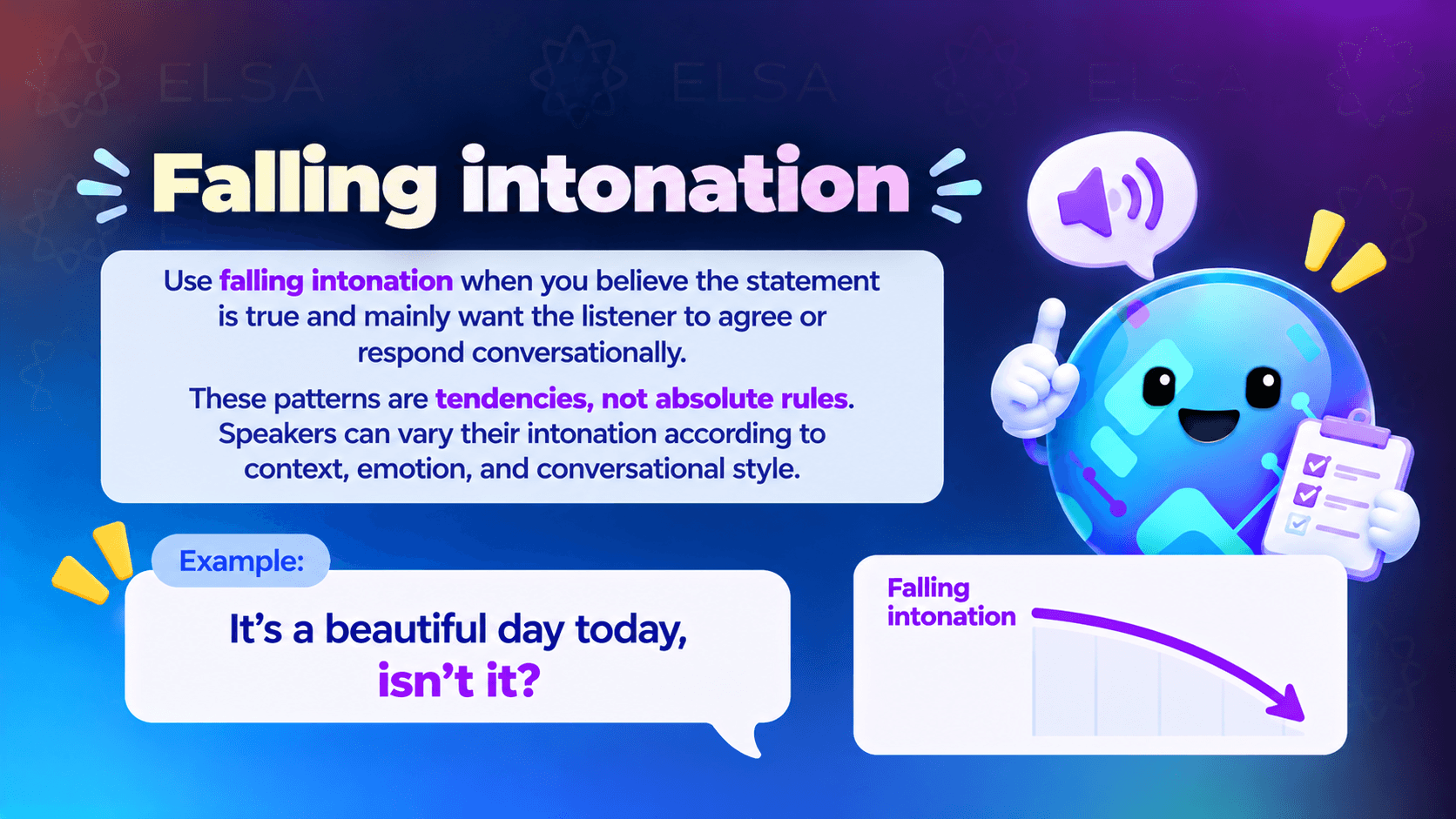
Use falling intonation when you believe the statement is true and mainly want the listener to agree or respond conversationally.
For example, “We’ve met before, haven’t we? ↘” suggests that the speaker expects the listener to recognize them.
These patterns are tendencies, not absolute rules. Speakers can vary their intonation according to context, emotion, and conversational style.
Practice exercises on tag questions
Test your understanding with the following exercises, covering basic structures, auxiliary verbs, and common exceptions.
Exercise 1: Fill in the blank with the correct tag question
Instructions: Complete each sentence with the correct question tag.
- Your sister is a teacher, ______?
- They don’t live near here, ______?
- Ben visited the museum yesterday, ______?
- We have finished the assignment, ______?
- You can drive, ______?
- I’m responsible for this task, ______?
- Let’s order some food, ______?
- Don’t open the door, ______?
- Nobody told you about the meeting, ______?
- Everything is under control, ______?
Exercise 2: Multiple-choice questions on question tags
Instructions: Choose the best answer (A, B, C, or D).
1. She doesn’t like spicy food, ______?
A. does she
B. doesn’t she
C. is she
D. did she
2. You were at the library yesterday, ______?
A. weren’t you
B. didn’t you
C. aren’t you
D. were you
3. Let’s start the meeting, ______?
A. will you
B. shall we
C. do we
D. won’t we
4. I’m early, ______?
A. am I
B. amn’t I
C. aren’t I
D. don’t I
5. Everyone enjoyed the performance, ______?
A. didn’t he
B. wasn’t everyone
C. did they
D. didn’t they
6. He has never traveled abroad, ______?
A. hasn’t he
B. has he
C. did he
D. does he
7. You can help me with this, ______?
A. can you
B. do you
C. can’t you
D. won’t you
8. Don’t be late, ______?
A. do you
B. won’t you
C. don’t you
D. will you
9. Nothing went wrong, ______?
A. did it
B. didn’t it
C. was it
D. does it
10. They had already left when we arrived, ______?
A. did they
B. hadn’t they
C. haven’t they
D. had they
FAQs about tag questions
What is the question tag of “I love you”?
The question tag is “don’t I?” because love is a simple present verb and the statement is positive. The tag therefore uses the negative auxiliary don’t and the pronoun I.
Example: “I love you, don’t I?”
This sentence is grammatically possible, but it is unusual if the speaker simply wants to express love. In everyday conversation, the most natural tag depends on the intended meaning and context.
Why do we say “aren’t I” instead of “amn’t I”?
“Aren’t I?” is the conventional form in standard English for the negative tag following I am. Standard English does not generally use amn’t I? in this construction. The form is an established exception that learners should memorize.
Example: “I’m invited, aren’t I?”
Can a tag question have the same polarity as the main clause?
Yes. Same-polarity tags, also called same-way tags, occur in informal speech to express surprise, skepticism, irony, or interest. Unlike standard opposite-polarity tags, they do not simply follow the usual confirmation pattern.
Example: “So you think you’re clever, do you?”
The speaker may be expressing skepticism or challenging the listener rather than neutrally asking for confirmation. For standard question-tag exercises, however, the opposite-polarity rule remains the main pattern to learn.
How do native speakers use tag questions to keep conversations flowing?
Speakers often use question tags to invite a response, check shared understanding, or encourage agreement without asking a direct question. Falling intonation commonly makes a tag sound like an invitation to agree, while rising intonation can signal genuine uncertainty.
For example, “It’s getting late, isn’t it? ↘” can help start a conversation about leaving or wrapping up an activity. The effect depends on the context, the relationship between speakers, and their intonation.
Mastering tag questions can help you sound more natural in everyday conversations, from casual small talk to workplace discussions. Review the opposite-polarity rule, practice the common exceptions, and pay attention to how intonation changes the meaning of a tag. Explore more lessons and practical exercises in the ELSA Speak English Grammar category to strengthen your grammar knowledge and communicate more confidently in English.